
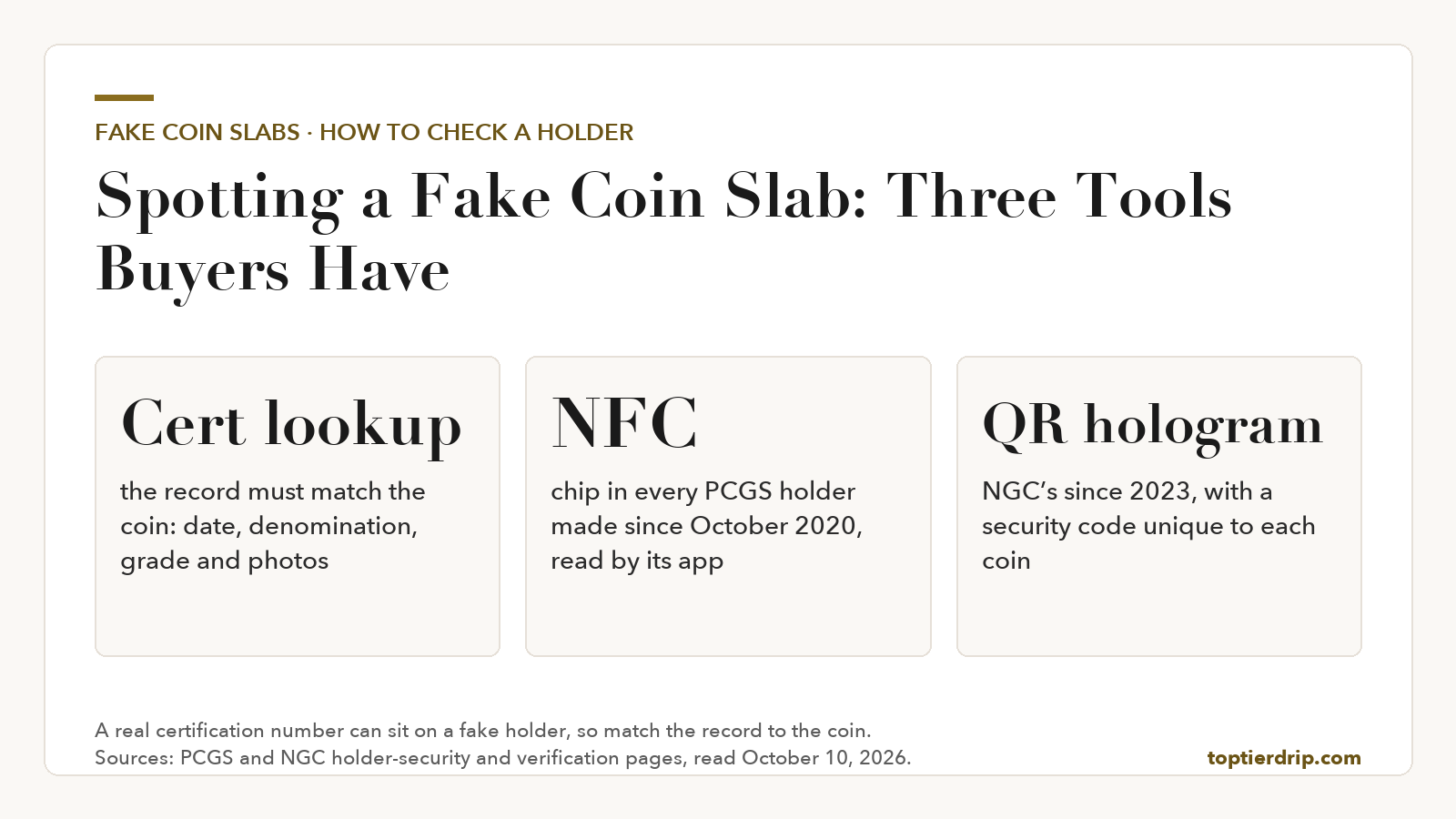
To spot a fake coin slab, look up its certification number with the grading service printed on the label, then check that the record matches the coin in your hand (date, denomination, grade and, where the service has them, its photos) before you trust the holder’s plastic. Counterfeiters reuse real numbers, so a number that looks up is the start of the test, not the end of it. The holder’s own security features, such as PCGS’s NFC chip and NGC’s QR-coded hologram, are the second half of the check.
As of October 10, 2026: every coin holder PCGS has made since October 2020 contains an NFC chip, PCGS says, readable by its Cert Verification app, with a fresh one-time code on each tap. NGC added a hologram with a QR code and an eight-digit security code unique to each coin in 2023, and keeps photos of most coins it has graded since late 2008. NGC’s lookup shows a Possible Counterfeit Holder alert when it has seen a fake using that number. Neither service’s guarantee covers a coin in a tampered holder.
What a fake coin slab is
A slab is the sealed plastic holder a grading service puts a coin in, with a label giving its grade and certification number. Fakes come in two forms. A counterfeit holder is made from scratch to look like a PCGS or NGC slab. A tampered holder is a genuine one that has been opened and resealed, often with a different coin inside. NGC’s own wording covers both: its lookup warns of “a counterfeit or tampered holder” using a given number.
The coin inside a counterfeit holder is often fake as well. NGC’s 2018 report on a federal case described “a seller of counterfeit coins in counterfeit NGC holders,” and a tampered holder can contain any coin at all. Either way, the guarantee does not travel with it. PCGS’s guarantee excludes any coin removed from its holder or in a holder that shows evidence of tampering, and NGC’s excludes coins in holders that have been damaged, unsealed, tampered with or altered.
Keep the scale in proportion. NGC said in that same report that counterfeit NGC holders “comprise a very small fraction of the total NGC holders in the marketplace,” while telling collectors to stay vigilant. A few minutes of checking is cheap insurance on a coin worth hundreds or thousands of dollars.
Check 1: Look up the certification number yourself
Start with the number, and look it up yourself rather than trusting a screenshot or a link sent by the seller. PCGS prints the cert number after the slash on a standard holder’s label, and its Cert Verification app takes the 7 or 8 digit number typed in or scanned from the barcode. PCGS frames the lookup as protection: checking a number in its database “helps mitigate the risk of purchasing counterfeit or altered coins.”
NGC’s website wants the grade typed in alongside the number; its FAQ says the extra field is there to stop automated browsing of its records. If nothing comes back, NGC lists three ordinary causes: a mistyped number, the wrong grade selected, or a coin NGC has not yet shipped. Some results carry alerts instead. A Possible Counterfeit Holder alert tells you NGC already knows of a fake or tampered holder carrying that number. Mechanical Error flags a typo on the label itself. Contact NGC Customer Service covers other cases NGC wants to hear about.
Data errors happen at PCGS too. Its cert page notes that occasional data entry errors can make a holder differ from the database, and asks owners to contact customer service when that happens. A mismatch is a reason to stop and ask, not proof of fraud. Jewelry buyers meet the same problem with lab reports; see what to do when a jewelry certificate and its listing disagree.
Check 2: Match the record to the coin in your hand
A cloned number passes the lookup, because the number is real. What a counterfeiter cannot easily copy is the coin that was actually graded, so compare the record with the slab and the coin field by field:
| Compare | Where | Red flag |
|---|---|---|
| Date and mint mark | Record, label, coin | Any of the three disagree |
| Denomination and size | Record, label, coin | A $5 record on a 1 oz coin |
| Grade and prefix | Record and label | MS on one, PF on the other |
| Photos | Record images, coin | Marks or spots in different places |
Size is easy to check through the plastic. The Mint gives the 1 oz Gold Eagle a diameter of 32.70 mm and the $5 tenth-ounce coin 16.50 mm, so a record for one on a holder containing the other fails at a glance.
Photos are the strongest test where they exist. NGC says it “has imaged virtually all non-bulk submissions since October 2008,” and its App Store listing says the app shows images for nearly 20 million NGC-certified coins. Tiny contact marks, spots and rim nicks sit in fixed places on a real coin, so a genuine match lines up mark for mark. If an older NGC coin has no images, NGC suggests its ReHolder service, which puts the coin in a new holder and images it; NGC’s fee page, read October 10, 2026, lists ReHolder at $15 for coins worth up to $10,000.
Check 3: Use the chip or QR code built into the holder
Newer holders carry features made to defeat cloned numbers, because they are tied to the physical slab rather than to the number on the label.
PCGS NFC. PCGS says that from October 2020 on, every coin holder it makes contains NFC technology. You can recognize it by a symbol of a shield with three bands above it, on the back of the slab or inside the plastic in the lower left corner; on some special labels the symbol appears only at the lower left of the front. Hold an NFC-capable phone near the holder and the PCGS Cert Verification app opens, or a browser page if the app is not installed. PCGS says the chip generates a cryptographic one-time password that “changes every time the insert is tapped,” and an outside authentication service checks it against the tag issued with that slab. Android phones from 2012 on and iPhone XS or newer models have NFC readers built in, PCGS says. It also warns that sticking a second NFC tag on the holder will likely stop both from working.
NGC QR hologram. NGC’s hologram, introduced in 2023, carries a QR code and an eight-digit security code unique to the coin, which NGC says makes the holder extremely difficult to copy or tamper with. Scanning the QR code opens that coin’s record, where NGC says you can compare the coin in hand with the images taken at encapsulation. NGC says it cannot honor requests for a particular hologram, so a holder graded before the change will carry an older design, and its absence on an older holder is not a red flag by itself.
Check 4: Inspect the seal, label and plastic
The physical features still count, especially on older holders without a chip or QR code. NGC says the hologram on the back of its holders has a dozen security features, some visible and some covert. Its labels carry a UV watermark, holographic foil and microprinting, and each holder is sealed by ultrasonic welding that helps reveal attempts at tampering. NGC adds that the weld is not meant to make the holder airtight or watertight, so a seal that lets air through does not by itself mean a fake.
At PCGS, the holder plastic contains an inert additive that only a hand-held reader built for PCGS can detect, and PCGS has supplied those readers to select Authorized Dealers. PCGS says its current holder has a stronger weld that more readily reveals tampering, and the Gold Shield on the label carries microtext. Look along the seam for cracks or uneven joins, and set the label beside one from a holder you know is genuine.
NGC declines to explain publicly how it spots fakes, saying detailed information “could help a counterfeiter to improve their craft and create more convincing forgeries.” That is one more reason to rely on the lookup, the photos and the chip rather than on how a holder looks.
Check 5: Weigh the price and the seller
The grading services’ own advice centers on who you buy from. NGC’s advice in 2018 was to “buy only from trusted retailers,” and PCGS’s cert page encourages buying PCGS-verified coins from its Authorized Dealers. The U.S. Mint’s bullion guidance makes the price point: when a bullion coin is offered below the current market price, it says, “extra scrutiny should be exercised.” Our guide to what a $5 Gold Eagle is worth shows how to work out the gold value, a useful reference when a price looks too good.
Before paying a private seller, ask for clear photos of both sides of the slab, including the hologram or NFC symbol, and the certification number, then run the checks above yourself. The questions are much the same ones we suggest when buying estate and vintage jewelry: who is selling, what evidence backs the description, and what happens if it proves wrong. For which service’s holder you are dealing with and how their guarantees differ, see our PCGS vs NGC comparison.
Check 6: Know what to do if a slab fails
Contact the service named on the label before you do anything else with the coin. NGC says it can sometimes confirm whether a holder is genuine from high-resolution images and may otherwise need to examine it at its office. If NGC confirms the holder is fraudulent, it photographs it, removes the coin, and returns the coin with a letter and the images, but it never returns the counterfeit holder parts. PCGS asks owners to contact its customer service whenever holder information differs from its database. Do not crack the holder open yourself first: a removed coin falls outside both guarantees.
Cases do reach court. On June 25, 2018, a Moorestown, New Jersey, man pleaded guilty in federal court in Camden to impersonating a federal agent and to illegally importing counterfeit coins and bars, which the U.S. Attorney’s office said came in falsely manifested packages from countries including China. The importation charge carried a maximum of 15 years in prison. NGC reported that the same seller had been selling counterfeit coins in counterfeit NGC holders and that it had passed what it gathered to a federal investigator. If your coin turns out to be genuine but in a damaged older holder, our guide to getting coins graded covers reholdering, and our coin grading app guide shows which official apps run these lookups. The wider grading picture is in our American Eagle gold grading pillar.
Frequently Asked Questions
How can you tell if a PCGS slab is fake?
Enter the certification number, the digits after the slash on the label, in PCGS Cert Verification yourself and check that the date, denomination and grade match the coin. On holders made from October 2020 on, look for the NFC symbol, a shield with three bands, and tap the holder with an NFC-capable phone; PCGS says each tap generates a one-time code that its service validates. Treat any mismatch as a reason not to pay until PCGS has answered.
How do I verify an NGC slab?
Use NGC’s certification lookup or the NGC App. On the website you enter the number and select the grade; in the app you scan the label barcode, and on holders with NGC’s 2023 hologram you can scan its QR code. Compare the coin with NGC’s photos, which NGC has for most coins graded outside bulk orders since October 2008.
Can a fake slab have a real certification number?
Yes. NGC’s lookup has a Possible Counterfeit Holder alert for numbers it has already seen on counterfeit or tampered holders, which means copied numbers circulate. That is why a lookup must be matched against the coin itself, ideally against the photos taken when it was graded.
What does Possible Counterfeit Holder mean on NGC?
NGC says the alert means it has seen a counterfeit or tampered holder using that certification number. It asks anyone who sees the alert to contact NGC Customer Service.
Do all PCGS holders have an NFC chip?
Only newer ones. PCGS says it began putting NFC technology in all of its coin holders in October 2020, marked by a shield with three bands on the back of the slab or in the lower left corner of the holder. A PCGS holder made before then will not have one, so check its number and the coin instead.
Are fake coin slabs common?
NGC said in 2018 that counterfeit NGC holders make up a very small fraction of the NGC holders on the market, while urging collectors to stay vigilant and buy from trusted retailers. We found no current count on either service’s pages, so the safer assumption is that any slab bought from a stranger should be checked.
What should I do if I think my coin is in a fake slab?
Contact the grading service named on the holder. NGC says it can sometimes judge a holder from high-resolution images and otherwise examines it at its office; if the holder is fraudulent, it returns the coin with a letter and images but keeps the holder parts. PCGS asks owners to contact customer service when a holder does not match its database.
Sources
- Verify NGC Certification (FAQ) — NGC Help Center, read October 10, 2026
- NGC Certified Coin Security Features — NGC Security Center, read October 10, 2026
- NGC Introduces New High-Security Hologram with Unique QR Codes — NGC, posted 7/25/2023, read October 10, 2026
- NGC Labels and Holders (FAQ) — NGC Help Center, read October 10, 2026
- Seller of Counterfeit NGC Holders Brought to Justice — NGC, posted 7/3/2018, read October 10, 2026
- Moorestown, New Jersey, Man Admits Impersonating Federal Agent, Importing Counterfeit Coins And Bars Into United States — U.S. Attorney’s Office, District of New Jersey, June 25, 2018, read October 10, 2026
- About NGC Grades (FAQ) — NGC Help Center, read October 10, 2026
- The NGC Guarantee — NGC, read October 10, 2026
- NGC Services and Fees — NGC, read October 10, 2026
- NGC: Verify Coins & Check Pops (App Store listing) — Apple App Store, developer Numismatic Guaranty Corporation, read October 10, 2026
- PCGS Cert Verification — PCGS, read October 10, 2026
- PCGS Mobile Apps — PCGS, read October 10, 2026
- Gold Shield Security: The PCGS Holder — PCGS, read October 10, 2026
- PCGS Guarantee of Grade and Authenticity — PCGS, read October 10, 2026
- Bullion Consumer Awareness — United States Mint, read October 10, 2026
- American Eagle Gold Proof Coin — United States Mint, read October 10, 2026
Grading standards, fees and policies are quoted from each organization’s own pages on the date shown and change often, so check the current terms before you submit, buy or sell. This article is general information, not investment, tax or legal advice. Top Tier Drip is not affiliated with any grading service, laboratory, mint or dealer named here and earns nothing from them.