
PCGS and NGC both grade modern Gold Eagles on the 1-to-70 Sheldon scale, seal them in tamper-evident holders, guarantee the result in writing and publish a running count of every coin they grade, so the PCGS vs NGC choice comes down to fees, turnaround, guarantee terms and label rules. On the pages we read October 10, 2026, NGC cost less to submit a 1 oz Gold Eagle declared up to $5,000, PCGS’s guarantee carried no stated time limit but excludes the original submitter, and NGC’s runs ten years from grading. Neither company is ranked here; this is what each one documents, and the kind of collector each setup fits.
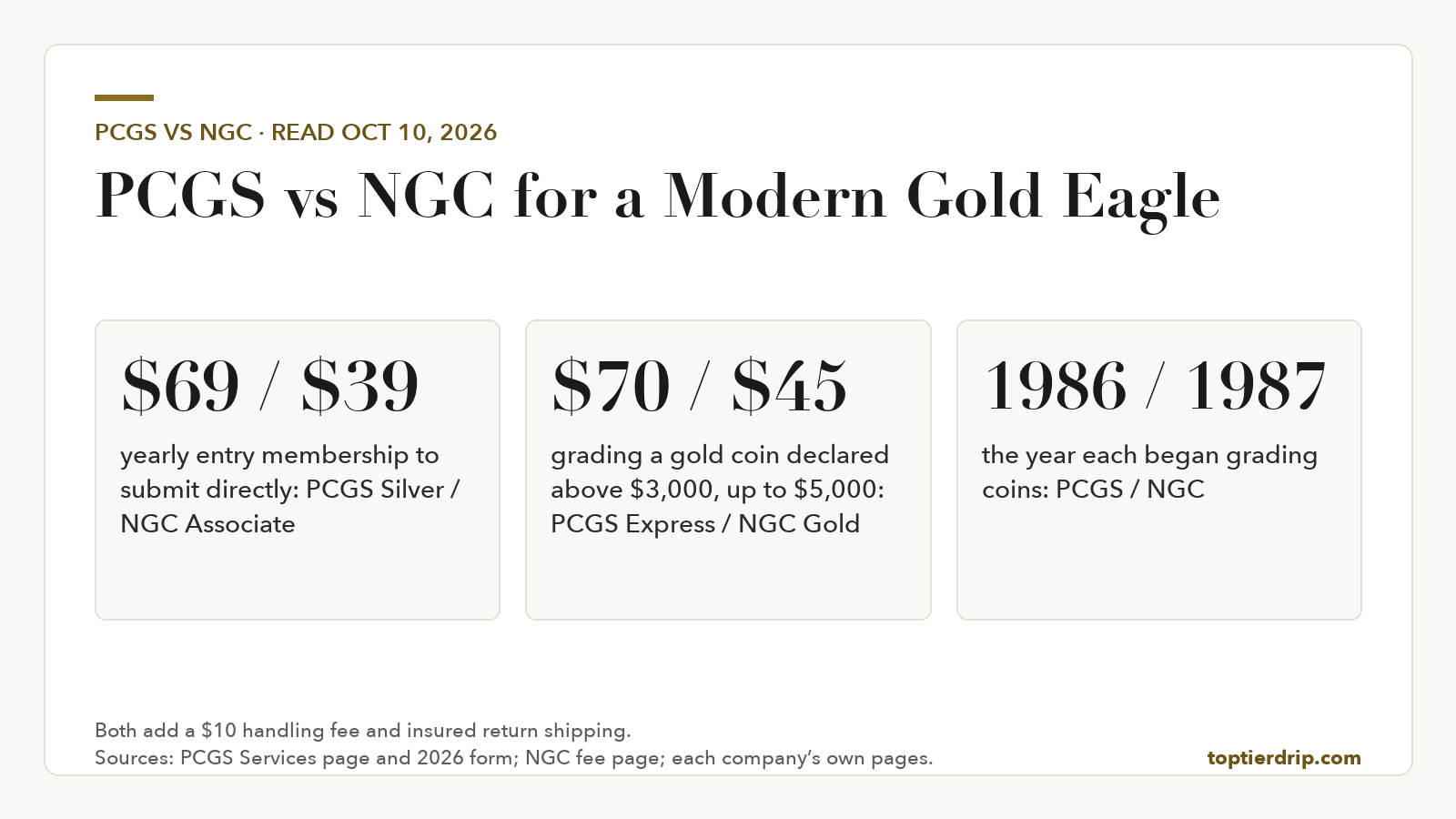
As of October 10, 2026: PCGS, a division of Collectors Universe, traces its encapsulated grading to 1986; NGC, part of the Certified Collectibles Group, began in 1987. Submitting directly costs at least $69 a year at PCGS and $39 at NGC. For a gold coin declared up to $5,000, NGC’s Gold tier was $45 with a 10-working-day estimate, against $70 and 20 business days for PCGS Express. Both charge $18 for their early-release designations.
PCGS vs NGC at a glance
| Point | PCGS | NGC |
|---|---|---|
| Grading since | 1986 | 1987 |
| Parent | Collectors Universe | Certified Collectibles Group |
| Entry membership | $69 a year | $39 a year |
| 1965-on coin to $3,000 | Modern: $30 | Modern: $20 |
| Gold coin to $5,000 | Express: $70 | Gold: $45 |
| Early-release label | First Strike, +$18 | Early Releases, +$18 |
| Guarantee claim window | None stated | 10 years from grading |
| Original submitter | Cannot claim | Capped at fees paid |
| Graded-coin count | Population Report | NGC Census |
Both describe themselves in superlatives. PCGS’s Services page says it has been “the gold standard in coin grading and authentication” since 1986, and NGC’s About page calls NGC “the world’s largest and most trusted third-party grading service for coins, tokens and medals.” Those are the companies’ own claims; neither offers a way to test them against the other.
Who owns them and when they started
PCGS says that in 1985 a small group of leading coin experts set out to fix the market’s grading problems, and that it introduced encapsulated, third-party grading in 1986. Its About page names it “a division of Collectors Universe, Inc.” At the end of November 2020, Numismatic News reported, a deal was announced for D1 Capital Partners and Cohen Private Ventures to buy all public shares of Collectors Universe at $75.25 each in cash, with the investor group led by sports card collector Nat Turner. We found no first-hand source for the closing date, so we leave it out.
NGC says it adopted the 1-to-70 scale when it opened in 1987, and that it has since graded more than 70 million coins with more than 30 full-time graders. It adds that NGC and those graders do not buy and sell coins commercially. NGC is one of the Certified Collectibles Group companies, along with PMG, CGC, JSA and ASG; the group’s CEO is Steven R. Eichenbaum. On July 1, 2021, Numismatic News reported that Blackstone funds had agreed to buy a majority stake in CCG in a deal valuing it at more than $500 million, with founder Mark Salzberg and Eichenbaum keeping a significant minority. Whether that split still holds today is not on any page we read.
Fees and membership for a modern Gold Eagle
Membership is the first difference. PCGS sells Collectors Club levels at $69, $149 and $249 a year, and the two upper levels include grading vouchers; those apply only to Regular service and, per the join page, not to coins valued over $2,500, so any coin declared above that figure pays full price. NGC’s Associate level is $39, Premium is $159 with a $150 credit, and ANA members can get an NGC submission membership free because NGC is the ANA’s official grader.
Tier prices depend on the declared value. A 1965-or-later coin declared up to $3,000 costs $20 in NGC Modern or $30 in PCGS Modern. For a gold coin declared above $3,000 and up to $5,000, NGC’s Gold tier costs $45 while PCGS sends it to Express, $70 a coin, a $25 gap per coin. Above $5,000 the order flips: PCGS Express stays $70 up to $10,000, while NGC Express is $80. Each service adds $10 handling, and insured return postage starts at $27.00 at PCGS and $30 at NGC. The NGC entry membership is $30 a year cheaper.
Those are fee lines, not totals. Our Gold Eagle grading cost breakdown adds them up for one coin and for five, and the American Eagle gold grading pillar covers when grading a Gold Eagle pays at all.
Turnaround times compared
Speed follows the tier. On US coins, PCGS’s estimates were 25 business days in Modern and 20 in Express. NGC’s were 60 working days in Modern (half that with its $15 Fast Track), 10 in Gold and 7 in Express. For a gold coin in the $3,000-to-$5,000 band, then, the NGC tier is both the cheaper and the quicker one on paper. Under $3,000 the trade reverses at NGC: Modern is cheapest but slowest, and paying for Gold cuts the estimate from 60 working days to 10.
Neither service promises these numbers. NGC says plainly that its turnaround times are estimates only and are not guaranteed, and PCGS describes its own as estimated business days.
What each guarantee covers, and for whom
Both guarantees cover the same two things. PCGS: “All U.S. and World coins graded and encapsulated by PCGS are guaranteed genuine,” and their grade is guaranteed too. NGC guarantees that a coin in its holder is genuine and “Not overgraded (meaning that it is not graded higher than NGC’s Grading Standards).” The differences lie in who may claim and for how long.
- The original submitter. PCGS’s guarantee “does not apply to, and cannot be utilized by, the original submitter” or anyone connected to them. NGC lets the submitter claim but caps compensation at the grading fees actually paid.
- Time limit. NGC claims must be made within ten years of the grading date. The PCGS guarantee page states no deadline.
- Spots. PCGS excludes deterioration after certification, “including spotting on modern silver coins.” NGC excludes spots after encapsulation too, and adds that “certain gold Coins can develop red spots post-encapsulation.”
- Holders. Both exclude coins taken out of the holder or in a tampered one, and PCGS adds that counterfeit PCGS holders are not covered.
- Labels. NGC states that special designations such as Early Releases are not guaranteed.
For a buyer of already-graded coins, the PCGS wording sets no deadline; for someone grading their own coins, NGC’s compensation, capped at the grading fee, is the only recourse either guarantee offers. NGC’s terms were revised June 2, 2026, so reread both before relying on them. A grading guarantee covers authenticity and grade and nothing else. Protection against loss or theft is a separate product, the same split our post on insurance vs warranty vs service plan draws for jewelry.
Early-release labels and their rules
Both services sell a designation for coins sent in soon after release, at the same $18 a coin, but they test the timing differently. PCGS ties First Strike to a coin’s first 30 days after its official release, and accepts either a package postmarked by its cutoff date or coins in the Mint’s original unopened shipping box postmarked before the cutoff. NGC’s Early Releases and First Releases depend on arrival: a coin must generally reach NGC or an approved depository within 30 days of release, and NGC says original packaging and sealed Mint boxes are not required.
One rule matters for Gold Eagle buyers. NGC states that regular US submissions of Mint State American Gold Eagles “are not eligible for the First Releases designation,” which it reserves for select bulk submitters; Early Releases is the label a collector can request. NGC lists Early Releases coins separately in its census. Other special labels cost $8 on top of the tier at NGC, and PCGS’s 40th Anniversary label is $7. What these labels say about the coin itself is the subject of our First Strike vs Early Releases explainer.
Holders and cert lookup
PCGS says it pioneered the “tamper-evident, sonically sealed, high security” holder, and its Services page states that NFC anti-counterfeiting technology comes with every service level. Its optional Gold Shield service, +$5 a coin on the 2026 form, adds high-resolution imaging and registration against PCGS’s image database. NGC seals its holder by ultrasonic welding to reveal tampering, says the seal is not designed to be airtight or watertight, and reports that the Smithsonian chose NGC holders for more than 300 of its most important coins.
Lookup works a little differently at each. On a standard PCGS label the cert number follows the slash, and PCGS’s page and app check a 7- or 8-digit number and show pricing and population data with it. NGC’s tool asks for the grade as well as the number, a step NGC says keeps people from crawling its database, and finds only coins that have already shipped. NGC says it has photographed nearly every non-bulk submission since October 2008, and flags any number it has seen on a fake holder with a Possible Counterfeit Holder alert. The full set of checks is in how to spot a fake coin slab.
Population Report vs NGC Census
Each company counts only the coins it has graded. PCGS calls its count the Population Report, which showed a last update of 10/10/2026 when we read it. NGC describes its census as “an up-to-date population report showing the latest number of coins, tokens and medals graded by NGC for every type and grade,” refreshed each Monday.
Because the two counts are separate, the number of MS70 or PF70 examples of a given Gold Eagle at one service says nothing about the other. NGC adds its own caution: these reports “only reflect the quantities and types of collectibles previously graded by the CCG Companies, and are not an indicator of value or rarity.” Our MS69 vs MS70 comparison covers what separates the two top grades and how their prices compare.
Which setup suits which collector
- Grading a few gold coins yourself: NGC’s lower membership and its Gold tier give the lower published cost for coins declared up to $5,000, and ANA members can skip the membership fee.
- Grading many lower-value coins: PCGS Gold and Platinum vouchers can absorb Regular-tier fees for coins under the voucher cap.
- Coins above $5,000: PCGS Express is the cheaper published tier up to $10,000.
- Buying already-slabbed coins: PCGS’s guarantee is written for later owners and sets no deadline; with NGC, check the grade date in its verification tool because the ten-year window runs from grading.
- Wanting an early-release label on a Mint State Gold Eagle: PCGS judges by postmark, NGC by arrival, and NGC offers Early Releases rather than First Releases to regular submitters.
Frequently Asked Questions
Is PCGS or NGC better for Gold Eagles?
Neither service publishes anything that settles it, and we do not rank them. They grade on the same 1-to-70 scale and both guarantee their holders. What differs is documented: NGC’s fees for a 1 oz Gold Eagle declared up to $5,000 were lower on October 10, 2026, while the PCGS guarantee sets no time limit and NGC’s runs ten years from grading. Pick by the fee, guarantee and label rules that matter for your coins.
Is NGC cheaper than PCGS?
For most modern Gold Eagle submissions on the sheets read October 10, 2026, yes: the entry memberships cost $39 a year at NGC and $69 at PCGS, and a gold coin declared up to $5,000 costs $45 in NGC’s Gold tier against $70 in PCGS Express. Above $5,000, PCGS Express ($70) undercuts NGC Express ($80).
Who owns PCGS and NGC?
PCGS describes itself as a division of Collectors Universe, Inc., which Numismatic News reported in 2020 would be bought by an investor group led by Nat Turner. NGC belongs to the Certified Collectibles Group; Blackstone agreed in 2021 to buy a majority stake in CCG, with founder Mark Salzberg and CEO Steven Eichenbaum keeping a significant minority. Neither page we read gives today’s ownership split.
Can NGC grade a coin that is already in a PCGS holder?
Yes. NGC’s CrossOver service reviews PCGS-holdered coins for NGC certification at the normal tier fee, and PCGS offers its own crossover for coins graded by other companies. Neither refunds the fee if the coin does not cross at the grade you asked for.
What is the difference between the PCGS Population Report and the NGC Census?
Each is a running count of the coins that one company has graded, by type and grade. They do not share data, so a coin graded MS70 by NGC appears only in the NGC Census. NGC updates its census each Monday and warns that such reports are not an indicator of value or rarity.
How do I check whether a PCGS or NGC slab is real?
Enter the certification number on the grader’s own website or app and compare the result, including any images, with the coin and label in hand. PCGS puts the cert number after the slash on its label; NGC asks for the grade as well as the number. An NGC alert reading Possible Counterfeit Holder means NGC has seen a fake or tampered holder using that number.
Sources
- About PCGS — PCGS (Collectors Universe), read October 10, 2026
- PCGS Grading Standards — PCGS, read October 10, 2026
- PCGS Services (Coin Grading, Modern tab) — PCGS (Collectors Universe), read October 10, 2026
- PCGS U.S. Coin Submission Agreement (2026 form, Rev 8/26) — PCGS / Collectors Universe, read October 10, 2026
- Join The PCGS Collectors Club — PCGS, read October 10, 2026
- PCGS Coin Grading Services (fees page) — PCGS, read October 10, 2026
- PCGS Guarantee of Grade and Authenticity – U.S. and World Coins — PCGS, read October 10, 2026
- PCGS Services (Crossover, Modern tab) — PCGS (Collectors Universe), read October 10, 2026
- PCGS First Strike — PCGS, read October 10, 2026
- PCGS Special Labels — PCGS, read October 10, 2026
- PCGS Cert Verification — PCGS, read October 10, 2026
- PCGS Population Report — PCGS, read October 10, 2026
- Collectors Universe to be privately owned — Patrick A. Heller, Numismatic News, December 10, 2020, read October 10, 2026
- About NGC — NGC (Numismatic Guaranty Company), read October 10, 2026
- NGC Coin Grading Scale — NGC, read October 10, 2026
- NGC and PMG name an Official Submission Center in Canada (CCG release) — NGC / Certified Collectibles Group, posted 7/14/2026, read October 10, 2026
- CCG, parent company of NGC, acquired by Blackstone Tactical Opportunities — Numismatic News Staff, July 1, 2021, read October 10, 2026
- NGC Services and Fees — NGC, read October 10, 2026
- NGC Grading Tiers & Services for US and World Coins (collector price sheet) — NGC, dated March 17, 2026, read October 10, 2026
- Join NGC — NGC, read October 10, 2026
- General Submission FAQs — NGC Help Center, read October 10, 2026
- The NGC Guarantee — NGC, revised June 2, 2026, read October 10, 2026
- NGC Special Designations — NGC, read October 10, 2026
- NGC Labels and Holders (FAQs) — NGC Help Center, read October 10, 2026
- Verify NGC Certification (FAQs) — NGC Help Center, read October 10, 2026
- NGC Census — NGC, read October 10, 2026
- NGC Census (FAQs) — NGC Help Center, read October 10, 2026
Grading standards, fees and policies are quoted from each organization’s own pages on the date shown and change often, so check the current terms before you submit, buy or sell. This article is general information, not investment, tax or legal advice. Top Tier Drip is not affiliated with any grading service, laboratory, mint or dealer named here and earns nothing from them.