
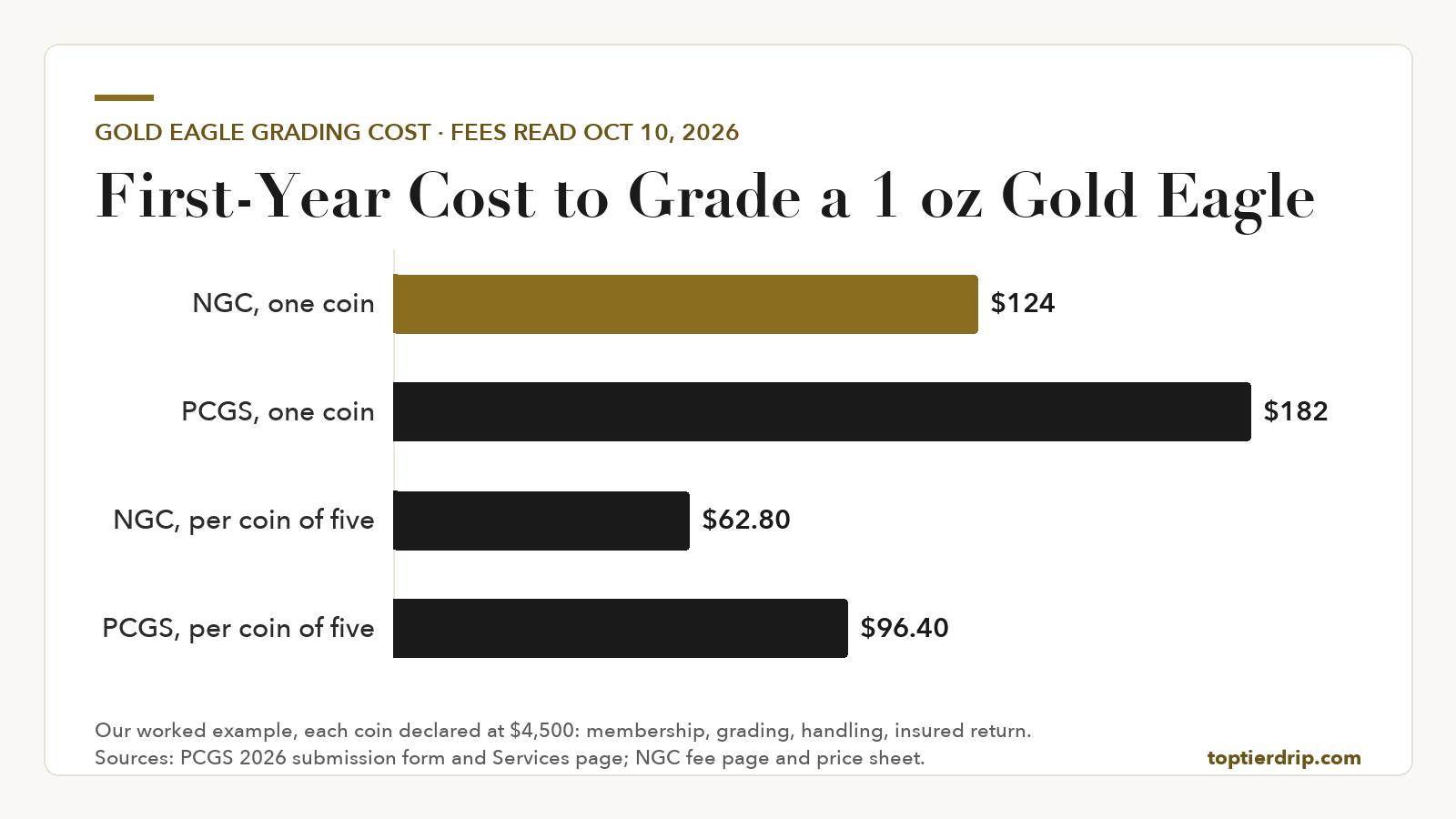
In our worked example, the first-year Gold Eagle grading cost for one 1 oz coin declared at $4,500 comes to $124 at NGC and $182 at PCGS, once membership, the grading fee, handling and insured return shipping are added together. The grading fee itself is only $45 (NGC) or $70 (PCGS) of that; the rest is membership and postage, which is why the cost per coin drops fast when several coins travel in one box. Below is every line on both fee sheets as we read them on October 10, 2026, the tier a Gold Eagle lands in at each service, and the costs neither sheet prints.
As of October 10, 2026: NGC charges $20 a coin in its Modern tier (coins struck 1965 to the present, declared up to $3,000), $45 in its Gold tier (up to $5,000) and $80 in Express (up to $10,000). The Modern tab of PCGS’s Services page lists Modern Value at $17 (up to $300), Modern at $30 (up to $3,000) and Express at $70 (up to $10,000). Submitting directly takes a paid membership at either service: NGC Associate at $39 a year or PCGS Collectors Club Silver at $69 a year. Each adds a $10 handling fee, and insured return shipping starts at $30 at NGC and $27.00 at PCGS.
Gold Eagle grading cost at a glance
Four kinds of charge make up the bill: a yearly membership, a per-coin grading fee set by the coin’s declared value, a handling fee and a return shipping charge for each package, and optional label or imaging extras. The table lines them up for a modern Gold Eagle. For how the two services differ beyond price, see our PCGS vs NGC comparison.
| Fee line | PCGS | NGC |
|---|---|---|
| Membership, per year | $69 (Silver) | $39 (Associate) |
| Coin declared up to $3,000 | $30 (Modern) | $20 (Modern) |
| Gold coin over $3,000, up to $5,000 | $70 (Express) | $45 (Gold) |
| Coin $5,001 to $10,000 | $70 (Express) | $80 (Express) |
| Handling | $10.00 | $10 per invoice |
| Return shipping, 1 coin to $5,000 | $27.00 or $33.00 | $30 |
| First Strike / Early Releases | +$18 a coin | +$18 a coin |
The membership is the only line you pay once a year no matter how many boxes you send. Handling and return shipping come back with every package, and the grading fee and any label extra come back with every coin.
Membership: the yearly charge before any coin ships
PCGS’s 2026 submission form states the rule plainly: “You must be a Collectors Club member or PCGS Authorized Dealer to submit coins.” Its Collectors Club comes in three levels. Silver costs $69 a year with no grading vouchers, Gold costs $149 with 4 vouchers and Platinum costs $249 with 8. The join page adds that the membership renews automatically and that no refunds are given once the card is charged. PCGS’s guide notes sales tax on memberships in New Jersey and Texas.
The vouchers look like free grading, but they rarely fit a 1 oz Gold Eagle. PCGS’s form allows them only on Regular service, and the join page excludes First Strike fees and “coins valued over $2,500.” The Other tab of the Services page lists the voucher with a $3,000 limit instead, so the two PCGS pages disagree. Either cap sits below our $4,500 example. Voucher packages still pay their own shipping and handling.
NGC’s join page lists four levels. Free ($0) gives online resources only. Associate ($39 a year) adds direct submission privileges and 10% off select add-on services. Premium ($159) adds a $150 credit with NGC, and Elite ($329) adds bulk rates and 10% off NGC grading. NGC’s help center confirms you need “an Associate or higher NGC Collector membership” to submit directly.
There is one more door at NGC. Because it is the American Numismatic Association’s official grading service, NGC lets ANA members sign up for a free submission membership. NGC’s pages do not list ANA dues, so compare the ANA’s own rate with the $39 Associate fee before choosing that route. Our guide to how to get coins graded walks through the membership, dealer and ANA routes step by step.
Which tier a 1 oz Gold Eagle falls into
Both services sort coins by declared value, not by metal or size. PCGS’s guide says “Service Level is based on the declared value per item listed,” and no single value may exceed the tier’s cap. NGC uses the declared value to insure the coin while it holds it, and the same figure sets the tier. Leave the value blank on a PCGS form and PCGS assigns $50 a coin, far too little to cover a gold coin.
Because a 1 oz coin’s value follows the gold price, its tier can change from one month to the next. We do not quote a gold price here; check the coin’s realistic value on the day you fill in the form, then read across:
- Declared up to $3,000: NGC Modern at $20, or PCGS Modern at $30. NGC’s Modern tier covers any US coin struck from 1965 on, with no carve-out for proofs or gold.
- Above $3,000, up to $5,000: NGC’s Gold tier at $45 covers “All gold coins” to that cap. PCGS’s Modern tier stops at $3,000, so the next PCGS level is Express at $70.
- $5,001 to $10,000: NGC Express at $80 and PCGS Express at $70.
NGC’s Gold tier has moved recently. Its fee notice effective January 7, 2025 set it at $40; the price sheet dated March 17, 2026 and the live fee page both show $45. NGC did not say on those pages when the change took effect.
Fractional coins follow the same value bands, with one open question at PCGS: a footnote sends “fractional gold” to Regular service or higher without defining the term. Ask PCGS before sending a 1/10 oz coin under Modern. Whether grading a small coin pays at all is covered in our article on what a 1/10 oz Gold Eagle is worth, and the wider case for and against grading is in our American Eagle gold grading guide.
Turnaround: what each tier buys in time
The cheaper tiers are the slower ones. On the dates we read them, PCGS estimated 25 business days for Modern and 20 for Express on US coins. NGC estimated 60 working days for Modern, 10 for Gold and 7 for Express. NGC’s Fast Track adds $15 a coin to halve the Modern estimate to 30 days, but NGC says the fee is not refunded if the work runs late.
That produces an odd result at NGC. A Gold Eagle declared at $3,000 or less can go in Modern for $20 and wait about 60 working days, or in Gold for $45 and wait about 10. Paying more buys speed, not a different grade.
Treat every figure as an estimate. NGC states that its turnaround times “are estimates only and are NOT guaranteed.” PCGS’s older fees page showed 30 business days for Modern as the previous week’s average, and PCGS starts counting the day after an order is entered, so the days spent in the mail and on opening the box are extra.
That older PCGS page disagrees with the current one on price as well. It still shows Regular at $40 for coins valued up to $2,500, while the 2026 form and the Services page show Regular at $42 with a $3,000 cap. We use the form’s figures throughout, since the form is the document you sign.
Handling, return shipping and insurance
PCGS’s 2026 form carries a $10.00 handling line. Return postage and insurance are priced by number of coins and the package’s total declared value. For 1 to 4 coins the form lists $27.00 up to $1,000, $33.00 from $1,001 to $5,000 and $41.00 from $5,001 to $15,000. For 5 to 25 coins it lists $32.00, $38.00, $46.00 and $53.00, the last for $15,001 to $25,000. Every return goes back fully insured and needs a signature.
NGC’s price sheet charges $10 handling per invoice, and its fee page adds that shipping is extra. Its return table, effective August 5, 2025, charges 1 to 10 coins $30 at a declared $1 to $5,000 and $40 at $5,001 to $25,000. NGC ships domestic returns by FedEx insured up to $100,000 a package.
Using your own carrier account changes the math. NGC charges $4 a shipment and does not insure it. PCGS’s form says $5 per order while its online guide says $4, and either way you supply your own insurance.
Label and imaging add-ons
Label extras are optional and charged per coin, on top of the tier. At PCGS, First Strike adds $18 a coin; PCGS’s labels page reserves it for coins issued within 30 days of their official release. TrueView photography adds $5, and the PCGS 40th Anniversary special label costs $7 per label at any service level.
PCGS’s form also offers two service groups, Standard or Gold Shield, with Gold Shield at +$5 per coin for high-resolution imaging and registration. The same form’s service-level header reads “SERVICES INCLUDE GOLD SHIELD FEE,” so confirm with PCGS whether the extra $5 applies before you budget it.
At NGC, Early Releases or First Releases costs the tier fee plus $18, a special label costs the tier plus $8, and Internet Imaging is $5 a coin. NGC’s paid memberships take 10% off select add-ons. What those early-release labels actually certify is in our guide to First Strike vs Early Releases.
Costs neither fee sheet shows
Some of the bill never appears on either service’s page:
- Postage and insurance on the way in. PCGS states that “Packages to PCGS must be insured,” and the carrier, not the grader, sets that price.
- Dealer charges. PCGS invites collectors to submit through its Authorized Dealers, and NGC says many of its dealers take submissions from the public. Neither service publishes what a dealer adds, so ask for the dealer’s full price list in writing.
- ANA dues, if you use the free NGC membership route.
- Fees on coins that come back ungraded. PCGS charges the full grading fee even when a coin is returned as genuine only, and NGC gives no refunds once a package has been delivered.
Coverage once the slab is home is a separate cost. Graded coins raise the same questions we cover in jewelry insurance vs warranty vs service plan.
Worked example: one 1 oz Gold Eagle, first year
Here is our example: a single 1 oz Gold Eagle given an example declared value of $4,500, sent directly with the cheapest membership that allows submission and no add-ons. All figures are our arithmetic on the fees as read October 10, 2026.
| Line | PCGS | NGC |
|---|---|---|
| Membership (yearly) | $69 | $39 |
| Grading tier | $70 Express | $45 Gold |
| Handling | $10 | $10 |
| Return shipping | $33.00 | $30 |
| First-year total | $182 | $124 |
Raise the example declared value to $5,500 and both totals climb: NGC moves the coin to Express at $80 and charges $40 return shipping, for $169, while PCGS stays at Express but its shipping band rises to $41.00, for $190. A second one-coin package later in the same membership year drops the membership line, so at $4,500 it would cost $113 at PCGS and $85 at NGC. Adding a First Strike or Early Releases label adds $18 to any of these totals.
Worked example: five coins in one box
Now send five 1 oz Gold Eagles, each at the same $4,500 example value, so the package is declared at $22,500. At PCGS that is $69 membership, $350 in Express fees, $10 handling and $53.00 return shipping for 5 to 25 coins in the $15,001 to $25,000 band: $482 in all, or $96.40 a coin. At NGC it is $39 membership, $225 in Gold tier fees, $10 handling and $40 return shipping: $314, or $62.80 a coin.
The fixed costs are what shrink per coin. Membership, handling and one return box are shared by five coins instead of carried by one. First Strike or Early Releases labels on all five would add $90 at either service.
Two membership choices change these totals. PCGS Gold vouchers do not help, because each coin is declared above the voucher cap. NGC Premium costs $159 but carries a $150 credit with NGC, so a submitter who spends that credit pays a net $9 for the year, less than Associate. Whether fees on this scale are worth paying depends on the grade a coin can reach; our look at MS69 vs MS70 Gold Eagles covers that question.
Frequently Asked Questions
How much does it cost to get a Gold Eagle graded?
It depends on the declared value and on whether you already hold a membership. In our worked example, one 1 oz Gold Eagle declared at $4,500 costs $124 in the first year at NGC (Associate membership, Gold tier, handling and return shipping) and $182 at PCGS (Silver membership, Express tier, handling and return shipping), using fees read on October 10, 2026. Later packages in the same membership year skip the membership line.
Is NGC cheaper than PCGS for grading Gold Eagles?
On the published sheets read October 10, 2026, NGC came out lower in both of our worked examples, mostly because its Associate membership is $39 a year against $69 for PCGS Silver, and its Gold tier is $45 against $70 for PCGS Express. The gap narrows above $5,000 declared value, where NGC Express is $80 and PCGS Express is $70 per coin. Fees change, so check both sheets on the day you submit.
Do I need a membership to send coins to PCGS or NGC?
To send them directly, yes. PCGS requires a Collectors Club membership or Authorized Dealer status, and NGC requires an Associate or higher membership. NGC also offers ANA members a free submission membership, and both services point collectors without a membership to their Authorized Dealers, who set their own charges.
Can I use PCGS Collectors Club vouchers on a Gold Eagle?
Only if the coin fits the voucher rules. Vouchers apply to Regular service, and the Join page excludes coins valued over $2,500, while the Other tab of the Services page shows a $3,000 limit. A 1 oz Gold Eagle declared above both caps cannot go in on a voucher, and voucher packages still pay shipping and handling.
How long does PCGS or NGC take to grade a Gold Eagle?
As read on October 10, 2026, PCGS estimates 25 business days for Modern and 20 for Express on US coins. NGC estimates 60 working days for Modern, 30 with Fast Track, 10 for its Gold tier and 7 for Express. Both say these are estimates, and neither count includes the days your package spends in the mail.
What declared value should I put on a Gold Eagle?
A realistic current market value for that coin on the day you ship. The figure sets the tier at both services, and NGC uses it to insure the coin while it is in NGC care. NGC says it does not value or appraise coins, and PCGS assigns $50 to any coin listed without a value, which is far too low to protect a gold coin in transit.
Sources
- NGC Services and Fees — NGC (Numismatic Guaranty Company), read October 10, 2026
- NGC Grading Tiers & Services for US and World Coins (collector price sheet) — NGC, dated March 17, 2026, read October 10, 2026
- Join NGC — NGC, read October 10, 2026
- General Submission FAQs — NGC Help Center, read October 10, 2026
- NGC Return Shipping Fees — NGC, posted 8/5/2025, updated 1/12/26, read October 10, 2026
- NGC Announces Revised Services and Fees for 2025 — NGC, posted 12/10/2024, read October 10, 2026
- PCGS Services (Coin Grading, Modern tab) — PCGS (Collectors Universe), read October 10, 2026
- PCGS Services (Coin Grading, Other tab) — PCGS (Collectors Universe), read October 10, 2026
- PCGS U.S. Coin Submission Agreement (2026 form, Rev 8/26) — PCGS / Collectors Universe, read October 10, 2026
- Join The PCGS Collectors Club — PCGS, read October 10, 2026
- PCGS Submission Guidelines — PCGS, read October 10, 2026
- PCGS Coin Grading Services (fees page) — PCGS, read October 10, 2026
- PCGS Special Labels — PCGS, read October 10, 2026
Grading standards, fees and policies are quoted from each organization’s own pages on the date shown and change often, so check the current terms before you submit, buy or sell. This article is general information, not investment, tax or legal advice. Top Tier Drip is not affiliated with any grading service, laboratory, mint or dealer named here and earns nothing from them.