
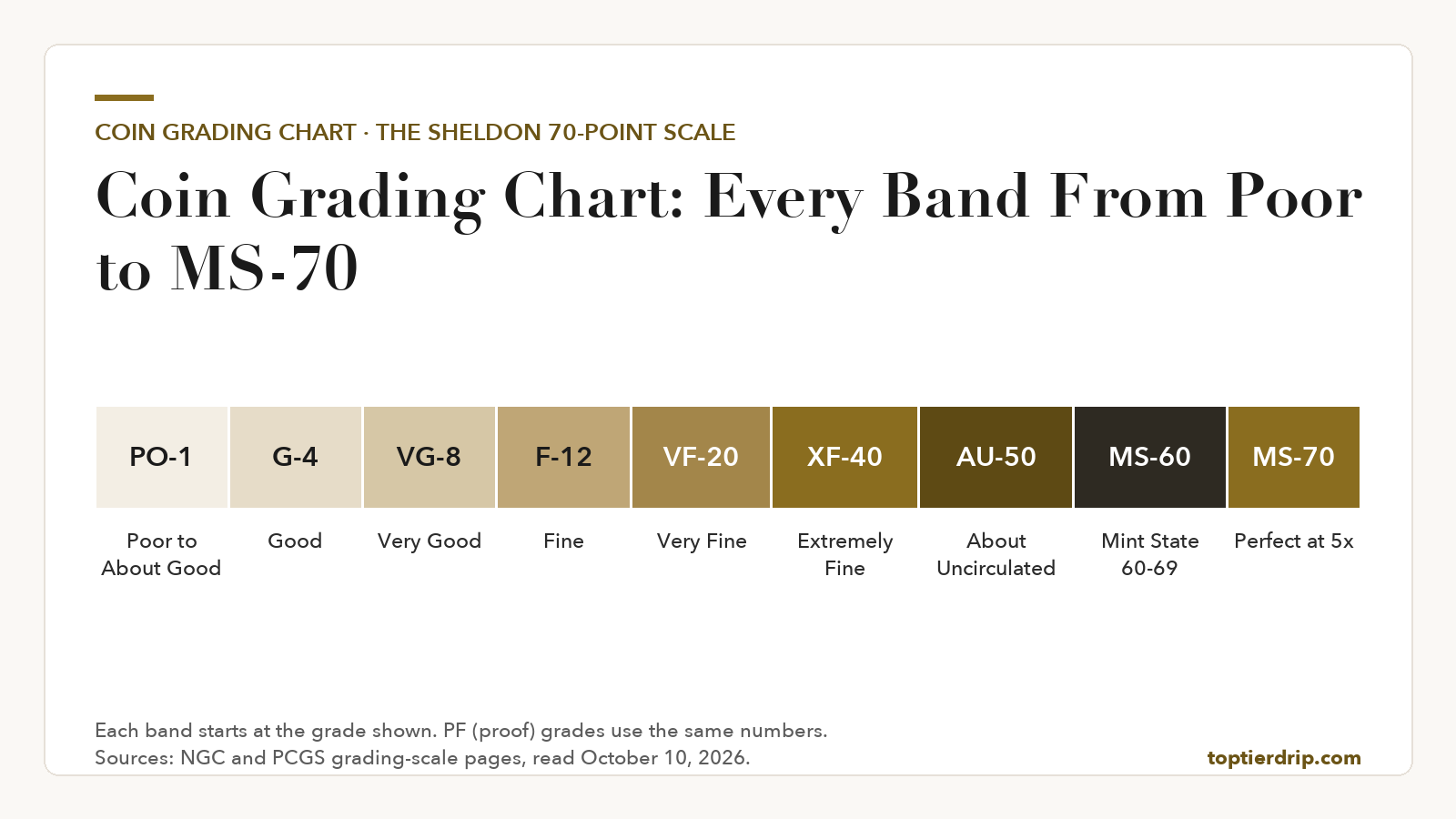
A coin grading chart is the Sheldon scale laid out from 1 to 70: Poor (PO-1), where little more than the date and type can be made out, up to Mint State or Proof 70, a coin without a single post-production flaw visible at 5x magnification. Grades 1 through 58 measure wear, and 60 through 70 are kept for coins with none, ranked by marks, strike and luster. The full chart is below with each grade’s name and a short description condensed from NGC’s grading standards, followed by what the letters mean and where modern American Gold and Silver Eagles actually fall.
As of October 10, 2026: PCGS and NGC both grade on the 1-to-70 scale, with MS for Mint State, PR (PCGS) or PF (NGC) for Proof, and SP for Specimen. The census NGC updated that day for the 2024 1 oz Gold Eagle bullion coin counted 8,363 coins graded, none below MS68 and 74% at MS70, which shows how little of the chart a new bullion coin uses.
Coin grading chart: every grade from PO-1 to 70
Names for the circulated bands follow the adjectival table on NGC’s grading-process page. The Choice and Gem labels for 63 to 66 come from PCGS’s glossary, and the labels for 67 to 70 from CoinWeek’s grade-by-grade guide. Descriptions are our short versions of NGC’s grading standards. PCGS writes the same grades with a hyphen (MS-65) and NGC with a space (MS 65).
| Grade | Name | What it means |
|---|---|---|
| PO-1 | Poor | Date and type identifiable; rims flat |
| FR-2 | Fair | Some detail left; rims barely show |
| AG-3 | About Good | Most lettering readable; rims worn into fields |
| G-4 | Good | Outer lettering nearly full; rims worn |
| G-6 | Good | Outer lettering full; rims still sharp |
| VG-8 | Very Good | Worn all over; lettering soft |
| VG-10 | Very Good | Worn all over; lettering a little firmer |
| F-12 | Fine | Recessed areas soft; lettering sharp |
| F-15 | Fine | Recessed areas only slightly soft |
| VF-20 | Very Fine | Moderate detail; crisp letters and digits |
| VF-25 | Very Fine | Detail nearly complete; design fairly soft |
| VF-30 | Very Fine | Detail nearly complete; moderate softness |
| VF-35 | Very Fine | Complete detail; every high point worn |
| XF-40 | Extremely Fine | Complete detail; light wear on most high points |
| XF-45 | Extremely Fine | Complete detail; light wear on some high points |
| AU-50 | About Uncirculated | Slight wear over half the design or more |
| AU-53 | About Uncirculated | Like AU-50, high points only faintly soft |
| AU-55 | About Uncirculated | Slight wear on under half the design |
| AU-58 | About Uncirculated | Slight wear on the highest points only |
| MS-60 | Mint State (Uncirculated) | No wear; many abrasions or large marks |
| MS-61 | Mint State | No wear; heavy marks or big abrasions |
| MS-62 | Mint State | No wear; more marks than a 63 |
| MS-63 | Choice Uncirculated | Moderate abrasions and hairlines |
| MS-64 | Choice Uncirculated | Several obvious marks or hairlines |
| MS-65 | Gem Uncirculated | Well struck; moderate marks or hairlines |
| MS-66 | Gem Uncirculated | Very well struck; minimal marks |
| MS-67 | Superb Gem | Sharp strike; only a few imperfections |
| MS-68 | Superb Gem | Very sharp strike; tiny imperfections only |
| MS-69 | Near-Perfect | Full strike; flaws barely perceptible |
| MS-70 | “Perfect” | No post-production flaws at 5x |
Every number from 60 to 70 is in use, but below 60 only the numbers in the chart exist; there is no 57 and no 41. NGC notes that numbers are skipped below 60, the grade it treats as the threshold for Uncirculated. Proofs use the same numbers with PF or PR in front instead of MS, all the way down to 1, and PCGS’s glossary calls a proof below 60 an impaired proof, meaning one that has circulated.
Where the 70-point scale came from
PCGS dates the scale to 1948, when Dr. William Sheldon introduced it, and says he meant a coin graded 70 to be worth 70 times one graded 1. CoinWeek’s history says the scale was first conceptualized in 1949 and grew out of the pricing formula in Sheldon’s book Penny Whimsy, written about 1794 large cents. NGC says only that American use of the scale began in the late 1940s. The sources differ by a year, so we give both. PCGS’s glossary supplies the starting point of the formula: one dollar for a 1794 large cent in the lowest grade.
Before Sheldon, dealers described coins in words such as Good, Very Good and Fine, which is why those names still sit beside the numbers. CoinWeek reports that the American Numismatic Association adopted the numeric scale in 1977. PCGS built its standards on the scale when it began sealing graded coins in holders in 1986, and NGC adopted it when it opened in 1987. Sheldon’s price arithmetic did not survive; his numbers did.
Reading the circulated grades, 1 to 58
Below 60, a grade mostly measures wear: how much of the design has rubbed away, and where. The bands climb from coins that can barely be identified (Poor, Fair, About Good), through coins with complete but flattened outlines (Good, Very Good), to coins whose details are all present with wear only on the high points (Very Fine, Extremely Fine). Each step up adds back a little detail in the hair, feathers or lettering.
About Uncirculated, 50 to 58, is the last circulated band. At AU-58 the friction is so light that PCGS says you may need to tilt the coin toward a lamp to see it. Older U.S. coins that changed hands in daily use are graded across this whole range.
Modern American Eagles almost never use it. They are sold as bullion or as collector coins rather than spent, and the grades they receive show it: NGC’s census for the 2024 1 oz bullion Gold Eagle has no entries below 68.
What Mint State and Proof mean
The letters before the number describe how a coin was made, and only then how it has survived. NGC uses MS for coins struck in the same format as circulation issues, limited to grades 60 through 70. PCGS describes Mint State as a business-strike coin that has never circulated, anywhere from heavily marked at MS-60 to flawless at MS-70.
Proof is a method of manufacture, not a top grade. PCGS explains that proofs come from specially prepared dies and blanks and are often hit more than once for sharper detail; NGC calls proof a special format for collectors. A proof handled down into the 50s is still a proof, and NGC keeps the PF prefix for every grade from 1 to 70.
The third prefix, SP for Specimen, is what NGC calls a hybrid between Mint State and Proof. The two services do not apply SP the same way to modern burnished coins; that split is set out where we compare proof and uncirculated Gold Eagles.
The jump from About Uncirculated to Mint State
The step from 58 to 60 is the line between some wear and none. It is not a line of beauty. CoinWeek observes that it is not unusual for an AU58 to look better than an MS60, and PCGS’s glossary notes that the reverse of an AU58 is often fully Mint State. An MS60 has never circulated but may carry heavy bag marks and weak luster; PCGS calls it the lowest of the eleven Mint State grades.
Two kinds of label sit outside the plain numbers:
- Plus and Star. PCGS adds a plus to coins it judges in the top 30% of their grade, from XF-45 through 68. NGC’s Plus covers the same span but excludes US bullion and modern commemorative coins, and its Star marks exceptional eye appeal.
- Details grades. Coins with cleaning, scratches or damage get no number at all at NGC. They receive an adjectival Details grade and go into a purple-label holder.
The top of the chart: 65 to 70
From 65 upward, the differences shrink to what a grader sees under magnification. PCGS’s glossary gives the Gem name to 65 and 66; CoinWeek calls 67 and 68 Superb Gem and 69 Near-Perfect. PCGS describes a 69 as virtually fully struck with tiny imperfections visible on close inspection. At NGC, at least two professional graders examine every coin.
The two services word the 70 differently. NGC’s test is the absence of post-production imperfections at 5x. PCGS asks for a full strike, full luster and no visible marks, but its standard tolerates small flaws created at the Mint itself if they leave the coin’s eye appeal intact. At both, a mark picked up after the coin left the press is enough to rule out a 70. What separates the two top grades in practice is the subject of our MS69 vs MS70 Gold Eagle comparison.
The American Eagle gold grading chart: where Eagles land
For modern bullion, the useful part of the chart is three numbers long. NGC’s census for the 2024 1 oz Gold Eagle, updated October 10, 2026, counted 8,363 coins: 1 at MS68, 2,172 at MS69 and 6,190 at MS70, or 74%. CoinWeek says MS70 is typically seen only on ultra-modern, bullion and commemorative coins, and NGC’s 2020 grading guide for Silver Eagles said 99% of the Silver Eagles it had graded were 67 to 70.
Two limits apply to those figures. A census counts only the coins owners chose to send in, so it describes submissions, not every coin the Mint struck. And NGC itself says such reports “are not an indicator of value or rarity.”
Early dates are a different story. NGC columnist Jeff Garrett explains that gold is soft and early Gold Eagles were usually shipped in rolls, so contact between coins keeps most of them out of MS70. PCGS says 1986 $50 coins are easy to find up to MS69 and much scarcer in MS70. On those coins the step from 69 to 70 is a real hurdle; on a 2024 coin it is the common outcome. How Gold Eagles are graded from start to finish is covered in our American Eagle gold grading guide, and the silver side in our Silver Eagle grading guide.
A vocabulary, not a price list
Sheldon wanted the number to set the price. NGC’s own claim for its grades is more modest: it says a numeric grade gives a strong indication of a coin’s value relative to other grades of the same coin, which is a ranking within one issue, not a formula across issues. A 70 on one Gold Eagle and a 70 on another share a description, not a price.
For bullion, the metal comes first. The U.S. Mint describes a bullion coin as valued by its weight and fineness, unlike numismatic coins valued by mintage, rarity, condition and age. On a Gold Eagle, the grade adds to a base that moves with the gold price every day; it does not replace it. Number scales that rank rather than measure mislead in jewelry too, as our post on why the Mohs hardness scale misleads explains.
Use the chart to read a label, then check prices separately. The cost of putting a coin on the chart in the first place is broken down in our Gold Eagle grading cost guide, and the steps to submit one are in how to get coins graded.
Frequently Asked Questions
What is the 1 to 70 coin grading scale?
It is the Sheldon scale, the numbering PCGS and NGC both use. Grades 1 to 58 describe circulated coins by how much wear they show, from Poor (1) to About Uncirculated (58). Grades 60 to 70 are Mint State, or Proof for coins struck for collectors: no wear at all, ranked by marks, strike and luster. Below 60 only certain numbers are used.
What does MS70 mean on a coin?
MS stands for Mint State and 70 is the highest number on the chart. At NGC, it means nothing that happened to the coin after striking shows up under a 5x glass. PCGS describes its 70 as fully struck and lustrous with no visual marks, and allows minor flaws made at the Mint as long as they do not hurt eye appeal.
Is AU58 better than MS60?
On the scale, no: 58 still shows slight wear on the high points and 60 shows none. To the eye it can be the other way around. CoinWeek notes it is not unusual for an AU58 to have better eye appeal than an MS60, because an MS60 can carry heavy marks and dull luster while an AU58 has only a touch of friction.
What does PF or PR mean on a graded coin?
Both mean Proof, a coin made for collectors from specially prepared dies and blanks. NGC prints PF and PCGS prints PR. The prefix describes how the coin was made, not its condition, so the number that follows uses the same 1 to 70 scale as Mint State coins.
What grade are most modern American Gold Eagles?
Graded modern Eagles sit at the very top of the chart. NGC’s census for the 2024 1 oz bullion Gold Eagle, updated October 10, 2026, listed 8,363 coins with none below MS68 and 74% at MS70. Early dates are different: PCGS says 1986 $50 coins are easy to find up to MS69 but much scarcer in MS70.
Does a higher grade always mean a higher price?
Usually within the same coin, but not in proportion and not across different coins. NGC says numeric grades indicate a coin’s value relative to other grades of that coin, and that census counts are not an indicator of value. A bullion Gold Eagle is valued mostly by its gold, so the grade adds to that base rather than replacing it.
Sources
- NGC Coin Grading Scale — NGC (Numismatic Guaranty Company), read October 10, 2026
- NGC Coin Grading Certification Process — NGC, read October 10, 2026
- About NGC Grades (FAQs) — NGC Help Center, read October 10, 2026
- PCGS Grading Standards — PCGS (Collectors Universe), read October 10, 2026
- PCGS Lingo (glossary, full listing) — PCGS, read October 10, 2026
- The Sheldon Scale – How Coins Are Graded — Charles Morgan and Hubert Walker, CoinWeek, October 2, 2025, read October 10, 2026
- 2024 Eagle G$50 MS (Coin Explorer: NGC Census) — NGC, census updated 10/10/2026, read October 10, 2026
- 1986 $50 Gold Eagle (Regular Strike), PCGS #9806 — PCGS CoinFacts, read October 10, 2026
- Jeff Garrett: American Gold Eagles — NGC, posted 6/19/2025, read October 10, 2026
- Learn Grading: American Silver Eagles — NGC, posted 4/14/2020, read October 10, 2026
- NGC Census — NGC, read October 10, 2026
- Bullion Coins — United States Mint, read October 10, 2026
Grading standards, fees and policies are quoted from each organization’s own pages on the date shown and change often, so check the current terms before you submit, buy or sell. This article is general information, not investment, tax or legal advice. Top Tier Drip is not affiliated with any grading service, laboratory, mint or dealer named here and earns nothing from them.