
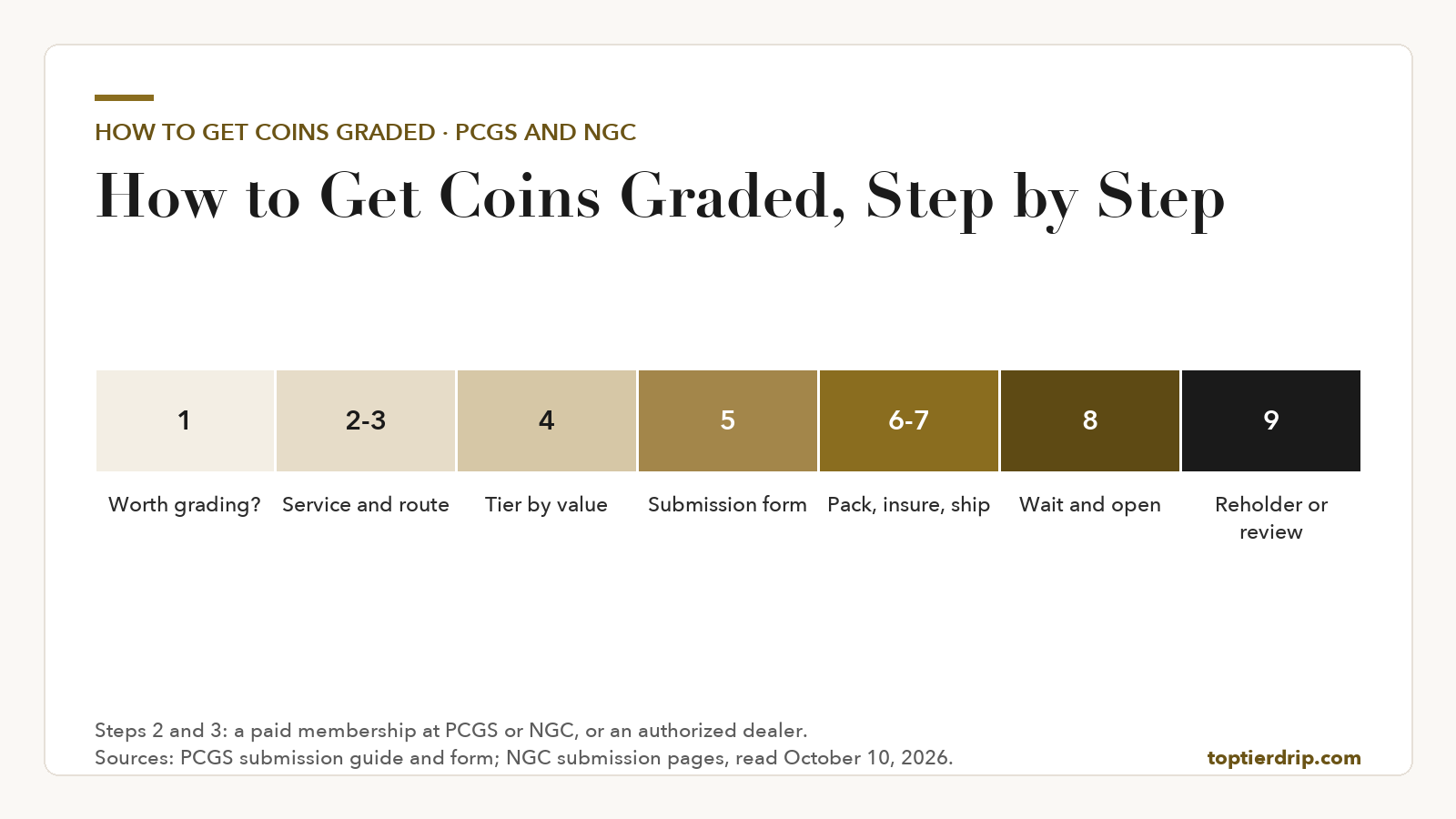
To get coins graded, become a submitting member of PCGS or NGC (or hand the coins to one of their Authorized Dealers), choose the service tier that fits each coin’s declared value, list the coins on the service’s submission form and mail them insured. Depending on the tier, they come back a week or two to a few months later, sealed in a holder with a grade and a certification number you can look up online. This guide on how to get coins graded walks through each step for modern coins such as American Eagles, with the fees and rules as both services published them on October 10, 2026.
As of October 10, 2026: sending coins straight to either service takes a paid membership: PCGS Collectors Club from $69 a year, NGC Associate at $39, or a free NGC submission membership for ANA members. Modern-coin tiers start at $17 (PCGS Modern Value, to $300 declared) and $20 (NGC Modern, to $3,000). Every package pays $10 handling plus insured return shipping, and estimated turnaround ranges from 7 working days (NGC Express) to 60 (NGC Modern).
How to get coins graded: the steps at a glance
- Decide whether the coin is worth grading once every fee is counted.
- Choose a grading service. For modern US coins that usually means PCGS or NGC.
- Choose your way in: your own membership, an Authorized Dealer, the ANA route at NGC, or a show.
- Pick the tier that matches each coin’s declared value and the wait you can accept.
- Fill in the submission form, online or on paper, one tier per form at PCGS.
- Pack each coin the way the service specifies and seal the box.
- Insure and ship with a carrier the service accepts, and keep the tracking number.
- Track the order and sign for the insured return.
- Check the holder, verify the certification number, and use reholder, regrade or crossover services later if needed.
Step 1: Decide whether the coin is worth grading
Grading adds a fixed bill to each coin, and part of that bill is the same whatever the coin is worth. NGC is open that value drives price: “Since NGC guarantees the authenticity and grade of coins that it certifies, it charges a higher fee for more valuable coins.” Add membership, handling and two-way insured postage and a single coin can cost far more than its tier fee.
The useful test is simple arithmetic. Work out the all-in cost per coin, then compare recent sold prices for the same coin graded and raw, sold prices rather than asking prices. Our Gold Eagle grading cost breakdown does the first half line by line, and our American Eagle gold grading guide covers when the grade itself tends to move the price.
Steps 2 and 3: Choose a service and a way in
PCGS and NGC are the two names most modern Eagle collectors meet first; our PCGS vs NGC comparison sets them side by side. A third option, CAC Grading, takes American Eagles of every metal dated 1986 to the present, charges $23 for its Modern Standard tier up to $3,000, and sells a $99 yearly club membership that includes $99 in grading credits.
There are four ways to get coins through the door, though not every one exists at every service:
- Your own membership. PCGS’s form says you “must be a Collectors Club member or PCGS Authorized Dealer to submit coins”; its levels run $69, $149 and $249 a year. NGC requires Associate ($39 a year) or higher.
- An Authorized Dealer. PCGS points non-members to its dealer list, NGC says many of its dealers take coins from the public, and CAC offers the same route. The services do not publish what dealers charge, so get the dealer’s price in writing.
- The ANA route. NGC, as the ANA’s official grader, gives ANA members a free submission membership.
- A show. PCGS lets club members drop off at select trade shows and lists a show-only Gold tier at $52 for US coins up to $5,500, with a 10-coin minimum. NGC takes member submissions by mail or at shows, and members cannot drop coins at its office.
Step 4: Pick the tier by declared value
The tier is set by what each coin is worth, not by your choice of speed alone. PCGS’s guide states that “Service Level is based on the declared value per item listed,” and no coin may exceed the cap of the tier you tick, though “You may select a higher service level for a quicker turnaround time.” Leave the value blank and PCGS writes in $50, which would leave a gold coin badly underinsured.
For modern coins, the main choices on October 10, 2026 were:
- PCGS: Modern Value $17 (to $300), Modern $30 (to $3,000, about 25 business days) and Express $70 (to $10,000, about 20 business days).
- NGC: Modern $20 (to $3,000, about 60 working days), Gold $45 for any gold coin to $5,000 (about 10), and Express $80 (to $10,000, about 7).
Use a realistic value for the day you ship; a 1 oz gold coin’s value moves with the metal and can push it into a higher tier. An appraisal is one way to document value for insurance, and our article on what an appraisal is and when you need one explains how that differs from a grade.
Step 5: Fill in the submission form
PCGS offers an Online Submission Center, which it calls “The most efficient way to submit your coins to PCGS,” and a printable 2026 paper form marked not valid after 12/31/26. The paper form allows one submission type at one service level per form, so a Modern order and an Express order need separate forms. On it you will:
- Choose Standard or Gold Shield as the service group, and decide what happens to a coin judged genuine but ungradable (Genuine with Details is the default).
- Choose Grading as the service type for raw coins, and tick the service level.
- List each coin, with its declared value, on its own line.
- Optionally set a minimum acceptable grade, and tick add-ons such as First Strike at $18 a coin.
NGC’s forms sit in your account under My Submissions. A single form holds up to 50 coins, and each coin needs a full description or NGC applies a $5 attribution fee to the whole submission. NGC takes credit cards only, no checks. Designations such as Early Releases cost the tier fee plus $18 and must be ticked on the form; see what First Strike and Early Releases labels mean before paying for one.
Steps 6 and 7: Pack, insure and ship
PCGS wants every raw coin in its own 2.5-inch-square mylar flip and refuses acrylic snap cases and cardboard-and-staple holders. Put a sticker on each flip showing the submission number and that coin’s line number on the form. PCGS asks you to tape the whole package, mark the service name on the outside without writing anything that hints at the contents, and use USPS Registered Mail for the safest delivery or FedEx to its street address. It takes no UPS or DHL shipments, and “Packages to PCGS must be insured.”
NGC warns that it rejects damaged or poorly sealed boxes and asks for reinforced shipping tape. An Express box gets EX written in large, bold letters on each side, and a box holding more than one tier is marked for the fastest one. Once a package is on its way, NGC will not change or cancel the order.
Insurance on the way in is your cost and your arrangement with the carrier; neither service prices it. The way back is priced on the form: PCGS charges from $27.00 for 1 to 4 coins and returns every order fully insured with a signature, while NGC charges from $30 for 1 to 10 coins and insures FedEx returns up to $100,000 a package.
Step 8: Wait, track and open the return box
The clock starts when the order is entered, not when you mail it; PCGS notes that its estimates leave out mailing time. Track a PCGS order on your PCGS account page. NGC shows progress under Submission Tracking and emails a carrier tracking number within a few hours of shipping your coins back. NGC’s customer service will not read grades out over the phone or by email.
What comes back is each coin sealed in the service’s holder with a label showing its grade and certification number. Mint packaging is not part of that. NGC returns capsules, certificates and boxes only if you order Return Mint Packaging at $5 per form, and warns that capsules cracked during removal are not returned. PCGS will not ship your order back in your own box.
Before anything else, look the certification number up. NGC tells owners to enter it in its Verify NGC Certification tool “to confirm the Coin’s grade and description,” and PCGS runs its own cert lookup; our guide to spotting a fake coin slab covers what to compare.
Step 9: Reholder, regrade, review or cross over
A graded coin is not locked in forever. Both services offer later work on coins already in a holder, priced as of October 10, 2026:
| Service | PCGS | NGC |
|---|---|---|
| New holder, same grade | $15 to $3,000; $25 to $50,000 | $15 to $10,000; $60 above |
| Regrade out of holder | Tier fee, plus 1% if upgraded | Tier fee |
| Review in holder | Reconsideration, tier fee | Appearance Review, $0 |
| Cross over | Tier fee, plus 1% if it crosses | Tier fee, PCGS slabs only |
At PCGS, regrade, reconsideration and crossover on modern coins use the same price list as first-time grading, $30 under Modern up to $3,000. The fee is due whether or not the grade improves, and success adds a Guarantee Premium of 1% of the coin’s value in its new grade, at least $10. Reconsideration leaves the coin in its holder unless it upgrades. A PCGS reholder never regrades the coin, and coins valued over $3,000 need Gold Shield to be reholdered, though PCGS’s guide gives $2,500 instead.
At NGC, ReGrade and CrossOver cost the normal tier fee and are not refunded if the grade does not rise; NGC places a ReGrade coin in a new holder with a new certification number even when the grade stays the same. CrossOver accepts only coins in PCGS holders. Appearance Review, for an NGC coin you believe is overgraded, carries no fee on the price list, though the guarantee says service and shipping fees may apply.
What each guarantee promises, and who can claim
PCGS writes: “All U.S. and World coins graded and encapsulated by PCGS are guaranteed genuine,” and “The grade of all U.S. and World coins graded and encapsulated by PCGS is guaranteed.” A buyer who thinks a PCGS coin is overgraded sends it through Guarantee Resubmission at $25 a coin, refunded if the coin is downgraded. If PCGS agrees, it either buys the coin at current market value for the original grade or pays the difference, and refunds the regrading fee, postage and insurance. If the grade stands, the owner pays the regrading fee and postage.
The key limit is who can use it. PCGS’s guarantee “does not apply to, and cannot be utilized by, the original submitter” or that submitter’s agents, employees, affiliates, family or representatives. It also excludes coins removed from the holder or in a tampered holder, and deterioration after certification, “including spotting on modern silver coins.” Claims must be brought in the courts of Orange County, California, and the page sets no time limit.
NGC guarantees that a coin in an NGC holder is genuine and “Not overgraded (meaning that it is not graded higher than NGC’s Grading Standards).” Claims go through Appearance Review, which does not require membership, and must reach NGC within ten years of the grading date; a ReGrade can extend that window. An original submitter may claim, but compensation “will not exceed the grading fee(s) actually paid for the certification of the Coin.” NGC also excludes damaged or opened holders, spots that develop after encapsulation, including red spots on some gold coins, and special designations such as Early Releases. The terms we read were revised June 2, 2026.
Frequently Asked Questions
How do I get my coins graded for the first time?
Pick a grading service, then either buy a submitting membership (PCGS Collectors Club from $69 a year, NGC Associate at $39 a year) or hand the coins to one of that service’s Authorized Dealers. Choose the tier that fits each coin’s declared value, complete the submission form online or on paper, pack each coin as the service asks and mail the box insured.
Can I send coins to PCGS or NGC without a membership?
Not directly. PCGS accepts coins from Collectors Club members and Authorized Dealers, while the lowest NGC level that can submit is the $39 Associate membership. The alternatives are to submit through an Authorized Dealer, or, at NGC, to use the free submission membership it offers ANA members.
How long does it take to get coins graded?
It depends on the tier. Estimates read October 10, 2026 ran from 7 working days for NGC Express to 60 for NGC Modern, with PCGS Modern at 25 business days and PCGS Express at 20. Mail time comes on top, and both services describe these as estimates rather than promises.
Can I get coins graded at a coin show?
Yes, at some shows. PCGS says Collectors Club members may drop off submissions at select trade shows, and lists a show Gold tier at $52 for US coins up to $5,500 with a 10-coin minimum. NGC accepts member submissions by mail or at shows, but not at its office.
What happens if my coin cannot be graded?
At PCGS the default is to return it in a holder with a Genuine with Details grade, or you can tick the box that says not to holder genuine-only coins; the full grading fee is charged either way. If you set a minimum grade and the coin falls short, PCGS returns it unholdered and still charges the fee.
Does the grading guarantee protect the person who submitted the coin?
Only partly at NGC and not at PCGS. NGC caps compensation to an original submitter at the grading fees actually paid. PCGS says its guarantee does not apply to, and cannot be used by, the original submitter or their agents, family or representatives; it is written for later buyers of the coin.
Sources
- PCGS Submission Guidelines — PCGS (Collectors Universe), read October 10, 2026
- PCGS U.S. Coin Submission Agreement (2026 form, Rev 8/26) — PCGS / Collectors Universe, read October 10, 2026
- PCGS Services (Coin Grading, Modern tab) — PCGS (Collectors Universe), read October 10, 2026
- PCGS Services (Coin Grading, Show tab) — PCGS (Collectors Universe), read October 10, 2026
- Join The PCGS Collectors Club — PCGS, read October 10, 2026
- PCGS Services (Crossover, Modern tab) — PCGS (Collectors Universe), read October 10, 2026
- PCGS Services (Reconsideration, Modern tab) — PCGS (Collectors Universe), read October 10, 2026
- PCGS Services (Reholder, Office tab) — PCGS (Collectors Universe), read October 10, 2026
- PCGS Guarantee of Grade and Authenticity – U.S. and World Coins — PCGS, read October 10, 2026
- NGC Services and Fees — NGC (Numismatic Guaranty Company), read October 10, 2026
- NGC Grading Tiers & Services for US and World Coins (collector price sheet) — NGC, dated March 17, 2026, read October 10, 2026
- Join NGC — NGC, read October 10, 2026
- General Submission FAQs — NGC Help Center, read October 10, 2026
- Shipping Collectibles to NGC (FAQs) — NGC Help Center, read October 10, 2026
- NGC Return Shipping Fees — NGC, posted 8/5/2025, updated 1/12/26, read October 10, 2026
- The NGC Guarantee — NGC, revised June 2, 2026, read October 10, 2026
- Coins Accepted (grading) — CAC Grading, read October 10, 2026
- Submission Pricing — CAC Grading, read October 10, 2026
- The CAC Grading Club — CAC Grading, read October 10, 2026
Grading standards, fees and policies are quoted from each organization’s own pages on the date shown and change often, so check the current terms before you submit, buy or sell. This article is general information, not investment, tax or legal advice. Top Tier Drip is not affiliated with any grading service, laboratory, mint or dealer named here and earns nothing from them.