
First Strike vs Early Releases is a difference of company and paperwork, not of coin: PCGS First Strike and NGC Early Releases both mark a coin that went to the grading service within roughly the first 30 days after the Mint released it, and both cost $18 a coin on top of the grading fee. Neither label says the coin was among the first struck or changes its grade; PCGS proves the timing with a postmark or a sealed Mint box, and NGC with the date the coin arrives. Here is how each label qualifies, how the release dates behind them are set, what First Day of Issue adds, and what the labels have and have not been worth on paper.
As of October 10, 2026: PCGS’s First Strike covers coins issued within 30 days of the Mint releasing them, at $18 per coin. NGC’s price sheet dated March 17, 2026 lists Early Releases and First Releases at the tier fee plus $18. For the 2026 proof Gold Eagles that went on sale March 5, 2026, PCGS’s First Strike cutoff was April 6, 2026. NGC’s First Day of Issue requires purchase within a day of first sale and arrival within a week. NGC settled a class action over its earlier “First Strikes” label by creating a $650,000 fund.
First Strike vs Early Releases at a glance
Five release designations turn up on Gold Eagle slabs. All of them describe timing; none of them is a grade.
| Label | Window | How it is proved |
|---|---|---|
| First Strike (PCGS) | Issued in the first 30 days | Postmark by the cutoff, or sealed Mint box |
| First Day of Issue (PCGS) | Release day | Rule not on the US pages we read |
| Early Releases (NGC) | Received within 30 days | Arrival at NGC or an approved depository |
| First Releases (NGC) | Same as Early Releases | Same; bulk only for Mint State Gold Eagles |
| First Day of Issue (NGC) | Bought within 1 day, received within a week | Purchase receipts |
The fee is identical at both services, $18 a coin on top of the grading tier, and paid membership vouchers at PCGS cannot be spent on it. Our Gold Eagle grading cost breakdown shows where that $18 sits in a full submission bill.
PCGS First Strike: the 30-day rule and two ways to qualify
PCGS states its rule in one line: “PCGS First Strike labels designate coins issued in the first 30 days* of the official release date.” The asterisk leads to an exception: in rare cases, PCGS says, coins issued more than 30 days before submission can still receive the designation.
There are two routes in. Either the package to PCGS is postmarked on or before the cutoff PCGS sets for that issue, or the coins arrive in the Mint’s original unopened shipping box with a postmark dated before the cutoff. In effect, the second route lets a buyer leave the coins in the unopened Mint box and send them after the cutoff, since the Mint’s own postmark carries the date. Asking for First Strike does not automatically bring the flag-style label, which PCGS offers free when its separate flag label guidelines are followed.
Two more PCGS rules matter for Gold Eagle buyers. PCGS asks for extra paperwork proving release and purchase dates on world coins only. And a coin graded elsewhere with an equivalent label is reviewed when it crosses into a PCGS holder; if approved, PCGS carries the designation over, for the First Strike fee. CoinFacts lists First Strike and First Day of Issue versions of even a bullion coin such as the 2024 $50 as separate entries.
NGC Early Releases and First Releases
NGC’s definition turns on arrival, not dispatch. Both names go on selected coins that NGC, or a depository it has approved, takes in during the 30 days after an issue is first released. NGC calls the two names interchangeable, with the same definition and cutoff dates, and adds that First30 is used synonymously with Early Releases. On NGC’s 2024 cutoff list, Early Releases was the default label unless the submitter asked for First Releases.
Packaging is not required. NGC says coins do not need to arrive in original packaging or sealed Mint boxes, but must reach it before the posted cutoff. Its notice for the 2026 proof Gold Eagles repeated that coins could come without US Mint packaging and had to go in under the Modern tier or higher.
Three conditions catch submitters out:
- Mint State Gold Eagles and First Releases. Under NGC’s rules, a Mint State American Gold Eagle sent in through a regular US submission cannot get First Releases; that version is kept for select bulk submitters. Early Releases remains open.
- Depository timing. Coins can be logged at an NGC-approved depository inside the window and graded later, but NGC’s 2024 cutoff list required them to be submitted within six months of the coin’s release date.
- NGC’s discretion. Eligibility is decided at NGC’s sole discretion, and NGC says it will disqualify a coin if it cannot reasonably determine the release date.
NGC lists Early Releases and First Releases coins separately in its census, so the labelled and unlabelled versions of a coin each carry their own population. Our PCGS vs NGC comparison sets these rules beside the two services’ fees and guarantees.
First Day of Issue at both services
First Day of Issue is a tighter test. At NGC, coins must be bought within one day of the first day the Mint offers the issue for sale and must reach NGC or an approved depository within one week of the release date, and the submitter must supply evidence, including purchase receipts, showing when the coins were bought. NGC usually limits the designation to bulk submitters or select trade shows, and charges a higher grading fee for it.
Some NGC First Day labels name a place, such as FIRST DAY – PHILADELPHIA. NGC is explicit that “These attributions relate solely to the US Mint location where the coins were purchased and not where they were struck.” A place name on the label is a shopping location, not a mint mark.
PCGS also issues First Day of Issue coins, and its CoinFacts catalog lists them separately. The US pages we read did not publish PCGS’s qualifying rule for coins. PCGS’s Asian arm announced its version in March 2017: coins had to be at its Shanghai or Hong Kong office by 10 am on the next business day after release, or be mailed with a postmark matching the release date. PCGS’s submission guide also says First Day of Issue or an equivalent will not be recognized when a coin crosses over from another service.
How release dates and cutoffs are set
Every one of these labels counts from a release date, so the date is the evidence. For Mint-direct products the Mint announces it: its press release for the 2026 proof Gold Eagles said sales would begin on March 5 at noon ET. PCGS then posts a table for each issue showing the release date, the ship date and the cutoff. For the 2026 proof one-ounce coin those were March 5, 2026, March 5, 2026 and April 6, 2026; for the 2026 Enhanced Uncirculated one-ounce, May 28, 2026, May 28, 2026 and June 30, 2026.
The two services can land on the same day. For the 2024 proof Gold Eagles, released May 2, 2024, PCGS’s First Strike cutoff was June 3, 2024, and NGC’s cutoff list gave June 3, 2024 for the same four coins.
NGC spells out two traps. A release date is not always the sale date, because many mints take orders before coins are released. And the release date “may be different from the date on the coin itself,” so a coin dated one year can be released the next. For proofs and burnished coins bought straight from the Mint, PCGS accepts the sealed, postmarked Mint box as evidence, while NGC goes by the day the coin arrives; our step-by-step coin grading walkthrough covers packing and sending them.
What the label does and does not tell you
A release label is a statement about timing. It is not a separate grade, a mint of origin, a mintage or a guarantee of value. The services’ own pages support each point:
- Not a better grade. NGC gives Early Releases and First Releases coins the same NGC Registry points as coins without the label. The MS or PF grade follows the same standard either way; our MS69 vs MS70 guide explains what that standard asks for.
- Not a limited edition. NGC warns that a number printed on a label implies no cap on the coin, the label, the grade or the designation.
- Not guaranteed. The NGC Guarantee leaves release designations, First Day of Issue included, outside its coverage, and puts the duty on the owner to send back a coin whose designation was assigned in error.
- Not a value opinion. When NGC launched Early Releases in December 2006, it said it offers no opinion on value and “leaves that to the marketplace.” PCGS, for its part, says First Strike “adds value to modern coins”; that is PCGS describing its own service.
Nor is a labelled coin necessarily scarce. Coin World’s Steve Roach described the First Strike era as one in which “original buyers send large quantities of coins directly to the grading services.” The PCGS figures below show the effect.
Do release labels change the price?
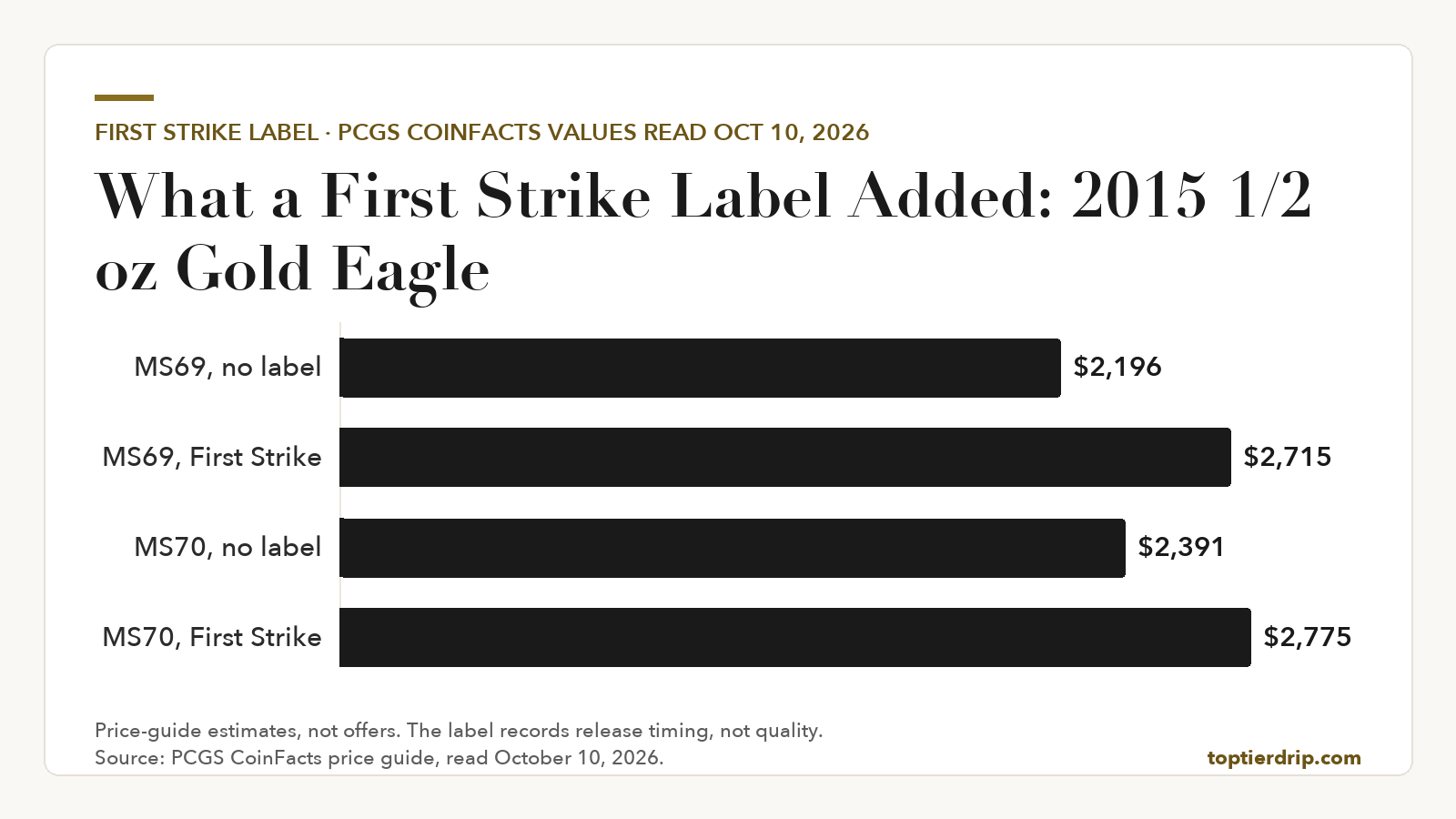
On PCGS’s price guide, sometimes. We read CoinFacts on October 10, 2026 for the 2015 half-ounce Gold Eagle with and without the First Strike label; the figure in brackets is PCGS’s graded count.
| 2015 $25, PCGS | MS69 (graded) | MS70 (graded) |
|---|---|---|
| No label | $2,196 (22) | $2,391 (300) |
| First Strike | $2,715 (78) | $2,775 (675) |
By our arithmetic the label carried a $519 guide premium in MS69 and $384 in MS70, more than the $195 the guide put between the two grades of the unlabelled coin. The labelled version is also the more common one in PCGS’s count, with 675 at MS70 against 300 without the label. Within the First Strike coins, MS70 sat only $60 above MS69.
Those are guide values for one issue, not sale prices, and a label premium is something buyers grant, not something the services promise. A buyer comparing a labelled and an unlabelled coin is choosing between two population counts and two price histories for the same strike, and the extra $18 per coin is the fixed part of that choice.
The First Strikes lawsuit and what changed
The meaning of these labels has been argued in court once. On November 7, 2006, collector Thomas Francisco sued NGC in the U.S. District Court for the Southern District of Florida. According to the American Numismatic Association, the class action alleged that buyers believed bullion coins NGC labelled “First Strikes” were among the first coins struck by the Mint and were therefore worth more than the same coins in the same grade without the label.
NGC denied liability. It said its definition was published on its website, that complaints were lacking, and that competitors had already used the term for coins released by the Mint within 30 days. In December 2006 NGC replaced the name with Early Releases and announced it would discontinue First Strikes. The case went to mediation on June 21, 2007, and under the settlement NGC agreed to stop using First Strikes unless coins were certified as among the first struck at a ceremonial striking on the Mint’s first day of minting, and to fund a $650,000 settlement. After fees and the class representative’s award, the ANA received $447,095.26 in February 2008 for collector education. NGC admitted no wrongdoing.
The ANA release covers the NGC case only. PCGS still uses the First Strike name and defines it on its own site by the 30-day issue window. We found no regulator action on release labels in the sources we could read. Where these labels sit among everything else a slab records, from the grade to the strike type, is laid out in our American Eagle gold grading overview for collectors.
Frequently Asked Questions
Is First Strike the same as Early Releases?
In practice they cover the same idea at two different companies. First Strike is the PCGS name for coins issued within about 30 days of release; Early Releases is NGC’s name for coins that arrive at NGC, or at a depository it approves, inside a 30-day window from release. NGC also sells First Releases, which it treats as the same designation under another name.
Does First Strike mean the coin was struck first?
No. Neither service says the coin was among the first struck. The labels record when the coin was sent to or reached the grader, measured from the Mint’s release date. NGC dropped its own First Strikes name in December 2006 and settled a class action over it.
Are First Strike coins worth more?
Sometimes on price guides, but neither service promises it. PCGS’s guide, read October 10, 2026, put a 2015 half-ounce First Strike at $2,715 in MS69 against $2,196 for the same coin without the label. NGC says it offers no opinion on value and leaves that to the market, and guide values are not sale prices.
How much does a First Strike or Early Releases label cost?
Each was $18 per coin on top of the grading tier when we checked on October 10, 2026: PCGS lists First Strike as an $18 add-on, and NGC’s March 17, 2026 price sheet lists Early Releases and First Releases at tier plus $18. PCGS vouchers cannot be used for the First Strike fee.
What does First Day of Issue mean on a coin label?
At NGC it means the coin was bought within one day of the Mint first offering it for sale and reached NGC or an approved depository within a week, backed by purchase receipts. NGC usually offers it only for bulk submissions or at shows. PCGS also lists First Day of Issue coins, but the US pages we read did not publish its qualifying rule.
Does an Early Releases label survive a crossover to PCGS?
It can. PCGS says it will review designations such as First Strike or an equivalent on crossover submissions and carry them over if approved, for an extra fee, but it will not recognize First Day of Issue or an equivalent on crossovers.
Sources
- PCGS FirstStrike — PCGS (Collectors Universe), read October 10, 2026
- PCGS Special Labels — PCGS, read October 10, 2026
- PCGS Submission Guidelines — PCGS, read October 10, 2026
- Join The PCGS Collectors Club — PCGS, read October 10, 2026
- 2024 $50 Gold Eagle (Regular Strike) — PCGS CoinFacts, read October 10, 2026
- 2015 $25 Gold Eagle First Strike (Regular Strike) — PCGS CoinFacts, read October 10, 2026
- 2015 $25 Gold Eagle (Regular Strike) — PCGS CoinFacts, read October 10, 2026
- PCGS Introduces First Day of Issue designation — PCGS Asia, March 14, 2017, read October 10, 2026
- NGC Releases Designations — NGC (Numismatic Guaranty Company), read October 10, 2026
- NGC Grading Tiers & Services for US and World Coins (collector price sheet) — NGC, dated March 17, 2026, read October 10, 2026
- NGC Special Labels and Designations for the 1776-2026-W Proof Gold Eagles — NGC, posted 2/26/2026, read October 10, 2026
- 2024 US Early and First Releases Cutoff Dates — NGC, posted 12/29/2024, read October 10, 2026
- NGC Offers Early Releases Pedigree for U.S. Bullion Coinage — NGC, posted 12/14/2006, read October 10, 2026
- The NGC Guarantee — NGC, revised June 2, 2026, read October 10, 2026
- ANA Receives $447,095 Donation: Settlement from Francisco v. NGC Will Support Education — American Numismatic Association press release, February 20, 2008, read October 10, 2026
- 2026 United States Mint American Eagle Gold Proof Coins on Sale March 5 — United States Mint press release, March 5, 2026, read October 10, 2026
- 1 of 13 MS-70 1989 gold Eagle $50 coins sells — Steve Roach, Coin World, March 28, 2016, read October 10, 2026
Grading standards, fees and policies are quoted from each organization’s own pages on the date shown and change often, so check the current terms before you submit, buy or sell. This article is general information, not investment, tax or legal advice. Top Tier Drip is not affiliated with any grading service, laboratory, mint or dealer named here and earns nothing from them.