
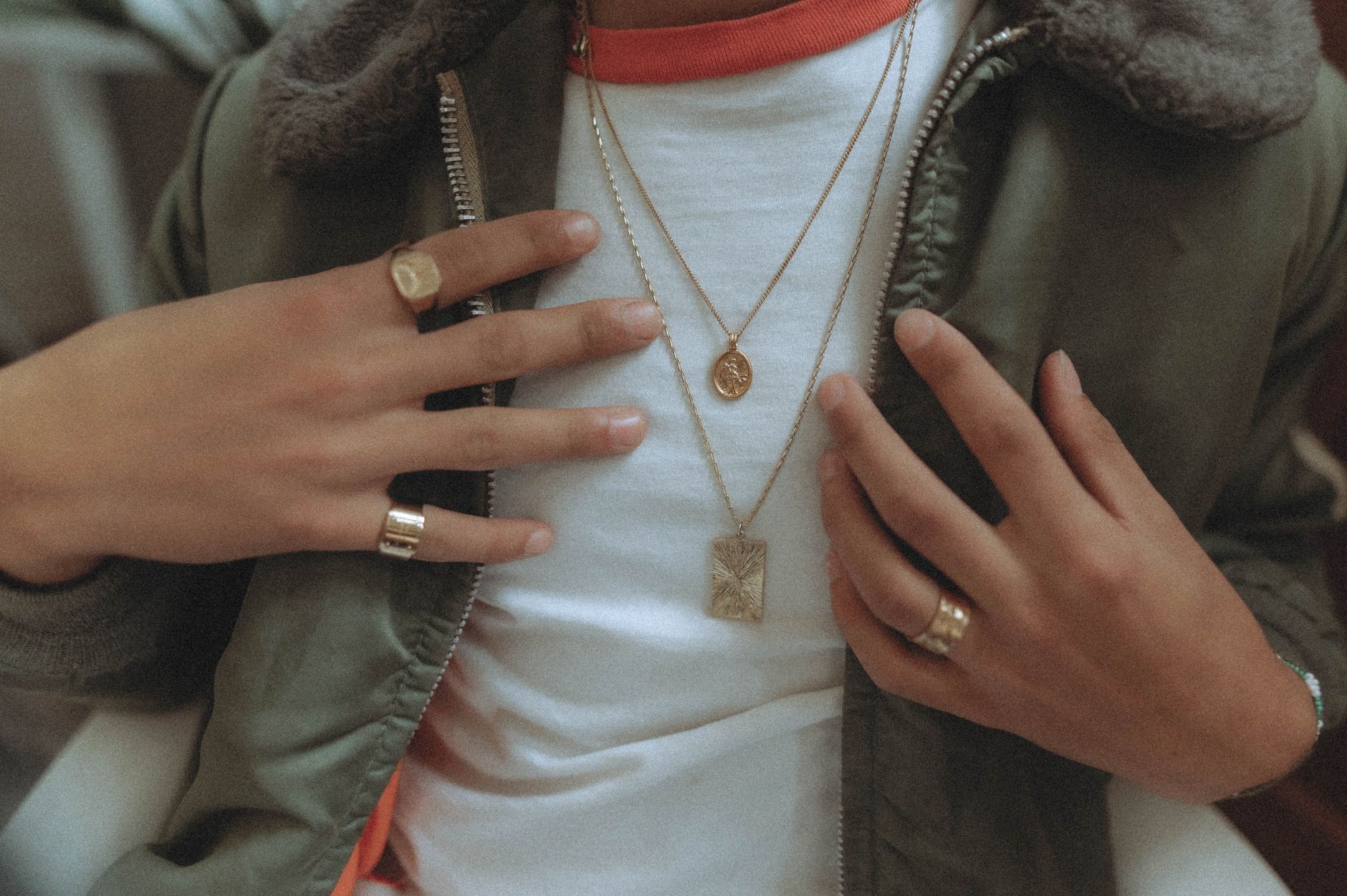
A 14K gold chain necklace holds roughly $66 to $69 of gold per gram right now, and that is the melt value — the worth of the metal alone. At retail you will pay far more, commonly $130 to $250 per gram for a finished chain, and if you sell one you should expect $33 to $62 per gram. Those three numbers answer the same question from three different sides, and the gap between them is the whole story. "14K" means the alloy is 14 parts gold out of 24, or 58.3% pure, so a gram of a 14K chain carries a little over half a gram of actual gold.
Table of Contents
- The arithmetic behind the $67 figure
- Why two websites quote different prices on the same day
- "This year" has no single answer
- What you actually pay, and what you actually get
- Hollow chains break the per-gram comparison
- Why the stamp is a usable input
- Frequently Asked Questions
The arithmetic behind the $67 figure
Every 14K per-gram quote starts from the spot price of pure gold. On November 20, 2026, spot sat near $3,526.90 per troy ounce, which Kitco's gold chart puts at $113.39 per gram of 24K. Multiply that by 0.583 and you get the 14K melt value.
That calculation produced about $66 to $69 per gram in mid-November 2026, with MeltValue quoting $69.02 per gram on a 58.33% basis and Gold Buyers USA showing $66.35 per gram from a slightly lower spot feed. You can run it yourself in one step: take any current 24K per-gram price and multiply by 0.583. A 20-gram 14K chain at November's level holds roughly $1,340 of gold.
Why two websites quote different prices on the same day
Published 14K quotes on November 19–20, 2026 ranged from $69.14 per gram at goldpricez down to $66.35 at Gold Buyers USA, with GoldPrice.com in between at $67.45. Nothing is wrong with any of them. Three variables explain the spread.
Each site pulls a different spot feed, each refreshes at a different moment in a market that moves all day, and they do not agree on the purity constant — GoldPrice.com uses 58.5% rather than the 58.3% that 14/24 actually gives. The practical takeaway: a few dollars per gram of disagreement is normal noise, not a better or worse deal. When a buyer quotes you a per-gram price, ask which spot price and which time they used.
"This year" has no single answer
Anyone pricing a chain against a 2026 average will be badly wrong. The LBMA PM gold fix peaked at $5,405 per ounce on January 29, 2026, with spot touching about $5,595 — roughly $101 to $105 per gram of 14K, as recorded in market reporting on the all-time high. By mid-November the LBMA PM price was reported at $3,890.85 per ounce, down 10.9% year-to-date and 28.0% below the January record.
A chain bought at the peak had lost about a third of its metal value inside ten months. So the honest framing is a date, not a year. A quote from January and a quote from November describe two different markets, and an older "14K price per gram" page is not a stale detail — it is off by a third.
What you actually pay, and what you actually get
Retail prices sit well above melt because you are buying manufacturing, design, brand and margin alongside metal. Jewelry-trade guidance puts machine-made 14K chains at roughly 20% to 50% over melt, while finished 14K jewelry commonly runs 1.5× to 5× melt — retail guides quote $130 to $250 per gram against that ~$67 melt base.
Selling runs the opposite direction. Reputable buyers and refiners typically pay about 70% to 90% of melt, and pawn shops 50% to 70%, which in November 2026 meant roughly $33 to $62 per gram. Before you accept either number, check these:.
- Ask the buyer to state their payout as a percentage of melt, not just a dollar figure.
- Weigh the piece yourself; clasps and non-gold findings may not be paid on.
- Confirm the karat stamp, since purity drives everything downstream.
- Compare at least two offers on the same day, because spot moves.
Hollow chains break the per-gram comparison
Per-gram math only works when you know the grams, and for chains you often do not. Major retailers list 14K rope chains by width and length and never publish a gram weight — a 20-inch 3mm Macy's sparkle rope at $1,020 and a 20-inch 2.9mm hollow Zales rope at $1,884.35 cannot be reduced to a price per gram without a scale. Hollow construction is the reason.
A hollow chain looks as wide as a solid one and weighs a fraction as much, so two visually similar 20-inch ropes can hold very different amounts of gold at very different prices. Width and length tell you how a chain wears, not what it contains. If the listing gives no weight, ask for it in writing before buying, and treat the stated millimeter width as a style note rather than a value input.
Why the stamp is a usable input
The purity number is not a convention jewelers chose informally. The FTC's Guides for the Jewelry, Precious Metals, and Pewter Industries, 16 CFR Part 23, bar describing an article as gold with a karat quality mark when the alloy is under 10 karat throughout.
That is what makes a stamped "14K" a legally governed claim rather than marketing, and why 58.3% is a defensible figure to plug into the calculation. The stamp is the input the entire per-gram chain of math rests on — so on an unstamped piece, ask for an acid or XRF test before anyone quotes you a per-gram price at all.
Frequently Asked Questions
How do I convert a 24K price to a 14K price per gram?
Multiply the 24K per-gram price by 0.583. At the $113.39 per gram Kitco showed on November 20, 2026, that gives about $66 per gram of 14K.
Will a jeweler buy my chain for the melt value?
Almost never. Buyers and refiners pay about 70% to 90% of melt and pawn shops 50% to 70%, since they carry refining costs and resale risk.
Does a wider chain mean more gold?
Not reliably. A hollow chain can match a solid one's width while weighing far less, so weight in grams is the only figure that tracks gold content.