
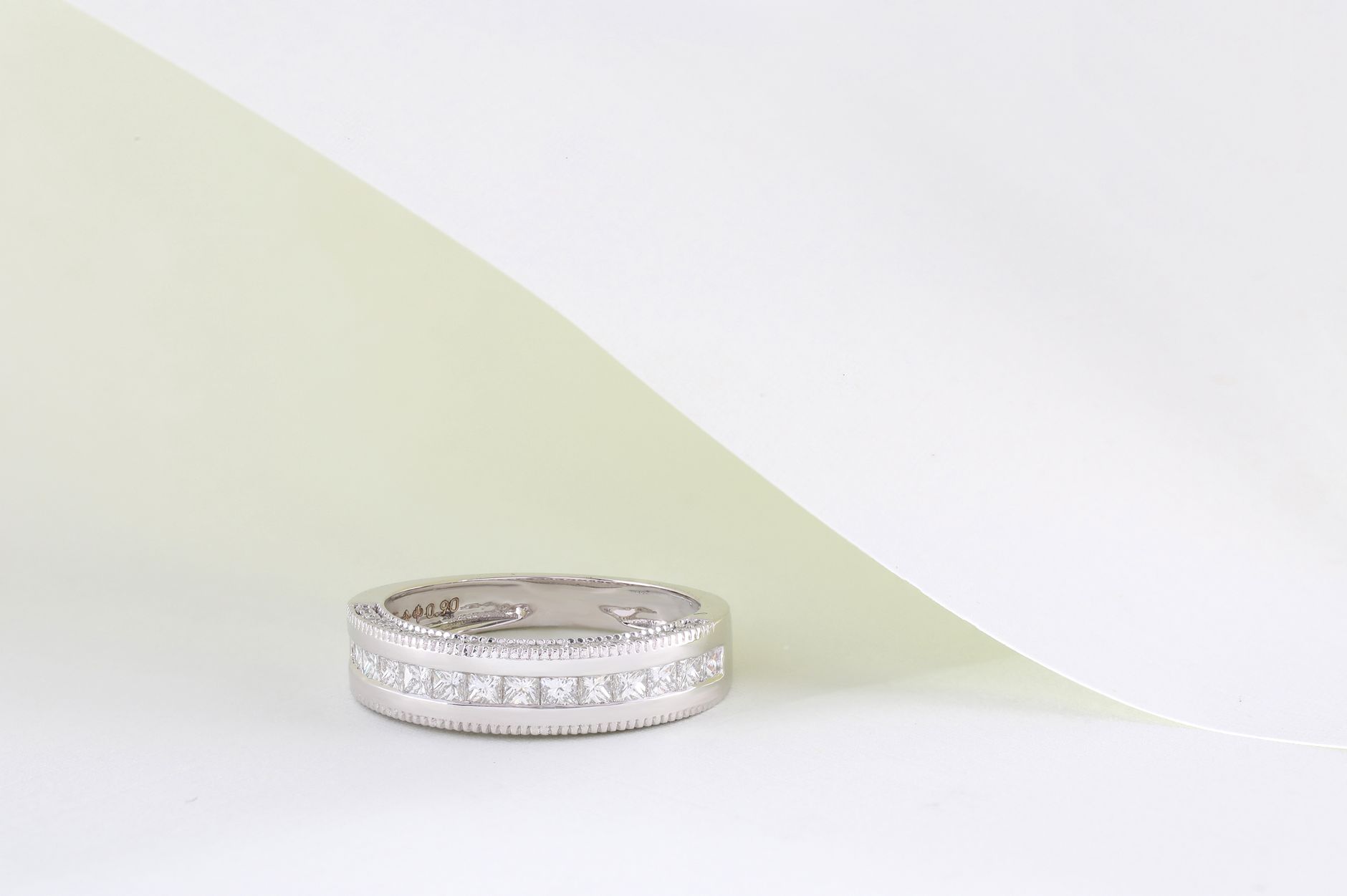
The only safe way to clean a ring with baking soda is to limit it to a plain, solid, unplated silver or gold band with no stones, use it as a brief wet paste rather than a dry scrub, and rinse and dry it immediately. For anything with a set stone, plating, or a coated finish, skip the baking soda entirely and use warm water with a drop of mild dish soap and a soft, new toothbrush, which removes everyday skin oil and soap film just as well.
That caution is not squeamishness about a kitchen staple. Sodium bicarbonate is a mild abrasive — Arm & Hammer's own industrial arm, ARMEX, sells it as a blasting medium for stripping coatings, and the jewelry insurer Jewelers Mutual lists it among the homemade-cleaner ingredients to avoid. A ring is worth more than the five minutes the paste saves.
Table of Contents
- Which rings can take baking soda, and which cannot
- The abrasive question, in numbers
- A careful method for a plain silver or gold band
- The aluminum-foil bath and why it is not for rings
- What to do instead, and when to hand it over
- Frequently Asked Questions
Which rings can take baking soda, and which cannot
Baking soda's one genuine use on jewelry is removing tarnish from solid silver. Arm & Hammer's own method is a silver-polishing paste: roughly half a box of baking soda mixed with water until it is "not runny but thoroughly wet," rubbed on with a sponge or cloth, left 30 seconds for light tarnish or up to 10 minutes for heavy tarnish, then rinsed in cool water and buffed dry. That recipe appears on Arm & Hammer's silver-polishing page as a silverware treatment, not a gemstone cleaner — a distinction worth holding onto. Three categories should never meet the paste.
Plated and coated bands are first: Jewelers Mutual's rose gold guidance says plainly, "Do not use abrasive materials (like steel wool soap pads, abrasive scrubbing tools or baking soda) or harsh chemicals, as these can scratch or damage the surface." The same logic covers rhodium-plated white gold, gold vermeil and any brushed or matte finish, because the finish is a thin surface layer and an abrasive takes surface layers off. Second are porous and organic materials. The Gemological Institute of America, which grades diamonds and trains gemologists, says porous stones such as coral and turquoise and delicate pearls — natural or cultured — "should always be kept away from any chemicals," and its turquoise guidance forbids steam and ultrasonic cleaning outright. Third is any setting at all, because the paste collects under a stone and around prongs, where you cannot see it or fully rinse it out.
The abrasive question, in numbers
Baking soda rates about 2.5 on the Mohs scratch scale, the 1-to-10 hardness ranking where talc is 1 and diamond is 10. ARMEX markets it as "the softer blasting abrasive" for sensitive substrates, with granules of 70 to 270 microns, soft enough that soda-blast nozzles can be made of brass. Soft for an industrial abrasive is still an abrasive.
Compare that to what you are cleaning. Fine silver and pure gold sit around 2.5 to 3 on the same scale; sterling and karat gold alloys are somewhat harder but still well under 4. A particle at 2.5 cannot scratch a diamond at 10, which is precisely why the metal is the vulnerable part — GIA warns that chlorine bleach or abrasives "such as household cleansers or toothpaste" should never be used on diamonds, "especially those set in jewelry," because "these types of products can erode some of the metals often used in diamond settings." Softer stones are at direct risk from the powder itself. Jewelers Mutual notes that baking soda "could scratch softer stones and metals" — the practical casualties are opal, pearl, turquoise, moonstone, amber and emerald, all of which sit below or near baking soda's effective working hardness once you factor in fractures and surface treatments.
A careful method for a plain silver or gold band
If the ring is a solid, unplated, stoneless band and it is tarnished, this is the low-risk version of the job: Two variants circulate online and both deserve a flat no. Mixing baking soda with vinegar produces an impressive fizz and a weaker cleaner: the acid and the base neutralize each other, so the resulting paste is less effective than either ingredient alone, and Jewelers Mutual separately warns that acidic ingredients like vinegar "can damage soft stones." Toothpaste, which many people reach for as a substitute, is the exact product GIA names as an abrasive to avoid.
- Mix a small amount of baking soda with water into a wet paste. Thin is better than thick; a stiff paste is a higher concentration of grit against the metal.
- Apply with a soft cloth or sponge, not a brush. Jewelers Mutual specifically flags that old toothbrushes scratch metal, and a stiff-bristled brush drives particles across the surface rather than lifting tarnish off it.
- Work with light pressure and no circular scrubbing. Let contact time do the work: 30 seconds for light tarnish, longer only for heavy tarnish.
- Rinse thoroughly in cool water, including inside the band, then dry and buff with a soft cloth. Residue left in a crevice keeps abrading every time the ring moves.
- Inspect under good light. A dulled or hazy patch means you have already removed a micro-layer of metal, and the next pass will remove more.
The aluminum-foil bath and why it is not for rings
The no-scrubbing version of the baking soda trick is electrochemical rather than mechanical. A Johns Hopkins materials scientist described baking soda, hot water and aluminum foil lifting tarnish from silver with "minimal muscle power", as electrons flow between the silver and the foil and sulfur transfers to the aluminum; the recipe traces back to a consumer pamphlet from what is now the National Institute of Standards and Technology. For a tray of tarnished flatware, it works. For a ring, the limitations bite hard.
Dragging the piece across foil still scratches it, the bath attacks plating, and it cannot safely include a set stone — a heated alkaline soak is the wrong environment for an emerald, an opal, a pearl or any stone held in place by adhesive or sitting in a closed setting. The method also requires full metal-to-foil contact, which an irregularly shaped band makes hard to achieve evenly. There is also a cosmetic cost that applies to both baking soda methods. Many silver rings are intentionally oxidized in their recessed areas for contrast, and tarnish removal does not distinguish between the oxidation you want and the tarnish you do not. A uniformly bright ring can read as flatter and cheaper than the piece you bought.
What to do instead, and when to hand it over
For the routine problem — a film of skin oil, lotion, soap and hand cream dulling a ring — the insurer's own recommendation for an engagement ring is "mild dish soap and warm water with a soft, new toothbrush," rinsed and dried. GIA gives essentially the same instruction for most colored gemstones: warm water, mild dish soap with no detergents, and a soft brush. Soap lifts oil, which is what is actually on the ring; abrasives remove material, which is not.
Tarnish is a different problem from dirt, and that is the one genuine reason to consider baking soda. But a silver polishing cloth impregnated with a tarnish remover does the same job with far less grit, and for a ring with any stone in it, a jeweler's professional cleaning costs little and carries no risk of a scratched setting. Build in a check regardless of method. GIA recommends having jewelry examined by a jeweler roughly every six months — that visit catches a loose prong or a worn shank before a stone drops out, and a prong already thinned by repeated abrasive cleaning is exactly the kind of failure a six-month inspection exists to find.
Frequently Asked Questions
Can I use baking soda on a diamond engagement ring?
No. The diamond itself is unscratchable by baking soda, but GIA warns that abrasives can erode the metals used in diamond settings — and paste trapped under the stone cannot be fully rinsed out. Use warm water, mild dish soap and a soft, new toothbrush.
How often is it safe to clean a silver ring with baking soda?
Treat it as an occasional tarnish remedy, not a routine. Each pass removes a thin layer of metal, so reserve it for visible tarnish and use soap and water for everyday film.
Is baking soda safe for gold-plated or rhodium-plated rings?
No. Jewelers Mutual rules out baking soda for rose gold specifically because abrasives scratch or damage the surface, and the same reasoning applies to any plated or coated band, where the finish is only microns thick.
Why do so many guides recommend baking soda and vinegar together?
Because the fizzing looks like it is working. The acid and base neutralize each other, leaving a weaker cleaner than either alone, and Jewelers Mutual warns that vinegar can damage soft stones.