
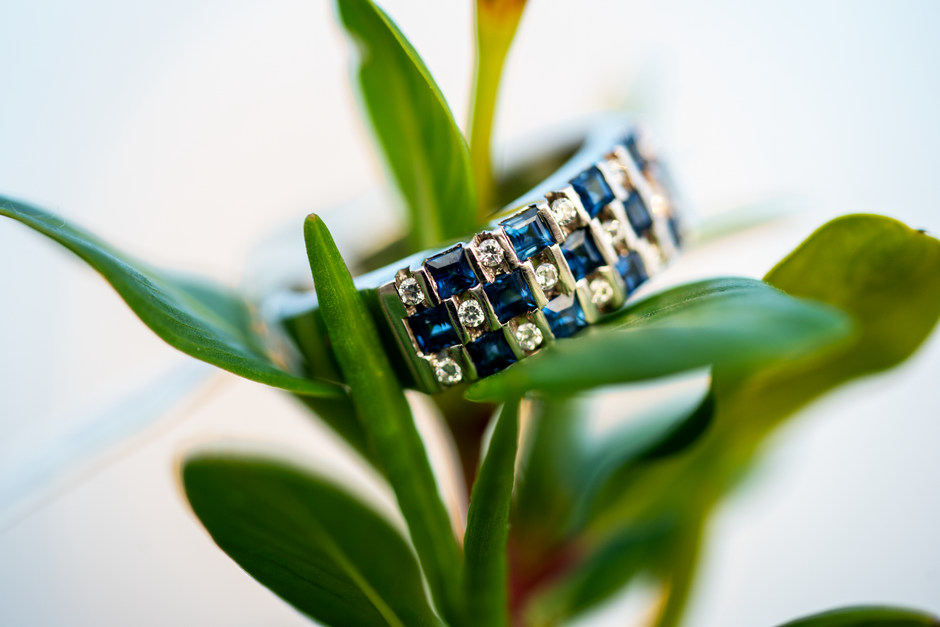
Almost every sapphire on the market has been heated, and that is normal. The questions that decide price are which colour you are buying, whether the treatment goes beyond ordinary heat, and whether any origin or “unheated” claim is backed by a laboratory report rather than a sales sheet.
What sapphire is
Sapphire is gem-quality corundum — aluminium oxide — and it sits at 9 on the Mohs scale, second only to diamond among common gem materials. Corundum coloured red is called ruby; every other colour is sapphire, qualified by hue: blue sapphire, pink sapphire, yellow sapphire, green, violet, and the pinkish-orange padparadscha. Colourless corundum exists too.
That hardness is why sapphire is a sensible daily-wear stone. It resists the fine scratching that dulls softer gems, and it tolerates ordinary bench heat during repairs better than emerald or opal do.
Colour is most of the price
Colour in coloured stones is judged on three components, and sellers usually quote only the first:
- Hue — the basic colour, plus its modifiers. A blue sapphire may be pure blue, violetish blue or greenish blue; green modifiers usually reduce value.
- Tone — how light or dark. Very dark stones read as near-black in ordinary light; very light ones look washed out.
- Saturation — how vivid the colour is. This is what separates a good stone from an ordinary one at the same hue and tone.
Look at any stone in more than one light: daylight, indoor lighting and shade. Sapphires can shift noticeably, and a stone that only performs under a jeweler’s spotlight will disappoint on a normal day. Extreme zoning — bands of colour visible face-up — lowers value even when the overall impression is good.
Heat, and the treatments that are not just heat
Ordinary heat treatment improves colour and clarity, is stable, and is so widespread that unheated material carries a premium precisely because it is unusual. Other treatments are different in kind:
| Treatment | Stability | Effect on price |
|---|---|---|
| Conventional heat | Permanent | The market default; unheated commands a premium |
| Lattice (beryllium) diffusion | Permanent, but colour is added from outside | Substantially lower value; must be disclosed |
| Surface diffusion | Colour is only skin-deep; re-polishing can remove it | Much lower value |
| Glass or lead-glass filling | Not permanent — damaged by heat and some chemicals | Far lower value; special care required |
The FTC Jewelry Guides require disclosure of treatments that are not permanent, that create special care requirements, or that significantly affect value. All four rows above meet at least one of those tests, so a seller who says nothing about treatment is not meeting the standard — ask directly and get the answer in writing.
Laboratory-created sapphire
Synthetic corundum has been produced commercially for more than a century and is chemically the same material. It is not a fake, but it must be disclosed clearly and conspicuously as laboratory-created or laboratory-grown, and it is worth a fraction of natural stone. Very clean, very saturated stones at unusually low prices are the ones to question.
Origin claims need paperwork
Kashmir, Burmese (Myanmar) and Ceylon (Sri Lankan) origins carry significant premiums. Origin determination is a laboratory opinion based on inclusions and trace-element chemistry, it is not always conclusive, and it cannot be established by looking at the stone in a shop. If origin is part of what you are paying for, insist on a report from a laboratory that issues origin opinions, and check that the report describes the stone in front of you — measurements and weight should match. The same discipline applies to any “GIA tested” claim made in a listing.
Setting and care
At Mohs 9, sapphire suits prong settings and daily wear. Clean with warm water, mild soap and a soft brush. Ultrasonic and steam cleaning are generally safe for untreated and conventionally heat-treated stones — and are not safe for glass-filled or fracture-filled material, which is one more reason to establish the treatment before you buy. If the stone is set alongside softer gems, treat the whole piece as being as fragile as its weakest stone, following the same logic as the halo ring cleaning rules.
Frequently asked questions
Are heated sapphires worth buying?
Yes. Conventional heat is stable, permanent and applies to the great majority of sapphires sold. It should still be disclosed, and unheated stones are priced higher because they are rarer, not because heated stones are defective.
How can I tell if a sapphire is real?
Not reliably by eye. Hardness, refractive index and inclusion patterns separate natural corundum from synthetics and simulants, and that is laboratory work. For any significant purchase, buy with a report or with a return period long enough to obtain one.
What is a padparadscha sapphire?
A pinkish-orange sapphire, traditionally from Sri Lanka. The colour range is narrow and debated, prices are high, and laboratories differ on where the boundaries lie — so the report matters more than usual.
Is a star sapphire less valuable?
Not necessarily. Asterism comes from oriented needle inclusions, and a sharp, well-centred star in a good body colour is desirable in its own right. The stone will be cut as a cabochon rather than faceted.
Sources
- GIA — sapphire quality factors — hue, tone and saturation; treatment types; Mohs hardness of corundum.
- FTC Jewelry, Precious Metals, and Pewter Industries Guides, 16 CFR Part 23 — treatment and laboratory-created disclosure requirements.