
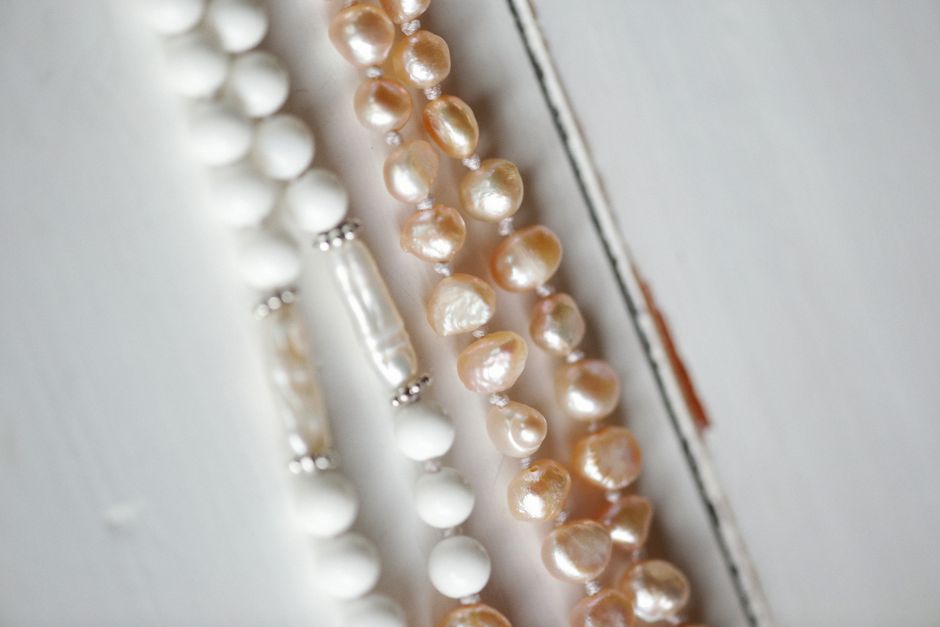
Luster is the whole game with pearls. Size and roundness are easy to see and easy to price; luster is what makes a strand look alive across a room, and it comes directly from the thickness and quality of the nacre. Everything else is secondary.
What a pearl is made of
A pearl is nacre: microscopic platelets of aragonite bound by an organic protein, conchiolin, deposited in layers by a mollusc. Light entering those layers is reflected and refracted between them, which is why good nacre has depth rather than a painted-on shine.
Pearls are soft — roughly 2.5 to 4.5 on the Mohs scale — and the organic component makes them vulnerable to acids, solvents and drying. That is why pearl care rules read differently from every other gem.
The four types you will be offered
| Type | Typical size | Character |
|---|---|---|
| Akoya | Small to medium | Saltwater, bead-nucleated; the classic round white strand with sharp luster |
| Freshwater | Wide range | Usually tissue-nucleated, so often solid nacre; huge variety of shapes and colours |
| Tahitian | Medium to large | Naturally dark — grey, green, aubergine, peacock overtones |
| South Sea | Large | White or golden, thick nacre, satiny rather than sharp luster |
Nearly all pearls sold today are cultured, meaning the process was started deliberately. That is not a defect and it is normal — but the FTC Jewelry Guides require that cultured pearls be described as such, and that imitation pearls never be called pearls without qualification. If a listing just says “pearl” at a very low price, ask whether it is natural, cultured or imitation, and get the answer in writing.
Nacre thickness is the hidden variable
A bead-nucleated pearl is a shell bead with nacre grown over it. Thin nacre gives a pearl that looks acceptable in the shop and wears through at the drill hole within a few years, sometimes showing the bead beneath. Thick nacre lasts and looks deeper. Two practical checks:
- Look at the drill hole under magnification. A visible boundary between a chalky core and a thin outer layer is bad news.
- Roll the strand under a point light source. Sharp, well-defined reflections indicate good nacre; a soft, milky look often means thin or poorly formed nacre.
Tissue-nucleated freshwater pearls are frequently solid nacre throughout, which is why a modest freshwater strand can outlast a more expensive thin-nacre saltwater one.
The value factors, in the order that matters
- Luster — sharpness and depth of reflection.
- Surface quality — how few blemishes, pits and ridges.
- Shape — perfectly round is rarest; drops, ovals and baroques cost less and can be more interesting.
- Colour — body colour plus overtone. Some colours are dyed or irradiated, which must be disclosed.
- Size — measured in millimetres; price climbs steeply at the top of each type’s range.
- Matching — on a strand, consistency of all of the above across every pearl.
Care that actually preserves them
- Last on, first off. Perfume, hairspray, cosmetics and even ordinary sweat contain acids that etch nacre.
- Wipe after wearing with a soft, slightly damp cloth, then let them dry before storing.
- Never use an ultrasonic or steam cleaner, and never any product containing ammonia, bleach or solvents.
- Store separately and not airtight. Pearls dry out in a sealed vault or a safe with desiccant, and they scratch against harder gems.
- Restring periodically if worn often — silk stretches and soils, and a knot between each pearl means a broken strand loses one pearl, not all of them.
Frequently asked questions
Are cultured pearls real pearls?
Yes. They are nacre grown by a mollusc, started by human intervention. They must be disclosed as cultured — the distinction the FTC guides care about is between natural, cultured and imitation.
How can I spot imitation pearls?
The traditional tooth test — real nacre feels slightly gritty against a tooth edge, glass and plastic feel smooth — is a rough indicator, not proof. Weight, drill-hole appearance and temperature against the skin all help, but a laboratory is definitive.
Why did my pearls turn dull?
Usually surface damage from cosmetics, perfume or perspiration, or nacre worn thin. Light dullness sometimes improves with careful cleaning; etched or worn nacre does not come back.
Are dyed pearls a problem?
Not if disclosed. Dyeing and irradiation are common for colour, and both must be disclosed under the FTC guides because they significantly affect value.
Sources
- GIA — pearl description and quality factors — nacre structure, pearl types and the value factors used to grade them.
- FTC Jewelry, Precious Metals, and Pewter Industries Guides, 16 CFR Part 23 — natural, cultured and imitation pearl terminology and treatment disclosure.