
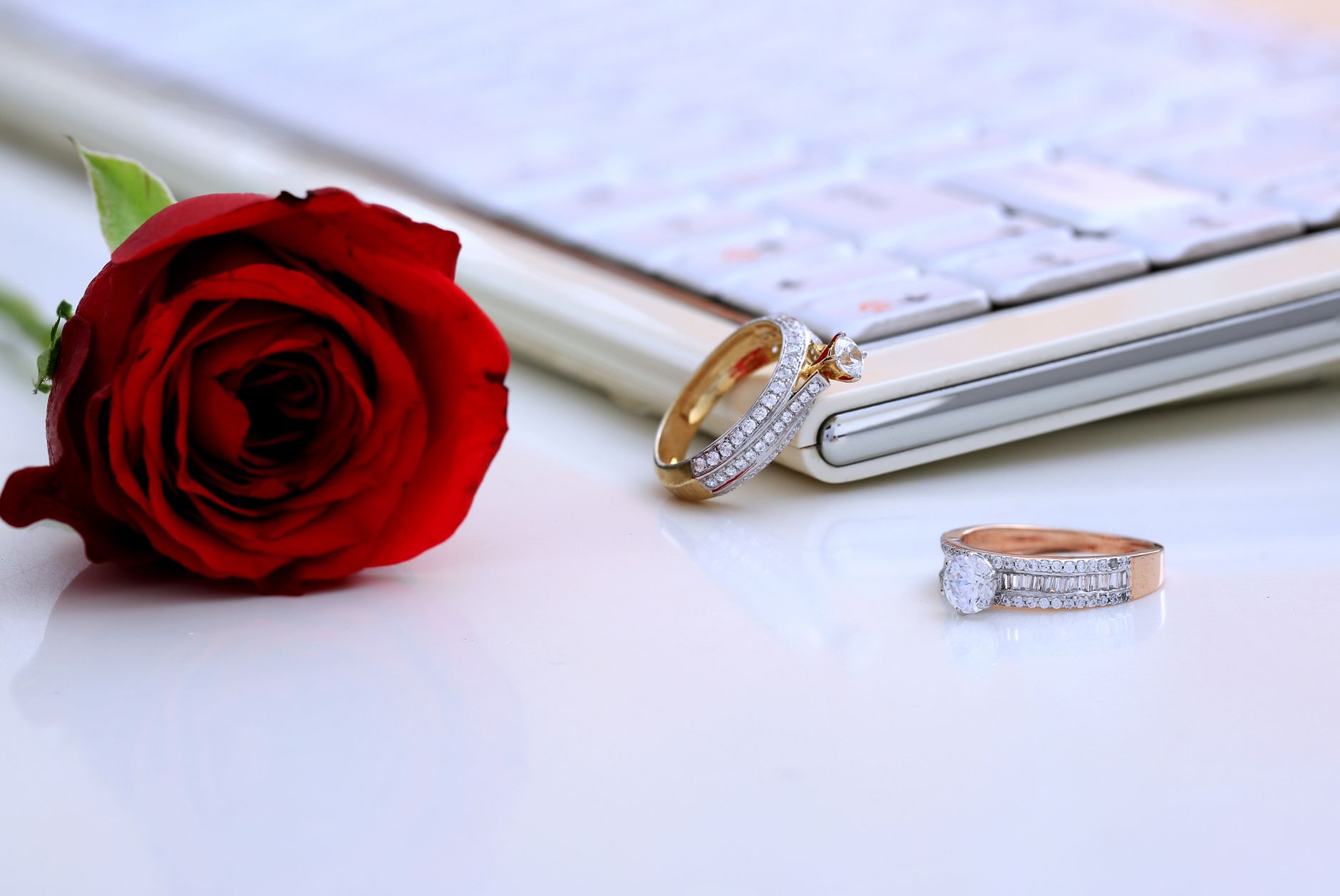
As of August 2026, ring buyers should verify a diamond's identity and quality, a metal's purity, the ring size, and future care needs. The source-checked answers below explain how to compare those details without confusing similar terms. A grading report or purity mark can clarify what a ring contains, but it does not replace practical checks. Consider durability, resizing limits, and maintenance before choosing a design.
Table of Contents
- How do the diamond 4Cs help buyers compare rings?
- Are laboratory-grown diamonds and simulants the same?
- What do 14K, 18K, solid gold, and plated mean?
- How can buyers get an accurate ring size?
- How should a diamond ring be cleaned and checked?
How do the diamond 4Cs help buyers compare rings?
The 4Cs are cut, color, clarity, and carat weight. The Gemological Institute of America identifies them as the industry-standard framework for comparing diamond quality on its 4Cs buyer guide. Each factor answers a different question: Carat does not describe visible size.
Two diamonds with the same weight may not present the same way in a ring, so do not use carat alone as a size comparison. A metric carat equals 0.2 grams, according to the GIA explanation of carat weight. Carat measures gemstone weight; karat, written as 14K or 18K, describes gold purity.
- Cut: How effectively is the diamond fashioned?
- Color: How is its color evaluated?
- Clarity: What internal or external features does it have?
- Carat: How much does it weigh?
Are laboratory-grown diamonds and simulants the same?
No. Laboratory-grown diamonds have nearly the same chemical, optical, and physical properties as natural diamonds. they can also appear indistinguishable from natural diamonds to the unaided eye. Origin therefore cannot be confirmed reliably through appearance alone.
Buyers who need to know whether a diamond is natural or laboratory-grown should obtain a laboratory determination using advanced testing, as the Gemological Institute of America explains. Moissanite, cubic zirconia, and glass belong to a different category. They may resemble diamonds, but they are simulants rather than diamonds because their atomic structures and physical and optical characteristics differ. Ask the seller to state the stone's identity clearly. "Looks like a diamond" does not establish whether the stone is natural, laboratory-grown, or a simulant.
What do 14K, 18K, solid gold, and plated mean?
A 14K gold ring contains 14 parts gold and 10 parts other metals. An 18K ring contains 18 parts gold and six parts other metals. Pure 24K gold is soft, so gold is commonly alloyed with other metals for durability. "Solid gold" addresses construction, not purity: the ring is not hollow. The Federal Trade Commission advises buyers to look for both a karat mark and the company name or registered U.S.
trademark that stands behind it in its gold jewelry buying guidance. Gold plating is a surface layer that can wear away over time. Its lifespan depends on the plating thickness and how the ring is used. "Gold-filled," "gold overlay," and "RGP" describe at least 10K gold mechanically applied to a base metal. These terms are not interchangeable with solid gold, so check the exact wording before comparing rings.
How can buyers get an accurate ring size?
A professional finger gauge is more reliable than string or paper. Fingers can change with temperature, humidity, altitude, and the time of day, which can distort a one-time measurement. Have the intended finger measured professionally rather than copying a size from a different finger.
If the fit seems unusually tight or loose during measurement, account for the conditions and measure again. Design matters as much as the initial measurement. Pavé, channel-set, and eternity rings can be difficult to resize, according to the GIA ring-sizing guide. Confirm the fit before buying one of these styles.
How should a diamond ring be cleaned and checked?
Diamonds resist scratches, but they are not indestructible. An impact can chip a diamond, and a setting can loosen even when the stone itself appears undamaged.
For routine cleaning: An inspection matters because cleaning does not reveal every loose setting. After a hard impact, arrange an inspection instead of assuming scratch resistance prevented damage.
- Wipe the ring with a lint-free cloth.
- Use warm water and mild soap when deeper cleaning is needed.
- Clean gently with a soft toothbrush.
- Have a jeweler inspect the ring periodically.