
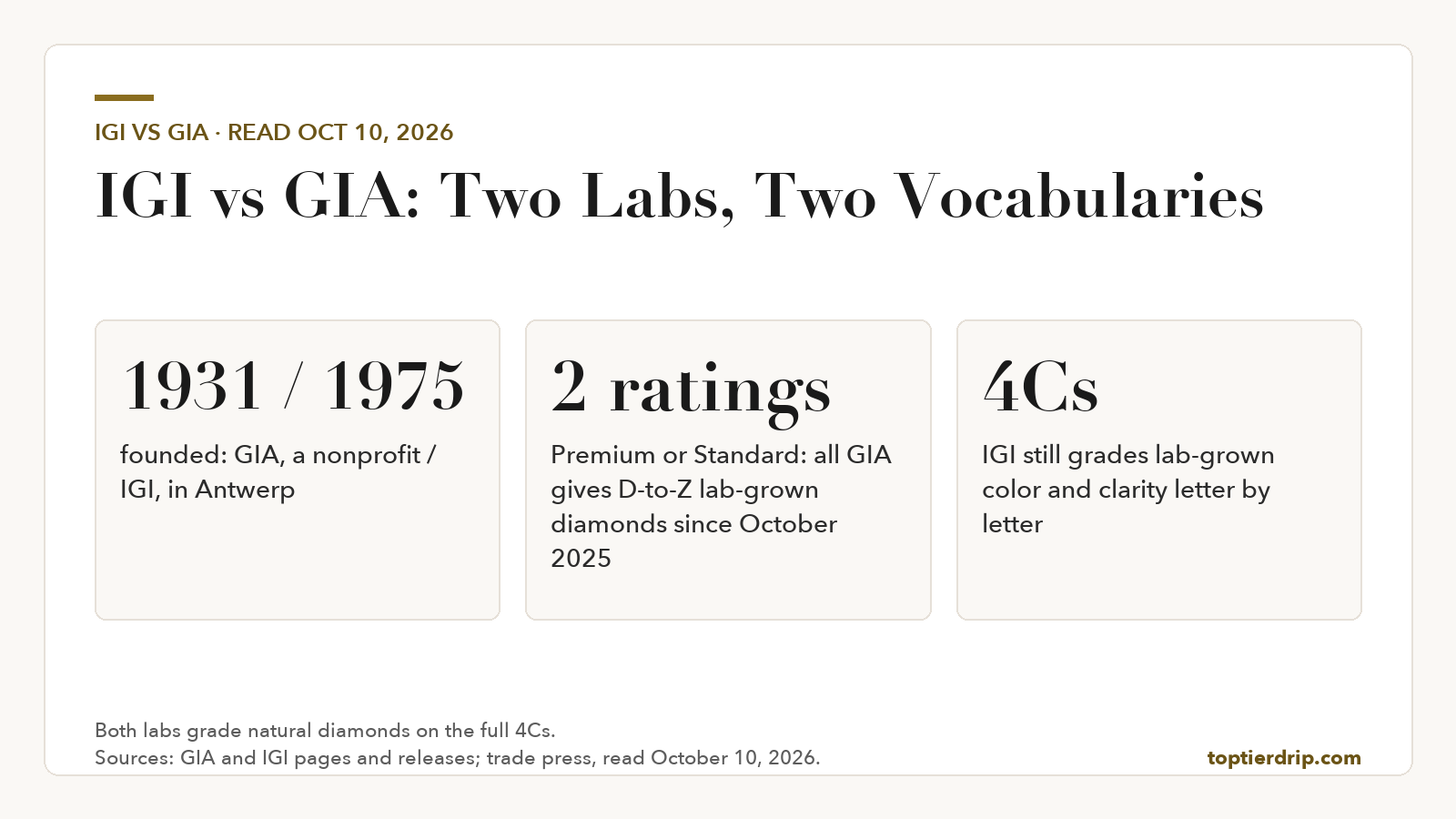
IGI vs GIA comes down to what each lab writes on the report. Both grade natural diamonds on color, clarity, cut and carat weight, but GIA now gives D-to-Z lab-grown stones only a Premium or Standard assessment, while IGI still assigns full letter grades. The two also differ in who runs them: GIA is an independent nonprofit established in 1931, while IGI, founded in Antwerp in 1975, has been owned by private equity firm Blackstone since 2023, and its Indian company has traded on India’s stock exchanges since December 2024.
As of October 10, 2026: GIA’s quality assessment for D-to-Z lab-grown diamonds, launched in October 2025, sorts stones into Premium or Standard and inscribes each girdle with the words Laboratory-Grown and an assessment number. IGI said in July 2025 that it would keep using the full 4Cs for natural and lab-grown stones alike. Each lab runs an online lookup for its report numbers, GIA Report Check and IGI’s report verification, and GIA states that a report is not a guarantee or a valuation.
IGI vs GIA at a glance
| GIA | IGI | |
|---|---|---|
| Founded | 1931 | 1975, Antwerp |
| Structure | Independent nonprofit | Blackstone-owned; Indian arm listed |
| Natural diamonds | Full 4Cs grades | Full 4Cs grades |
| Lab-grown, D to Z | Premium or Standard only | Full 4Cs letter grades |
| Inscription | Report number; lab-grown also marked | Laserscribe report number |
| Online check | GIA Report Check | Verify Your Report |
The table covers the paperwork, not the diamonds. A stone does not change because a different lab looked at it; what changes is the vocabulary used to describe it, and for lab-grown stones that difference is now large.
Who runs each lab
GIA, the Gemological Institute of America, ends its press releases with this description of itself: “An independent nonprofit organization, GIA (Gemological Institute of America), established in 1931, is recognized as the world’s foremost authority in gemology.” The authority claim is GIA’s own; the founding date and nonprofit status are facts. GIA devised the 4Cs and, in 1953, the International Diamond Grading System, and its D-to-Z letters and clarity names are the ones IGI’s reports use too. Besides its labs, GIA runs research, gemology education and instrument development.
IGI, the International Gemological Institute, was founded by the Lorie family in Antwerp in 1975. Its ownership has changed twice in recent years. Fosun, the Chinese conglomerate, took an 80 percent stake in 2018, with the remaining 20 percent staying with the Lorie family. In May 2023 Blackstone bought the business; the price was $569.7 million, according to a statement from the Fosun subsidiary that sold its stake. IGI’s Indian company then went public, and Business Standard reported that its shares made their market debut on December 20, 2024. Before the listing, IGI’s chief executive told CNBC that Blackstone’s holding would fall from 100 percent to 76 percent.
In its prospectus, as reported by National Jeweler, IGI called itself the second-largest independent grading and accreditation provider in the world, after GIA. IGI also says it pioneered lab-grown diamond grading in 2005, and lab-grown work is now a large share of its business: Rapaport reported in July 2025 that grading of loose lab-grown stones made up 54% of IGI’s operations in a recent quarter.
What each report states for natural diamonds
For a mined diamond, the two reports cover the same ground. GIA says its Diamond Grading Report confirms the stone is a diamond and describes its color, clarity, cut, carat weight, proportions and finish, and that “The report also identifies any known treatments.” The full report adds a plotted clarity diagram. The shorter GIA Diamond Dossier, for stones from 0.15 to 1.99 carats, swaps the plot for a laser inscription of the report number on the girdle.
IGI describes its natural report in similar terms, saying it gives “an accurate assessment of a diamond’s cut, color, clarity, and carat weight according to strict international standards.” Both labs use the D-to-Z letters for color and the familiar VVS, VS and SI clarity names, so a G VS1 on either report uses the same words.
The color group labels printed on the reports are not identical. GIA calls K to M faint, while IGI’s lab-grown report key groups the same letters as slightly tinted. Our diamond color scale guide explains GIA’s five ranges, and the diamond clarity chart lays out all 11 clarity grades.
Lab-grown diamonds: where the two labs split
GIA has changed course on lab-grown stones more than once. National Jeweler reported that GIA began grading them in 2007, at first with broad color ranges and only four clarity bands. In October 2020 GIA introduced digital-only reports that gave lab-grown diamonds the same 4Cs color and clarity specifications as natural ones. Then, in June 2025, it announced it would stop applying its natural-diamond nomenclature to them, and its August 26, 2025 release set the replacement service to launch on October 1, with the old services available until September 30.
The replacement is the GIA Laboratory-Grown Diamond Quality Assessment. It gives one word, Premium or Standard, based on a combined look at clarity, color and cut:
| Factor | Premium needs | Standard minimum |
|---|---|---|
| Color | D | J or better |
| Clarity | VVS or better | VS or better |
| Polish | Excellent | Very Good |
| Symmetry | Excellent | Very Good (Good for fancy shapes) |
| Cut grade (rounds) | Excellent | Very Good |
A stone must meet every Premium line to be called Premium. Any mix of Premium and Standard results makes it Standard, and missing even one Standard minimum means GIA issues no assessment. Each assessed stone comes back with a printed document and a girdle inscription reading Laboratory-Grown plus its assessment number. GIA’s August 2025 release, read on October 10, 2026, set the fee at US$15 per carat with a $15 minimum, plus a US$5 evaluation charge for stones that fail to qualify; check GIA’s current fee schedule before submitting. Lab-grown reports GIA issued under the old system stay valid.
The practical effect: a GIA Standard label spans a wide band. It can describe a D VVS1 stone whose cut grades Very Good as well as a J VS2 with Very Good polish. Our guide to GIA Premium and Standard reports explains how to compare those stones on price.
IGI took the opposite position. In July 2025 it said it “will continue applying the universal 4Cs grading to all diamonds, whether natural or lab-grown,” and, without naming GIA, criticized “the unprecedented shift by others to a different, diluted scale for lab-grown diamonds.” Another lab, HRD Antwerp, had said a month earlier that it would stop issuing certificates for loose lab-grown diamonds. IGI adds that, on request, the growth process and any treatments are noted in the comments section of its lab-grown report.
How the two labs grade
On paper, the methods look alike. GIA grades color by comparing a stone, table-down, with masterstones under controlled light, and finalizes clarity under a 10x loupe with more than one grader giving an opinion. IGI says its gemologists judge D-to-Z color “with the diamond placed upside down, viewed through the side, to facilitate a neutral view,” that several graders submit opinions independently, and that clarity is assessed at 10x.
Online comparisons often claim that one of these labs grades more leniently than the other. We looked for a first-hand test of that claim, such as a published study or a trade-press re-grading of the same stones at both labs, and did not find one we could verify. This guide therefore does not rank the two labs on strictness.
One documented point concerns where some of IGI’s grading happens. National Jeweler reported that IGI’s draft prospectus, filed in August 2024, disclosed that much of its lab-grown grading is done inside the factories of the companies growing the diamonds, with grading done by IGI gemologists and by the producers’ own employees, on equipment the producers supply. IGI’s filing acknowledged the risk in its own words: “While we conduct quality checks and periodic calibration of our gemologists to reassess and adjust their grading techniques, such measures may not be effective in preventing all instances of grading errors or fraud by gemologists or third parties.”
Checking a report: Report Check, IGI verification and inscriptions
A report number is only useful if you check it against the lab’s own records. GIA’s database is GIA Report Check; IGI’s site offers a lookup where you enter the report number to “See a digital copy of your IGI grading report.” Compare the online record with the listing line by line: shape, measurements, carat weight, color, clarity and any comments.
Then tie the paper to the stone. GIA notes that an inscribed number can be read under 10x magnification with a jeweler’s loupe and matched to the report or to Report Check. GIA applies the inscription automatically on Dossier and Diamond Focus reports and offers it as a low-cost option with a full Diamond Grading Report. IGI says it co-created the modern laser inscription process and offers it as Laserscribe, which puts the report number on the girdle so the stone can be identified under magnification. If the number in a listing does not match what you find, read what to do when a certificate number and listing disagree before paying.
An inscription can be faked, which is why the measurements matter too. In 2021 IGI’s Bangkok lab examined a 6.18-carat round brilliant submitted for verification with a GIA report describing a natural D color, flawless stone. IGI found it was lab-grown, cut to match the GIA report’s data, and National Jeweler reported that its girdle carried a fake report number, a problem GIA had been dealing with at the time.
What a grading report does not guarantee
A lab report describes quality; it does not set a price or promise anything about the sale. GIA’s 4Cs site says a diamond report “is not a certificate or guarantee and does not indicate a diamond’s monetary value,” and draws the line with appraisals, which estimate monetary worth. For insurance or resale value you need an appraiser; see our guides on what a jewelry appraisal is for and on appraisals that come in far above the price paid.
A report also describes the stone as it was on the day it was graded. A chip, a repolish or a recut since then can change the grade, and the swapped stone in Bangkok shows that a genuine report can travel with the wrong diamond. Finally, a report covers a loose stone or the stones it names, not a seller’s wording around it. Phrases such as certified or GIA tested on a jewelry listing need the report itself behind them, as our guides to certified gemstone claims and GIA tested claims explain.
Frequently Asked Questions
Is IGI or GIA better for lab-grown diamonds?
They report lab-grown diamonds differently rather than one being simply better. Since October 2025 GIA describes D-to-Z lab-grown stones only as Premium or Standard, while IGI still prints full color and clarity grades. If you want a letter grade to compare stones, an IGI report gives one; a GIA assessment tells you which of two quality bands the stone meets.
Is an IGI certificate legitimate?
IGI is an established lab founded in Antwerp in 1975, and in its prospectus it described itself as the second-largest independent grading provider after GIA. As with any report, check the number in IGI’s online lookup and match the measurements and any inscription to the stone in front of you.
Does GIA still grade lab-grown diamonds?
GIA still accepts them, but it no longer gives D-to-Z lab-grown stones letter grades. Its quality assessment, launched in October 2025, classes them as Premium or Standard, inscribes the girdle with Laboratory-Grown and an assessment number, and issues nothing for stones below the Standard minimums.
How do I verify a GIA or IGI report number?
Enter the number in GIA Report Check or in IGI’s report verification page, then compare shape, measurements, weight, color and clarity with the listing. If the stone is inscribed, read the girdle number with a 10x loupe and confirm it matches the report.
Do GIA and IGI use the same grading scales?
For natural diamonds both use the D-to-Z color letters and the same clarity names, such as VVS1, VS2 and SI1. The group labels differ slightly; IGI calls K to M slightly tinted where GIA says faint. For lab-grown stones GIA has dropped the letters in favor of Premium and Standard.
Is a grading report the same as an appraisal?
No. GIA says a grading report is not a guarantee and does not state a diamond’s monetary value. An appraisal is a separate document that estimates worth, usually for insurance or resale.
Sources
- GIA to Use New Descriptive Terminology for Laboratory-Grown Diamonds — GIA press release, June 2, 2025; read October 10, 2026
- GIA Launches Updated Laboratory-Grown Diamond Services October 1 — GIA press release, August 26, 2025; read October 10, 2026
- GIA Gets Specific on Laboratory-Grown Diamonds — GIA press release, October 13, 2020; read October 10, 2026
- GIA’s New Reports for Lab-Grown Diamonds Are Out — National Jeweler, October 15, 2020; read October 10, 2026
- GIA Diamond Grading Reports: Understanding the Diamond Color Grade — GIA 4Cs blog, published January 26, 2016; read October 10, 2026
- 4Cs Q&A with GIA: Diamond Clarity Grading — GIA 4Cs blog, published July 29, 2013; read October 10, 2026
- What is the difference between a Diamond Grading Report and an Appraisal? — GIA 4Cs blog, published August 28, 2012; read October 10, 2026
- How to Protect Your Diamond Engagement Ring — GIA 4Cs blog, read October 10, 2026
- Laboratory Grown Diamond Report (Wayback Machine capture of May 1, 2026) — International Gemological Institute (IGI), captured May 1, 2026; read October 10, 2026
- IGI Reiterates Intention to Treat Lab-Grown the Same as Natural — Rapaport News, July 15, 2025; read October 10, 2026
- Blackstone Officially Inks Deal to Acquire IGI — National Jeweler, May 22, 2023; read October 10, 2026
- IGI Set to Go Public Next Week — National Jeweler, December 11, 2024; read October 10, 2026
- International Gemmological Institute shares list at 22% premium on bourses — Business Standard, December 20, 2024; read October 10, 2026
- IGI Finds 6-Carat ‘Natural’ Diamond Is Actually Lab-Grown — National Jeweler, June 14, 2021; read October 10, 2026
Grading standards, fees and policies are quoted from each organization’s own pages on the date shown and change often, so check the current terms before you submit, buy or sell. This article is general information, not investment, tax or legal advice. Top Tier Drip is not affiliated with any grading service, laboratory, mint or dealer named here and earns nothing from them.