
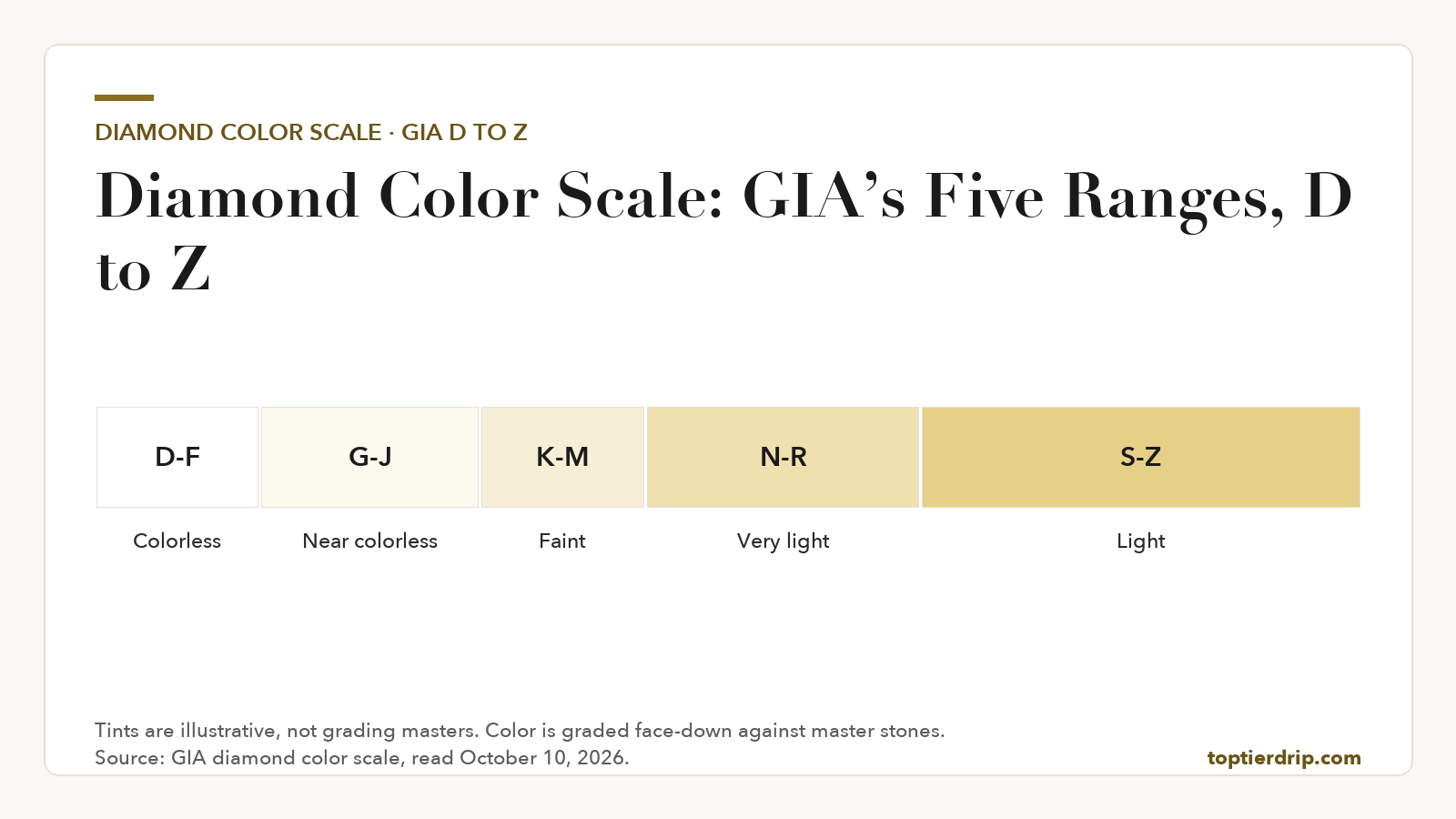
The diamond color scale is GIA’s D-to-Z system of 23 letter grades, which measures how close a white diamond comes to having no color: D is colorless and Z is light yellow, brown or gray. The letters fall into five ranges, D-F colorless, G-J near colorless, K-M faint, N-R very light and S-Z light, and one letter is usually too small a step to see without a lab’s lighting and reference stones. Diamonds with more color than Z, or with a different hue altogether, leave this scale for GIA’s fancy-color system.
As of October 10, 2026: GIA’s D-to-Z scale, introduced in 1953, is still the color reference printed on its natural-diamond reports. Graders compare each stone, table-down, with masterstones of known grade under daylight-type light on a neutral background. Fluorescence gets its own line on the report and does not change the color letter. For D-to-Z lab-grown diamonds, GIA dropped letter grades when its new assessment launched in October 2025: Premium requires D color, Standard allows color down to J, and stones below J are not assessed.
The diamond color scale at a glance
This is a scale of absence. Within the D-to-Z range, and with cut, clarity and carat equal, the less color a stone shows, the rarer and more valuable it is. GIA also stresses that the letters are bands, not points: “Each letter represents a narrow range of color, not a specific point.” Two G diamonds can differ slightly in depth of color and still share the letter.
| Range | Grades | What GIA says you will notice |
|---|---|---|
| Colorless | D, E, F | Rarest; no color to see |
| Near colorless | G, H, I, J | Color usually seen only by trained graders |
| Faint | K, L, M | Still hard for an untrained eye |
| Very light | N to R | Tint visible in larger stones |
| Light | S to Z | Yellow or brown shows at most sizes |
Most stones in engagement rings come from the upper-middle of that table. GIA says the typical engagement diamond is near colorless with hints of yellow or brown, and that truly colorless stones are very rare. So for many buyers the real comparison happens inside G to J, where a one-letter step can change the price more than the look. Our guide to what drives engagement ring prices shows how color trades off against the other Cs.
Why the scale starts at D
Before GIA’s system, color was described in several overlapping ways. GIA lists “letters of the alphabet (A, B and C, with multiple A’s for the best stones), Arabic (0, 1, 2, 3) and Roman (I, II, III) numerals,” plus descriptive phrases such as gem blue and blue white. The result was a market where the same stone could be sold under several labels.
When GIA introduced the D-to-Z scale in 1953, it began at D on purpose, so that no one could confuse the new top grade with an old A or AAA. The letters are now used almost everywhere in the trade, but GIA’s researchers pointed out in a 2008 Gems & Gemology article that borrowing the letters is not the same as following GIA’s grading standards and procedures.
One old phrase still carries a legal limit. Section 23.15 of the Federal Trade Commission’s guides for the jewelry trade makes it deceptive to describe a diamond as blue white if, in north daylight or its equivalent, it shows any trace of a color other than blue or bluish. If a seller leans on that term instead of a letter grade, ask for the grade.
How a lab grades color: masterstones, light and a face-down view
A color grade is a comparison, not a reading from a meter. GIA describes the setup in detail: “Diamonds are examined under a daylight-fluorescent light source, against a neutral gray background. They are held in a white non-reflective grading tray, with subdued, low-level ambient lighting in the surrounding area.” The grader’s sightline and viewing angle are controlled too, so sparkle does not mask body color.
The references are masterstones: diamonds picked for set weight, color, clarity and cut, each standing for one letter. They sit in order in the tray, tables facing down, and the grader moves the unknown stone along the row until it matches. GIA logs each grader’s opinion separately and fixes the final grade only once enough of those opinions agree.
Why upside down? Face-up, a well-cut stone throws back flashes and reflections that hide its faint body color. GIA explains that the table-down position cuts through that complexity in colorless and near-colorless stones. Its 2008 research article names the same pillars: a fixed grading method, “a standard illumination and viewing environment, and the use of color reference diamonds” that serve as master stones for side-by-side comparison. A grade estimated in a showroom, without masterstones, is a different thing, which is why the lab report is worth checking against the listing.
Why one grade is hard to see, and what changes the look
GIA is blunt about how fine the steps are. Its color page says: “Many of these color distinctions are so subtle as to be invisible to the untrained eye. But these slight differences make a very big difference in diamond quality and price.” Within a single letter, it adds, the variation is noticeable only to a trained grader.
Several things decide whether you will notice color once the stone leaves the lab:
- Size. GIA’s range descriptions say tint in the N-R band shows in larger stones, while S-Z color is visible in stones of many sizes, so the same letter is easier to spot in a large stone than in a small one.
- Metal. Diamonds act like small mirrors and pick up the color of the prongs and band. GIA says white gold or platinum can emphasize the lack of color in colorless and near-colorless stones, while gold can make a lower-graded diamond look more yellow. It also warns that yellow gold prongs alone can make a colorless or near-colorless diamond look like a different grade.
- The K to M zone. GIA calls K and L a middle zone that can go in either white or yellow metal, and says M and below will likely show a noticeable yellow tint. For those stones, GIA says, yellow gold will bring the yellow forward, while a white band may make the diamond read as less tinted.
- Cut, light and surroundings. GIA notes that cut, natural versus artificial light, and even the clothes you are wearing can change how color reads.
For how the alloy itself changes tone, see our comparison of rose, yellow and white gold; for how much metal surrounds the stone, compare ring setting styles before you pick a mounting.
Beyond Z: fancy-color diamonds
Past the Z masterstone, a yellow or brown diamond stops being an off-white stone and becomes a colored one. GIA concedes there is no single rule for the word fancy but says the industry generally applies it to yellows and browns with more color than a Z masterstone, and to any diamond showing a hue other than yellow, gray or brown, such as pink, blue or green.
These stones are graded the other way round. Instead of judging absence of color table-down, GIA’s colored-diamond system judges presence of color face-up, using its own masterstones and a Macbeth Judge II light box chosen for neutral, color-balanced light. GIA lists the grade terms this way: “Terms used by GIA to describe colored diamonds include: Faint, Very Light, Light, Fancy Light, Fancy, Fancy Dark, Fancy Intense, Fancy Deep and Fancy Vivid.” More color generally means more value, and GIA says Fancy Vivid and Fancy Deep usually command the highest prices, though a very dark Fancy Dark stone can be less desirable than a lighter Fancy Intense.
Natural fancy colors are scarce. GIA cites expert estimates that only about two percent of rough diamond production is fancy colored, which is why the scale for these stones, and their prices, works so differently from D to Z.
Fluorescence: a separate line on the report
Fluorescence is the visible glow some diamonds give off under ultraviolet light, which is part of ordinary daylight. GIA reports list it as None, Faint, Medium, Strong or Very Strong, and GIA treats it as an identifying characteristic, not a grading factor. In GIA’s words, “Fluorescence will not affect the color grade.”
It is common. GIA says approximately 25% to 35% of the diamonds it received over a decade showed some fluorescence, but only 10% of those were strong enough (medium, strong or very strong) to possibly affect appearance. In more than 95% of fluorescent diamonds, the glow is blue.
Opinions in the trade differ on what that glow does. GIA reports that “Many in the diamond trade believe that strong blue fluorescence can make a light yellow diamond look closer to colorless when exposed to a UV source such as sunlight.” GIA’s own observer testing found that “For the average observer, meant to represent the jewelry buying public, no systematic effects of fluorescence were detected.” At the extreme, a few very strongly fluorescent stones can look hazy or oily; GIA puts that at fewer than 0.2% of the fluorescent diamonds it sees. If a listing mentions Strong or Very Strong fluorescence, ask to see the stone in daylight.
Treated color and what the report says
Color can be changed after mining. GIA names high pressure, high temperature (HPHT) processing as perhaps the most common method: it can turn some brown diamonds colorless or shift them to yellow, greenish yellow or green. Irradiation, annealing and surface coatings are also used.
A GIA report signals this in two ways. If the treatment is considered permanent, as HPHT is, the report puts an asterisk after the color grade and names the process in the Comments section. If the color comes from a treatment that is unstable or reversible, such as a coating, GIA does not issue a grading report at all, only an identification report. In the US, the FTC’s treatment rule in section 23.24 treats it as deceptive to stay silent about a treatment that significantly affects a stone’s value, so an asterisk on the report should be matched by a plain statement in the listing.
How lab-grown color is described now
GIA has used three different approaches to lab-grown color. Before 2020, its synthetic diamond reports gave no specific letter, only ranges such as colorless (D-E-F) or near colorless (G-H-I). From October 2020, its LGDR reports used the same D-to-Z letters as natural stones. Then in June 2025 GIA announced it would drop that nomenclature, with Tom Moses, its chief laboratory and research officer, saying: “More than 95% of laboratory-grown diamonds entering the market fall into a very narrow range of color and clarity.”
The replacement launched in October 2025, as GIA’s August 26 announcement had scheduled. On color, Premium requires a D, together with top marks on clarity, polish, symmetry and cut. Standard accepts color down to J as long as every other minimum is met, and a lab-grown diamond below J receives no GIA assessment. IGI, by contrast, still prints letter color grades on its lab-grown reports, which our IGI vs GIA comparison covers alongside report checks. For the clarity half of the same change, see our diamond clarity chart, and before comparing prices on lab-grown stones, see how GIA’s Premium and Standard lab-grown documents compare.
Frequently Asked Questions
What is the best color grade for a diamond?
D is the top of the GIA scale and the rarest grade for a white diamond. Whether it is worth paying for depends on the stone and setting: GIA says color in the near-colorless G to J range is often unnoticeable except to trained graders.
Is H color a good diamond color?
H sits in GIA’s near-colorless range (G to J), where GIA says color is often noticeable only to trained graders, and GIA says most diamonds used in engagement rings fall in that near-colorless band. Yellow gold prongs can make a near-colorless stone look like a lower grade, so the setting metal matters.
Can you see the difference between G and H color?
Usually not without a grading setup. GIA says many color distinctions are invisible to the untrained eye and that labs compare stones table-down against masterstones under controlled light to separate them. Larger stones show color more readily than small ones.
Does fluorescence lower a diamond’s color grade?
No. GIA lists fluorescence separately as None, Faint, Medium, Strong or Very Strong and says it does not affect the color grade. GIA’s observer testing found no systematic effect on appearance for average viewers, though a very small share of strongly fluorescent stones can look hazy.
What color diamond looks best in yellow gold?
GIA says K and L stones sit in a middle zone that works in either white or yellow metal, and that a yellow gold band can make a diamond lower on the scale look more yellow. Stones of M and below will likely show a tint, which yellow gold tends to complement.
What is a fancy color diamond?
A diamond outside the normal D-to-Z range: a yellow or brown stone with more color than the Z masterstone, or one with another hue such as pink, blue or green. GIA grades these face-up on a separate scale from Faint to Fancy Vivid, Fancy Deep and Fancy Dark.
Sources
- Diamond Color — GIA 4Cs (Gemological Institute of America), read October 10, 2026
- Diamond Color Chart: The Official GIA Color Scale — GIA 4Cs blog, published July 8, 2015; read October 10, 2026
- GIA Diamond Grading Reports: Understanding the Diamond Color Grade — GIA 4Cs blog, published January 26, 2016; read October 10, 2026
- Diamond Color: Seven Things You Need to Know — GIA 4Cs blog, published February 22, 2018; read October 10, 2026
- Understanding Diamond Fluorescence — GIA 4Cs blog, published May 9, 2012; read October 10, 2026
- Diamond Engagement Ring Setting: How Metal Affects Diamond Color Appearance — GIA 4Cs blog, published October 31, 2017; read October 10, 2026
- Decoding Color: The GIA Colored Diamond Color Grading System — GIA 4Cs blog, published April 11, 2014; read October 10, 2026
- GIA 4Cs Color D-to-Z — GIA, read October 10, 2026
- Color Grading “D-to-Z” Diamonds at the GIA Laboratory — Gems & Gemology (GIA), Winter 2008; read October 10, 2026
- 16 CFR Part 23: Guides for the Jewelry, Precious Metals, and Pewter Industries — Federal Trade Commission, via eCFR, read October 10, 2026
- GIA to Use New Descriptive Terminology for Laboratory-Grown Diamonds — GIA press release, June 2, 2025; read October 10, 2026
- GIA Launches Updated Laboratory-Grown Diamond Services October 1 — GIA press release, August 26, 2025; read October 10, 2026
- GIA’s New Reports for Lab-Grown Diamonds Are Out — National Jeweler, October 15, 2020; read October 10, 2026
Grading standards, fees and policies are quoted from each organization’s own pages on the date shown and change often, so check the current terms before you submit, buy or sell. This article is general information, not investment, tax or legal advice. Top Tier Drip is not affiliated with any grading service, laboratory, mint or dealer named here and earns nothing from them.