
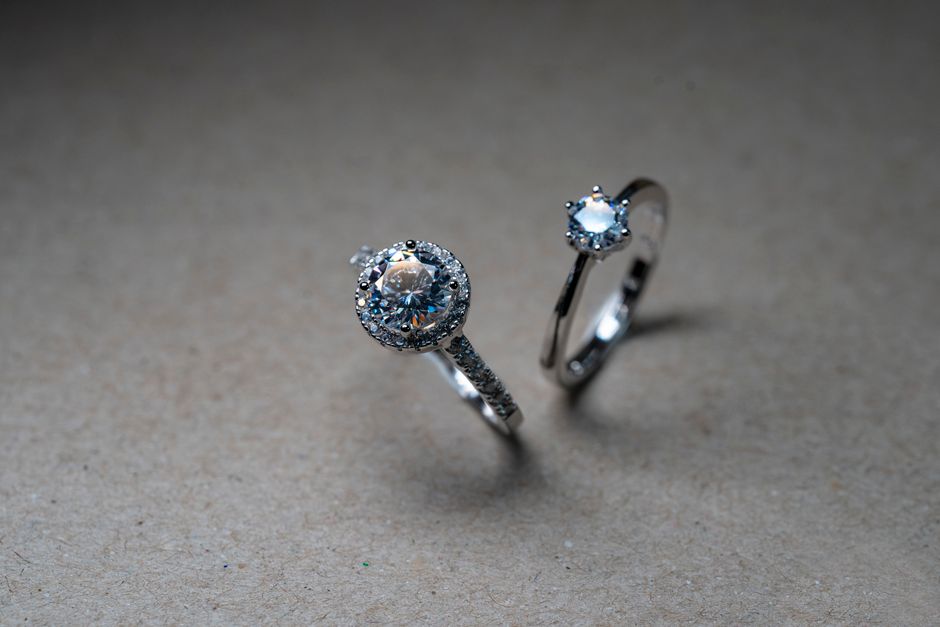
Every setting style trades light for protection. A tall prong head lets the most light into a stone and exposes it to the most abuse; a bezel wraps the girdle in metal and gives back some brilliance in exchange. Knowing which trade a setting makes is the fastest way to match a ring to the hand that will wear it.
The eight settings you will actually be offered
| Setting | Security | Light | Snag risk | Best for |
|---|---|---|---|---|
| Four-prong | Moderate | Highest | High | Maximum brilliance, careful wear |
| Six-prong | Higher than four | High | High | Round stones; losing one prong is not fatal |
| Bezel | Highest | Reduced | Lowest | Hands-on work, healthcare, childcare |
| Half-bezel | High | Better than full bezel | Low | A compromise between the two |
| Channel | High | Reduced at the sides | Very low | Rows of small stones on a band |
| Pavé | Moderate | High across the surface | Low | Continuous sparkle; needs regular checks |
| Flush / gypsy | High | Low | None | Men’s bands and hard-wear rings |
| Tension | Depends entirely on the maker | Very high | Moderate | A specific look; hard to service elsewhere |
How to judge a setting in person
The finish of a setting tells you more about a ring than the metal stamp does. With a loupe or a phone camera at maximum zoom:
- Prong tips should be rounded and sit flat on the stone, covering the crown edge — not standing tall or angled outward. Tall, thin, sharp prongs catch on fabric and bend.
- Each stone should be still under light pressure from a fingernail, and should not click when you tap the ring gently against your palm.
- Seats should be cut, not glued. Any trace of adhesive around a small stone is a serious defect.
- Bezel rims should touch the stone all the way round, with no visible gap where dirt will collect.
- Pavé beads should be even. Irregular bead size is the visible sign of rushed setting, and it predicts stone loss.
Those checks are the practical core of the prong-set, bezel-set and halo buying guides, and they apply equally to a $200 ring and a $20,000 one.
Match the setting to the stone’s weak points
Different cuts break in different places. Princess, marquise and pear cuts have exposed points and corners that chip; those shapes want V-prongs or a bezel over the tips. Emerald cuts have long, straight edges and step facets that show chips clearly. Round brilliants are the most forgiving.
Hardness matters as much as shape. Diamond sits at 10 on the Mohs scale and ruby and sapphire at 9, so they tolerate exposed settings. Opal (about 5 to 6.5), pearl, turquoise, tanzanite and emerald are softer, more brittle or both, and they are far better protected in a bezel or a low mount. GIA’s gem encyclopedia lists hardness and toughness per species, and it is worth checking before choosing a high-prong setting for anything unusual.
Match the setting to the wearer
- Hands in gloves all day — bezel or flush. Prongs tear nitrile and catch on cuffs.
- Lifting, climbing, tools — low profile, or take it off. Consider a second, cheap band for the gym.
- Young children — bezel. Prongs and hair are a bad combination, and small stones in pavé come out.
- Desk work and occasional wear — anything, including tall prong solitaires.
What each setting costs to maintain
Prongs need re-tipping over the years — a bench builds up the worn tip with fresh metal. That is normal maintenance, not a defect, and it is the single most common repair on an old engagement ring. Pavé and shared-prong settings need periodic tightening across many small stones. Bezels need almost nothing, but if a bezel-set stone does need to come out, the rim usually has to be reworked. Channel settings collect debris and want a proper clean rather than a scrub.
A twice-yearly inspection is cheap or free at most jewelers and is the practical difference between re-tipping a prong and replacing a lost stone. Some warranties require it — check the terms, because a missed inspection can void coverage.
Frequently asked questions
Which ring setting is the most secure?
A full bezel. The stone’s girdle is enclosed by metal on every side, there is nothing to snag, and there are no prong tips to wear thin.
Do bezel settings make a diamond look smaller?
They cover the girdle, so a little less of the stone shows — but a bezel rim can also be made to sit slightly wider than the stone, which reads larger from a distance. It is a design choice rather than a fixed penalty.
Are six prongs better than four?
For security, yes: losing one of six prongs leaves five holding the stone. Four prongs show more of the stone and give a squarer outline on a round diamond. Both are fine when well made.
Is a tension setting safe?
It can be, when engineered properly by a maker who specialises in them. The risks are that the shank cannot usually be resized and that another jeweler may decline to service it. Ask who repairs it and what happens if the stone comes loose.
Sources
- GIA Gem Encyclopedia — Mohs hardness, toughness and care guidance by gem species.
- FTC Jewelry, Precious Metals, and Pewter Industries Guides, 16 CFR Part 23 — disclosure rules for treatments and laboratory-created stones that a setting may conceal.