
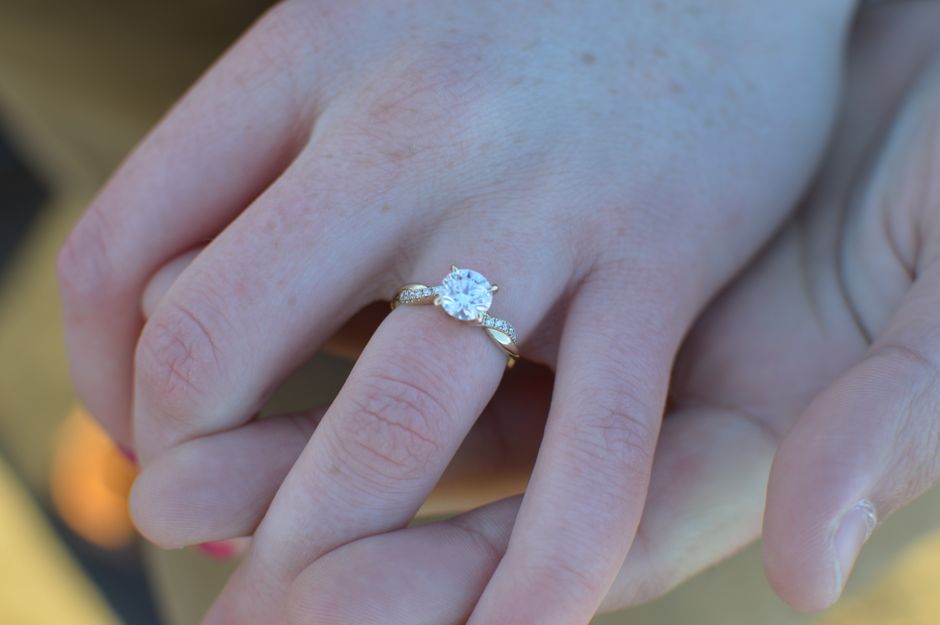
A ring spins because your finger is not round and the ring is not balanced. Fingers are oval in cross-section and narrower at the base than at the knuckle, so a ring sized to clear the knuckle has slack once it settles. Add a heavy stone on top and gravity does the rest. The fix is almost never a smaller size — it is a change to the shank that takes up the slack without touching knuckle clearance.
The three causes, in order of how common they are
1. Knuckle clearance versus base circumference
The ring has to pass the widest part of the joint. On a hand where the knuckle is much larger than the base of the finger, the ring that clears the knuckle is by definition loose once it is on. Sizing down fixes the spin and creates a new problem: the ring will not go on or come off.
2. A top-heavy setting
A solitaire, a tall cathedral mount or a large halo puts most of the ring’s mass above the finger. Anything free to rotate settles with its heaviest point lowest, so the head rolls toward the palm. This is physics, not a manufacturing defect, and it is why a plain band on the same finger sits still while the engagement ring beside it does not.
3. Day-to-day size change
Fingers change measurably with temperature, salt, alcohol, exercise, altitude, medication and time of day. A ring fitted in a warm shop in the afternoon can spin freely on a cold morning. Pregnancy, weight change and arthritis shift the baseline more permanently.
The fixes, what they cost you, and what they cost the ring
| Fix | What it does | Reversible? |
|---|---|---|
| Sizing beads | Two small metal balls soldered inside the lower shank; takes up about a quarter to a half size at the base only | Yes — they can be removed and the shank polished |
| European (flat-top) shank | The lower inside of the shank is flattened, so the ring seats against the flat of the finger instead of rolling | Partly — metal is removed and reshaped |
| Spring insert | A sprung metal strip inside the shank that compresses over the knuckle and grips at the base | Yes |
| Hinged or arthritic shank | The shank opens on a hinge and latches closed; designed for knuckles that no longer allow a ring to pass | No — it replaces the lower shank |
| Silicone ring guard | A clip-on sleeve; useful as a temporary test of how much smaller the ring should feel | Yes, but it is visible and wears out |
| Resizing down | Reduces the whole circumference, including the part that has to clear the knuckle | Yes, at the cost of another sizing |
For a top-heavy ring on a normal knuckle, beads or a flat-top shank are usually the right answer. For a pronounced knuckle, a spring insert or hinged shank is the honest solution — sizing down will only trap the ring or make it impossible to put on.
Test before you commit
Every permanent fix starts as a guess about how much slack to remove. You can measure the guess first:
- Wear a plastic ring guard or a wrap of surgical tape inside the shank for a week, including a cold morning and a hot afternoon.
- If the ring stops spinning and still comes off comfortably, that thickness is roughly what beads or a shank flat need to replicate.
- If it stops spinning but is now hard to remove, the problem is knuckle clearance and you want a hinged or spring solution, not less circumference.
Take the note with you. A bench can work to “about a quarter size at the base” far more reliably than to “it spins”.
Which designs spin most
Anything with a tall or wide head above a narrow shank: solitaires, big halos, cluster rings and cocktail rings. Wide bands spin less because the extra contact area resists rotation, which is one of the practical arguments for a wider band. Low-profile settings spin less because the mass sits close to the finger — a bezel setting is both lower and better protected than a tall prong head, which is why it is a common recommendation for people who work with their hands.
When spinning is a warning sign
A ring that has recently started spinning when it never did before is telling you something changed. Check for a worn shank — decades of contact thin the bottom of a band until it flexes out of round, and a flexing shank both spins and eventually cracks. Hold the ring up and look for an oval shape rather than a circle, and look for a bright, thin section at the base. That is a re-shank job, and it is far cheaper than losing a stone when the shank finally gives.
Frequently asked questions
Should I just size the ring down?
Only if it currently passes the knuckle with obvious room to spare. If the knuckle is the tight point, sizing down makes the ring hard to remove — swelling from heat or injury can then turn a loose ring into a cutting-off job.
Do sizing beads damage the ring?
No. They are small soldered additions on the inside of the shank and can be removed later, with the inside re-polished. They do sit against the finger, so people who dislike the feel usually prefer a flat-top shank.
Why does my ring spin in winter but not in summer?
Cold constricts the tissue in your fingers, so the same ring has more slack. Seasonal change is a good argument for a reversible fix such as a spring insert rather than a permanent resize.
Can a jeweler stop a heavy engagement ring rotating without changing the size?
Yes. Beads, a flat-top shank or a small counterweight in the lower shank all address balance rather than circumference, and none of them affect how the ring passes the knuckle.
Sources
- GIA Gem Encyclopedia — setting styles and the durability considerations behind low-profile mounts.
- FTC Jewelry, Precious Metals, and Pewter Industries Guides, 16 CFR Part 23 — how the metals used in shanks and repairs must be described.