
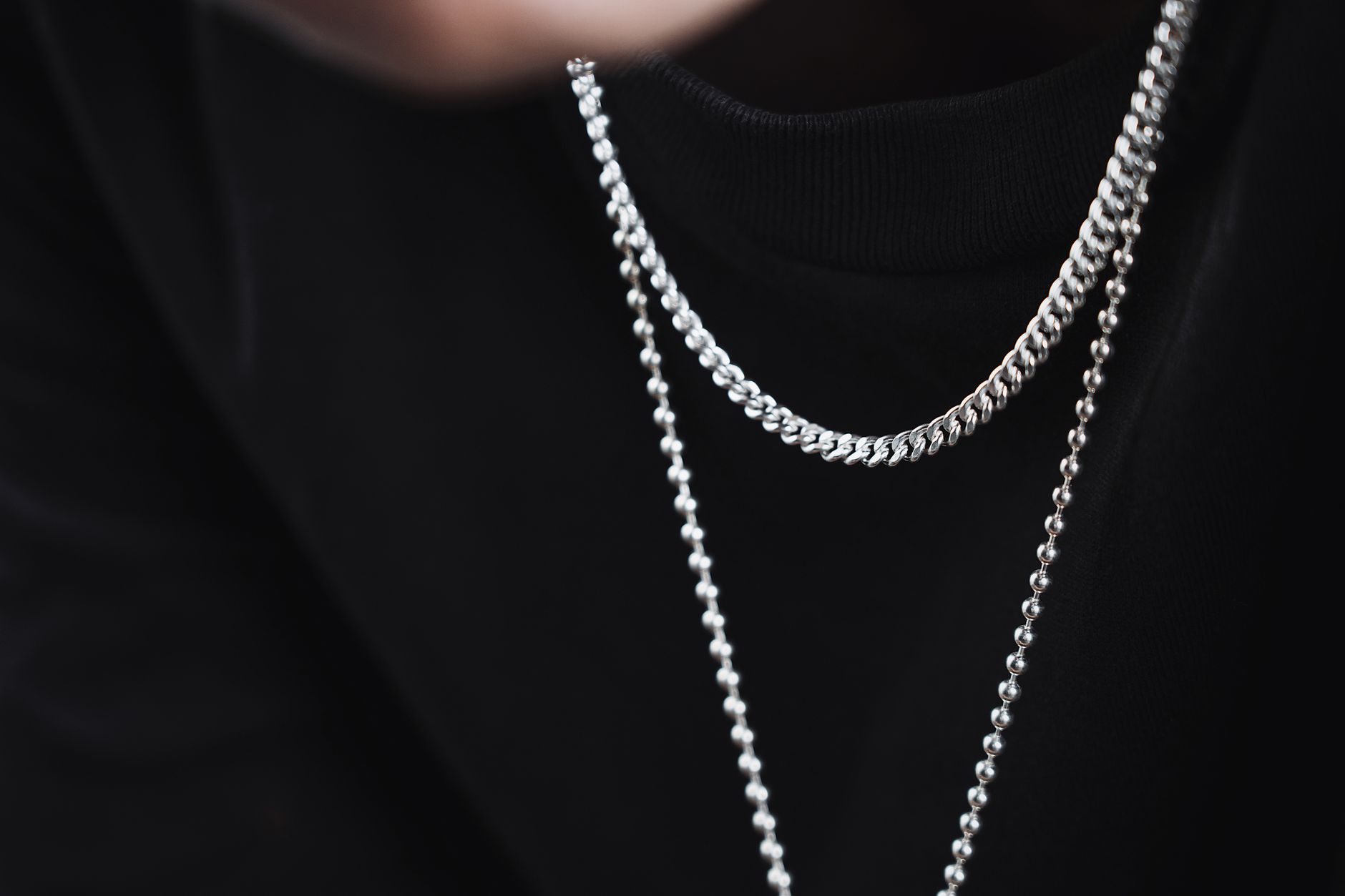
For everyday wear in the same metal, gauge, and quality of construction, a curb chain is generally the more durable of the two. Its links are twisted and flattened so they lie flush against each other, and each link is a closed, continuous loop — while a mariner link carries a soldered crossbar in the middle that gives the design one extra joint to fail. That said, "more durable" is a narrower claim than it sounds. Chain thickness, solder quality, metal alloy, and clasp choice matter more than link style in most real-world breakages, and a well-made 5 mm mariner chain will outlast a thin, hollow curb chain every time.
Table of Contents
- What each chain actually is
- Why the crossbar is the weak point
- What matters more than link style
- Clasps, pendants, and how chains really break
- How to choose between them
- Frequently Asked Questions
What each chain actually is
A curb chain — sometimes sold as a Cuban link when it is wide and heavy — is made of uniform oval or round links that are twisted so the whole chain lies flat. Flattening or "diamond-cutting" the faces is common, which is what gives Cuban links their broad, polished surface. Because the links interlock at a twist, they resist kinking and sit smoothly against the collarbone. A mariner chain, also called an anchor chain, uses oval links with a bar soldered across the center of each one.
The bar is the defining feature: it is what makes the link read as a nautical anchor-chain shape, and it is why the pattern looks the same from either face. Mariner links can be round in profile or flattened, and the flattened versions are often puffed or beveled for shine. Both styles are made in solid and hollow versions. Hollow links are tubes rather than solid wire, which keeps a wide chain affordable and light but makes it far easier to dent or crush.
Why the crossbar is the weak point
Every link in a chain is joined by a solder seam, and solder joints are where chains usually part. A curb link has one such seam per link, closing the loop. A mariner link has that seam plus the two ends of the crossbar, so the count of potential failure points per link is higher. The crossbar also concentrates stress.
When a chain is pulled lengthwise, force travels link to link through the contact points — and in a mariner, part of that load bears on the bar and its joints rather than only on the curve of the loop. A snag or a sharp yank tends to find that bar first. In practice this shows up less as a snapped chain and more as a bar that loosens, twists, or pops free on one side, leaving a link that no longer holds its neighbor. A jeweler can usually re-solder a single bar, which is a cheaper repair than replacing a run of damaged links.
What matters more than link style
Gauge is the single biggest factor. Doubling the wire diameter of a link adds far more strength than switching patterns, which is why a chunky mariner outperforms a delicate curb despite the structural difference. If durability is the goal and the budget is fixed, buy thicker before you buy a particular style.
Solid versus hollow is the next decision, and it is often not stated plainly in a listing. A hollow chain that looks identical on the shelf will weigh noticeably less and will crease permanently if it catches in a car door or a gym bag zipper. Weight in grams, compared against similar chains of the same length and width, is the most reliable tell. Metal choice sets the ceiling for scratch and bend resistance:.
- 14k gold is harder and more wear-resistant than 18k or 22k, which contain more pure gold and are correspondingly softer.
- Platinum is dense and does not wear away as quickly as gold, but it scratches and takes on a patina.
- Sterling silver is soft and tarnishes, making it the least suited to daily heavy wear.
- Stainless steel is the toughest of the common options and the least valuable as metal.
Clasps, pendants, and how chains really break
A large share of lost necklaces are not broken chains at all — they are failed clasps or opened jump rings. A spring-ring clasp is the most common and the weakest; a lobster clasp is better; a box clasp with a safety catch is better still on anything heavy. Match the clasp to the chain's weight, because a light clasp on a heavy chain is a mismatch that will eventually give. Hanging a pendant changes the math.
The link bearing the pendant's bail takes continuous load and constant rubbing, and on a mariner that load may sit directly against a crossbar. For pendant duty, a curb chain or a cable chain with solid links is the safer base, and a bail wide enough not to pinch a single link is worth asking about. Daily habits do more damage than design. Sleeping in a chain, wearing it under a seatbelt, lifting weights in it, and letting it tangle in a drawer all produce the slow link-by-link wear that precedes a break.
How to choose between them
One practical check before buying: hold the chain by one end and let it hang. A well-made chain in either style falls straight and even, with no link sitting at an odd angle and no visible gap at any seam. A mariner whose crossbars are not all square to the link is a chain that was rushed, and that is the one most likely to come back to you in two pieces.
- Pick a curb or Cuban link if you want maximum structural simplicity in a chain you will wear constantly and rarely remove.
- Pick a mariner if you want the nautical look, and buy it in a heavier gauge and solid construction to offset the extra joints.
- Buy solid, not hollow, for anything you intend to keep for decades.
- Prefer a lobster or box clasp over a spring ring once the chain exceeds a few millimeters in width.
- Have the solder joints and clasp inspected during routine cleaning, roughly once a year on a piece worn daily.
Frequently Asked Questions
Is a Cuban link just a thick curb chain?
Essentially yes. Cuban link is the trade name for wide, heavy curb chain, usually with flattened and polished link faces.
Can a broken mariner chain be repaired?
Usually. A jeweler can re-solder a loose crossbar or replace an individual link, and in gold or platinum the repair is typically invisible once polished.
Which style tangles less?
Curb, because its twisted links lie flat and resist folding back on themselves. Round-profile mariner chains are the more tangle-prone of the two.