
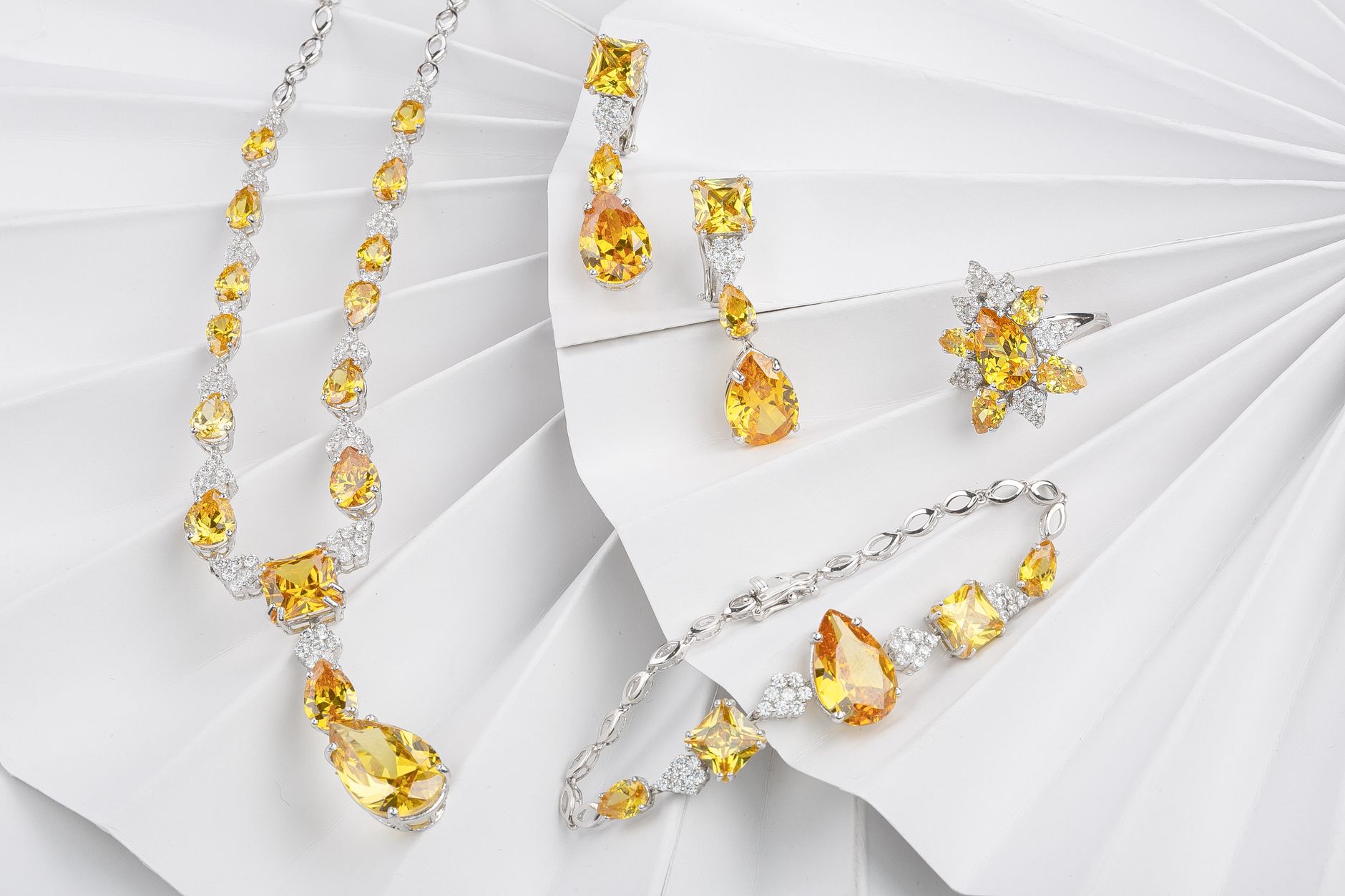
Gemstone jewelry means jewelry set with stones, and in 2026 it should be judged by stone material, treatments, quality evidence, and metal setting. There is no universal 2026 price: compare like-for-like stones, verify important claims, and get value-significant details in writing. Authenticity does not always mean "mined." A laboratory-created gem may share a mined gem's essential properties, while an imitation only resembles another material. Clear disclosure determines whether the description is accurate.
Table of Contents
- What material are you buying?
- How should you compare prices?
- Which treatments affect the decision?
- What proves identity and origin?
- Verify the setting and wear requirements
What material are you buying?
Gemstone jewelry can contain mined, laboratory-created, imitation, or composite stones. The FTC's consumer guidance on buying gemstones emphasizes disclosure because buyers may struggle to distinguish these materials by sight. Under FTC guidance, "laboratory-grown," "laboratory-created," and "synthetic" describe a stone with essentially the same optical, physical, and chemical properties as its mined counterpart.
A simulant such as moissanite must instead be identified as imitation or simulated. A composite combines multiple components. Ask for precise language rather than asking whether a stone is "real":.
- Is it mined, laboratory-created, imitation, or composite?
- What exact gem material is it?
- Does the written invoice use the same description as the advertisement?
- Is the quoted price for the complete piece or separately for the stone and setting?
How should you compare prices?
colored-gem prices cannot be reduced to a single per-carat rate. gia's seven colored-stone value factors are color, color uniformity, origin, size, clarity, shape, and cutting quality. Compare stones with matching descriptions and documentation. A heavier stone is not automatically the better value if its color, clarity, treatment, origin claim, shape, or cutting quality differs.
Ask the seller to explain which characteristics support the quoted price. Diamonds require a related but different comparison. GIA evaluates them through the combined 4Cs: clarity, color, cut, and carat weight. Within the usual D-to-Z range, a more colorless diamond generally carries a higher price per carat.
Which treatments affect the decision?
Ask whether the stone was heated, dyed, irradiated, fracture-filled, diffused, or otherwise enhanced. According to FTC guidance, sellers should disclose treatments that are not permanent, require special care, or significantly affect value.
A treatment does not automatically make a jewel unsuitable. It does change what you should compare and how you may need to care for the piece. Before buying, ask:.
- What treatment was performed?
- Is the treatment permanent?
- Does it limit cleaning, repair, resizing, or routine wear?
- Does the price reflect the treated condition?
- Will the treatment appear on the receipt and laboratory report?
What proves identity and origin?
When natural, untreated, or geographic-origin claims affect the price, request independent evidence. A GIA colored-stone report can identify material as natural or synthetic and list detectable treatments. An origin report adds an informed opinion about geographic origin. An origin opinion is not the same as an absolute guarantee.
Ask the seller to identify which report belongs to the stone and provide a copy before purchase. Make sure the invoice repeats any natural, untreated, or origin claim that influenced your decision. Reports also have limits. GIA does not issue diamond reports for simulants or diamonds with unstable treatments such as fracture filling or coating. Reports it does issue disclose laser drilling and high-pressure, high-temperature processing.
Verify the setting and wear requirements
The stone is only part of the purchase. Under FTC consumer guidance on precious-metal jewelry, 18K gold contains 18 of 24 parts gold, 14K contains 14 parts gold, and sterling silver is 92.5% pure silver. Gold plating can wear away with use. Ask whether the setting is solid precious metal, an alloy, or plated.
Confirm the stated fineness in the written description, and ask whether wear to plating can be repaired. Care must match the particular stone and its treatments. GIA places emerald at 7.5–8 on the Mohs hardness scale, yet heat, chemicals, ultrasonic vibration, and steam can harm fracture-filled emeralds. Use warm soapy water and gentle scrubbing instead.