
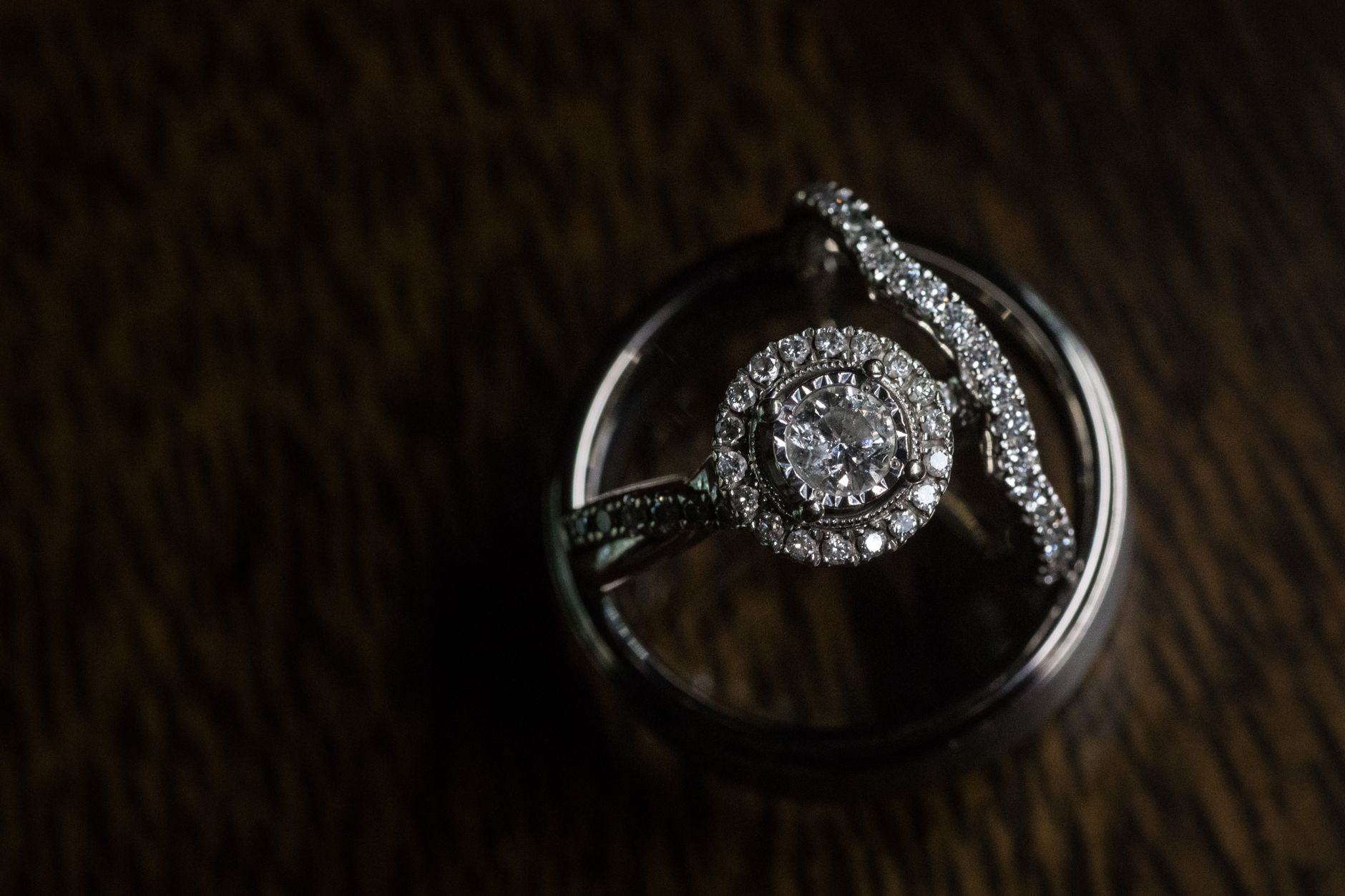
A halo setting encircles a center diamond or gemstone with one or more rows of smaller accent diamonds. It costs more than a solitaire with the same center stone, but it can cost less than a single larger diamond with the same face-up size. Blue Nile describes the common pavé version as set so metal recedes and sparkle merges. GIA defines the small stones as melee, diamonds weighing under 0.2 carat.
Table of Contents
- Why does the center look larger?
- Why does a halo cost more than a solitaire?
- When does a halo lower the total price?
- What care does a halo need?
Why does the center look larger?
A ring of smaller diamonds pulls the eye outward. GIA states that when smaller diamonds surround a center stone, the center can appear to be the size of the whole halo, drawing attention and adding sparkle, as explained in GIA's bigger-look guide.
Retailers put that illusion at roughly one-quarter to one-half carat of extra visual presence for a single halo. Ross-Simons estimates that a halo can boost perceived size by as much as half a carat, according to the Ross-Simons halo guide. Rare Carat gives a stronger example, where a 0.3-carat center can read as 0.75 to 1.0 carat.
Why does a halo cost more than a solitaire?
For the same center weight, a halo adds melee diamonds and bench time. The Jewelry Editor comparison found a matched Blue Nile pair where adding a hidden halo raised the setting price by $255 to $445, about 25-39%, as shown in this Jewelry Editor price check.
Setting guides reflect the same gap on a wider range. They commonly list halo settings around $1,000 to $4,000, compared with about $500 to $2,000 for a solitaire. The difference pays for the extra stones, matching, setting, and finishing.
When does a halo lower the total price?
The comparison changes when the goal is a larger face-up look. Rare Carat and Daniels Jewelers note that small melee costs far less per carat than a large center stone. That makes a smaller center with a halo a lower-price route to similar presence:.
- Keep the same center weight: solitaire usually costs less.
- Match the same face-up size: halo often costs less than one large diamond.
- Choose a double halo: visual size rises further, but stone count and labor rise too.
What care does a halo need?
Many tiny stones sit in thin beads or shared prongs. Alyce Jewels and GemTrove guides warn that those mounts wear, loosen after knocks, and complicate resizing. Plan for regular checks rather than waiting for a lost stone: Reve Diamonds places routine tightening at $30-$80, so budget inspection and small repairs as part of ownership.
- Ask for jeweler inspection about every 6-12 months.
- Have prongs retipped or stones tightened promptly after a hard knock.
- Discuss resizing limits before buying, since halos complicate the work.