
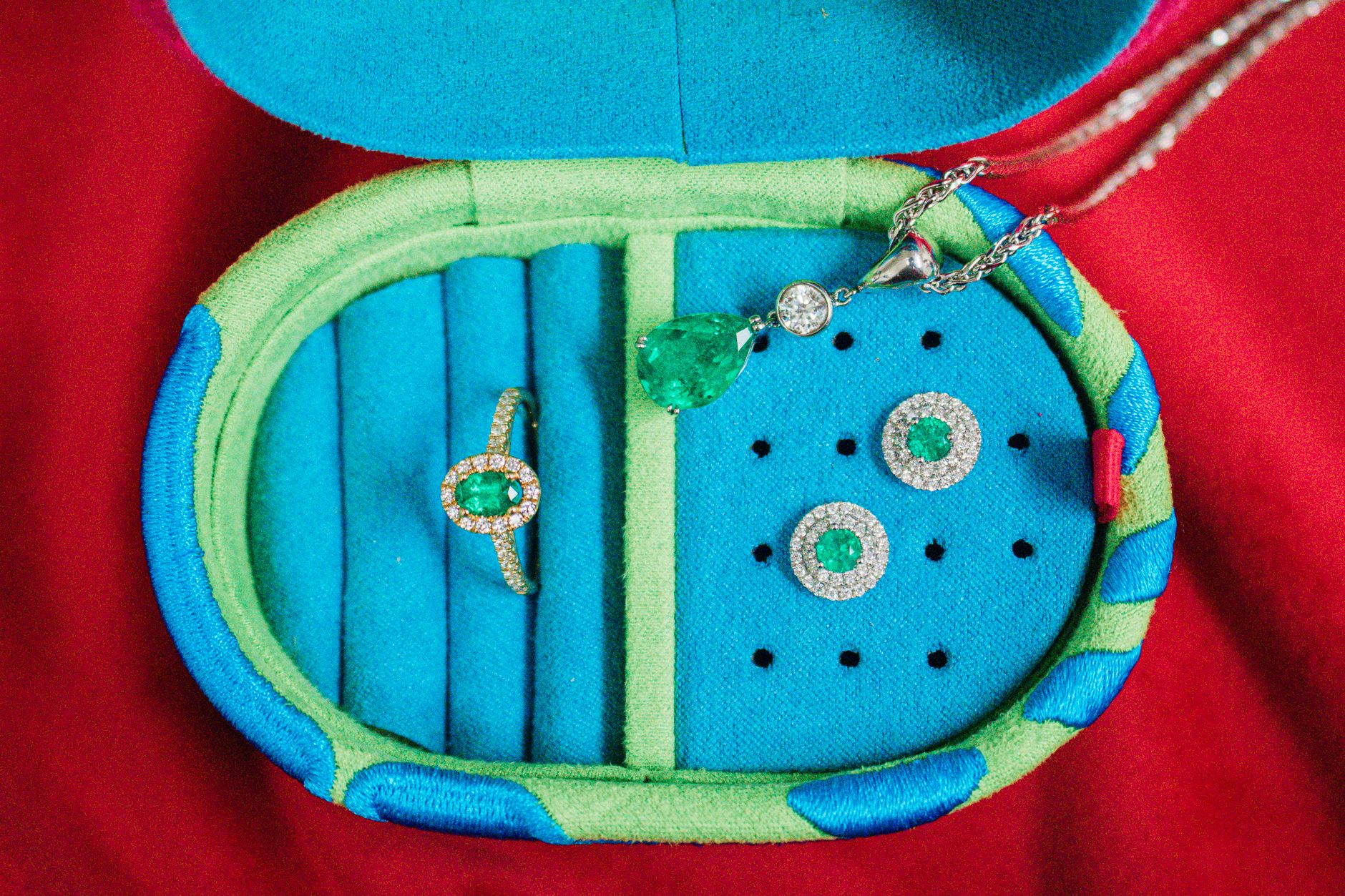
Verify gemstone jewelry claims in 2026 by matching the maker or seller's written records with an appropriate gem-laboratory report, then checking that report with the issuing lab. Treat missing disclosures, unverifiable report numbers, unexplained treatment codes, and vague "natural" claims as red flags. A maker record means an invoice, receipt, or other seller-issued document describing the piece and its gemstones. It records the seller's claims, while a laboratory report provides independent findings about the submitted stone.
Table of Contents
- What should the seller put in writing?
- How do you verify a gem-laboratory report?
- What can a colored-gem report establish?
- Natural, laboratory-grown, simulated, or treated?
- A practical pre-purchase check
What should the seller put in writing?
Require the sales paperwork to state the gemstone's claimed origin, weight or size, treatments, and special-care requirements. The Federal Trade Commission advises U.S. buyers to choose another seller if these details are not provided in writing in the sales documentation.
Compare that paperwork with the tag, product description, and laboratory report. Names, measurements, weight, treatment descriptions, and natural or laboratory-grown status should not conflict. Written records do not independently prove that every claim is correct. They establish exactly what the seller represented, which makes omissions and inconsistencies easier to identify before purchase.
How do you verify a gem-laboratory report?
Enter a GIA report number directly into GIA Report Check and compare the archived information with the report presented by the seller. GIA warns that a PDF or printout alone may not contain current grading information, making direct report-number verification essential. Check that the displayed stone details match the jewelry and paperwork.
A valid report number tied to different measurements, weight, color, or gemstone type does not verify the stone being sold. A GIA report records laboratory findings from the time of examination. It is not a certificate, guarantee, appraisal, or monetary valuation. Buyers who need evidence of value must obtain a separate appraisal.
What can a colored-gem report establish?
A GIA colored-gemstone Identification Report can state the gem type, whether it is natural or synthetic, detectable treatments, measurements, weight, color, and a photograph. Those findings help test specific seller claims instead of relying on appearance or a trade name. An origin report addresses a different question: where a gemstone may have formed geographically.
GIA describes origin as an informed opinion, not an absolute determination, so buyers should not treat an origin finding as certainty. The distinctions among identification, treatment detection, and origin are reflected in GIA's report descriptions. Choose the report that addresses the claim affecting your decision. An identification report may support natural status and detectable treatment findings without supplying a geographic-origin opinion or any statement about price.
Natural, laboratory-grown, simulated, or treated?
Natural and laboratory-grown diamonds may require specialized testing because they share essentially the same visual and physical characteristics. For laboratory-grown diamonds evaluated by GIA, look for a laser inscription reading "Laboratory-Grown" with an assessment number, then match that number to the associated information. Product wording must also reveal what the stone actually is. The FTC says terms such as "laboratory-grown," "laboratory-created," "simulated," or "imitation" must clearly identify the product's nature; an unqualified gemstone name used for an imitation, composite, or lab-created stone is a material warning sign. Treatment disclosure matters when a process is nonpermanent, requires special care, or significantly affects value.
FTC examples include color that may fade, restrictions involving solvents or ultrasonic cleaners, and laser drilling that reduces a diamond's value relative to an untreated comparable stone. These disclosure standards appear in the FTC's gemstone advertising guidance. Laboratory coverage also has limits. GIA tests submitted diamonds for natural status and known value-altering treatments, but it does not issue reports for unstable fracture-filled or coated diamonds. Stable laser drilling or HPHT treatment may appear with prominent disclosure.
A practical pre-purchase check
Verify the claim before accepting the seller's description or price rationale: Do not accept unexplained letter codes as adequate treatment disclosure. The American Gem Trade Association says retail disclosures must use plain language, so a tag or invoice containing only trade codes leaves the consumer without a sufficient explanation.
If the seller will not correct inconsistent records or state the claims plainly in writing, pause the transaction. The final record should tell you what the gemstone is, what was done to it, what care it needs, and which claims the laboratory actually examined.
- Obtain written claims for identity, natural or synthetic status, origin, weight or size, treatments, and special care.
- Request the complete laboratory report and identify what type of report it is.
- Check the report number directly with the issuing laboratory.
- Match the archived details, photograph, and any inscription to the stone being sold.
- Ask for plain-language explanations of every treatment notation.
You Might Also Like
- What Is New With Rings Jewelry in August 2026? Latest maker records and gem lab guidance and Key Takeaways
- What Is New With Necklaces and Chains Jewelry in August 2026? Latest maker records and gem lab guidance and Key Takeaways
- What Is New With Care and Cleaning Jewelry in August 2026? Latest maker records and gem lab guidance and Key Takeaways