
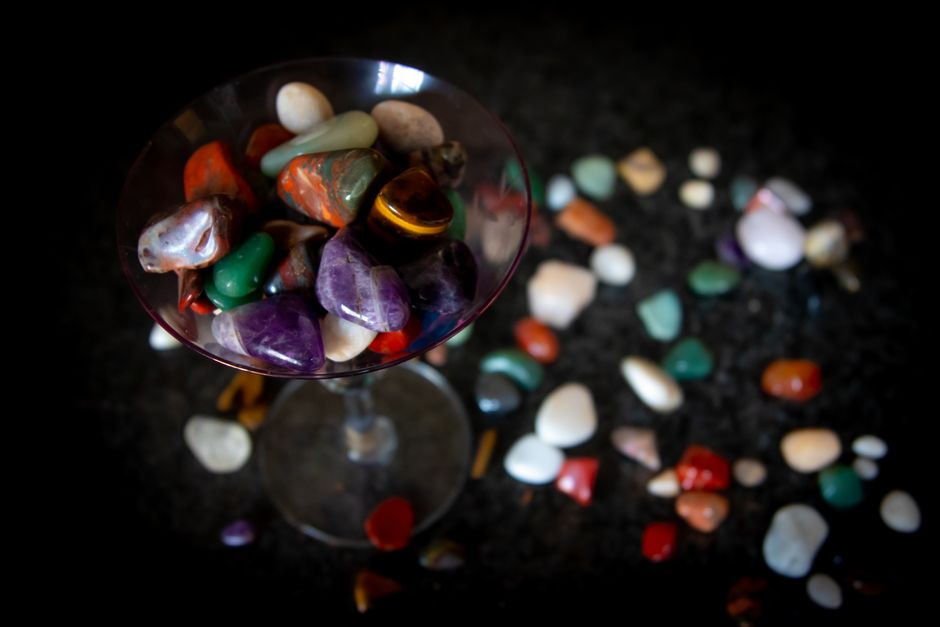
Mohs hardness tells you whether a stone will scratch. It says nothing about whether it will break. That single confusion explains most surprised owners: a diamond chipped on a door frame, a topaz split by a knock, a jade bangle that survived a fall onto tile. Durability is three properties, not one, and buying decisions get much easier once you separate them.
The three properties
- Hardness — resistance to scratching, measured on the Mohs scale from 1 (talc) to 10 (diamond). The scale is ordinal: the gaps between steps are not equal, and the jump from 9 to 10 is far larger than the jump from 2 to 3.
- Toughness — resistance to breaking, chipping and cracking. It depends on internal structure, inclusions and how the crystal holds together.
- Stability — resistance to chemicals, heat, light and humidity. This is what determines whether a stone survives a cleaning solution, a summer of sunlight or a jeweler’s torch.
A stone can be excellent at one and poor at another. Choosing a gem for daily wear means checking all three against how the piece will actually be used.
Where common gems really sit
| Gem | Mohs | Toughness | Watch out for |
|---|---|---|---|
| Diamond | 10 | Good, but has cleavage directions | A sharp blow on an edge can chip it |
| Ruby / sapphire | 9 | Excellent | Fracture-filled stones are far weaker |
| Topaz | 8 | Poor | Perfect basal cleavage — it can split cleanly |
| Emerald | 7.5–8 | Poor | Fissures and fillers; no ultrasonic |
| Quartz (amethyst, citrine) | 7 | Good | Some colours fade in prolonged sunlight |
| Jadeite / nephrite | 6–7 | Exceptional | Dyed and polymer-treated material is common |
| Tanzanite | 6–7 | Poor | Cleavage and sensitivity to sudden heat |
| Moonstone | 6–6.5 | Poor | Feldspar cleavage; chips at the edges |
| Opal | 5.5–6.5 | Very poor | Crazing, heat, and assembled stones |
| Turquoise | 5–6 | Fair | Porous — absorbs oils and can change colour |
| Pearl | 2.5–4.5 | Fair | Acids, cosmetics, drying out |
Two rows explain the whole point. Jade at 6 to 7 is softer than topaz at 8, and vastly tougher — its interlocking fibrous structure resists breaking, which is why it can be carved into thin bangles. Topaz will outlast jade against scratches and can split from a single knock in the wrong direction.
The quartz line
Ordinary household dust contains quartz particles at about 7 on the Mohs scale. Any gem softer than that will slowly abrade in everyday life, no matter how carefully it is treated — which is the real reason opal, moonstone, turquoise and pearl lose their polish over years of wear. It is not damage in a single event; it is thousands of small ones.
Cleavage: the property nobody mentions at the counter
Cleavage is a plane along which a crystal separates cleanly. Diamond has it, topaz has it prominently, and so do moonstone and tanzanite. A stone with strong cleavage can be very hard and still split from a single well-placed impact, and the risk is highest during setting, sizing and cleaning — which is why a jeweler asks what the stones are before starting work, and why some stones must be removed before a ring is resized.
How to use this when buying
- Match the gem to the piece. Rings take the most abuse; earrings and pendants take the least. A soft or brittle stone is a much safer buy as a pendant.
- Match the setting to the weakness. Cleavage and brittleness call for a bezel and a low profile — see setting styles compared.
- Ask about treatments before asking about cleaning. A fracture-filled stone has the durability of its filler, not of its species.
- Default to warm water, mild soap and a soft brush. Ultrasonic and steam cleaners are for hard, untreated, stable stones only.
- Store hard and soft separately. A loose diamond in the same pouch as an opal will win.
Frequently asked questions
Can a diamond really chip?
Yes. Diamond is the hardest natural material, but hardness is not toughness — a sharp impact along a cleavage direction can chip or split it. Girdles and pointed corners are the usual casualties.
What Mohs hardness is safe for an engagement ring?
Around 7 and above resists everyday scratching, and 8 or above is comfortable. Below 7, expect visible wear over years unless the stone is protected in a bezel and removed for physical work.
Is a harder stone always more durable?
No. Jade is a standing counter-example: comparatively soft, extremely tough. Durability is hardness, toughness and stability together.
Which stones must never go in an ultrasonic cleaner?
Emerald and other fracture-filled stones, opal, pearl, turquoise, coral, amber, tanzanite, and anything with loose settings or unknown treatments. When in doubt, do not.
Sources
- GIA Gem Encyclopedia — species-by-species hardness, toughness, stability and care guidance.
- FTC Jewelry, Precious Metals, and Pewter Industries Guides, 16 CFR Part 23 — disclosure of treatments that create special care requirements.