
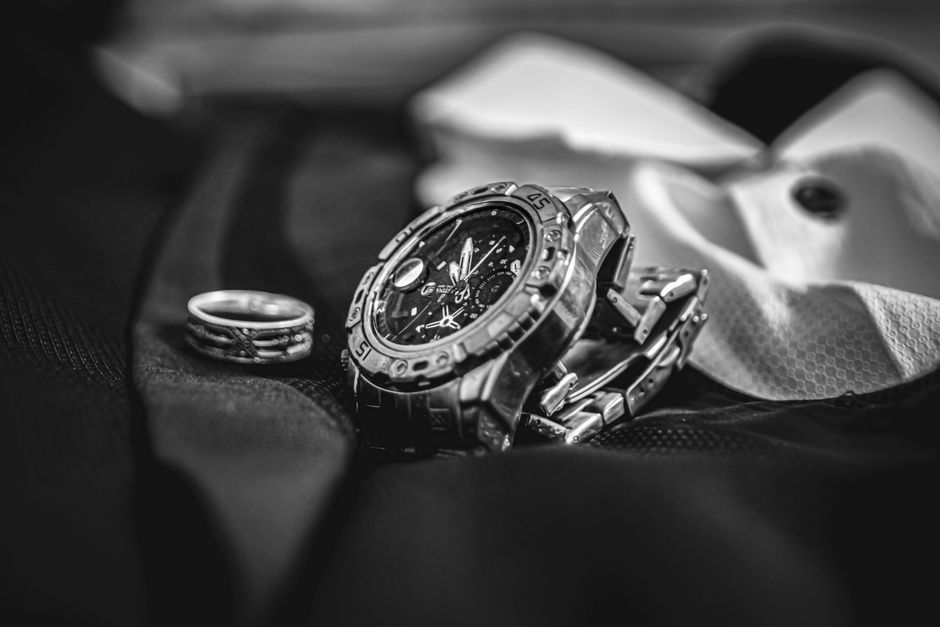
The metal decides three things you will live with: whether the ring can ever be resized, how it fails when it is damaged, and how it comes off in an emergency. Scratch resistance is the feature everyone shops on and the least important of the four. Here is how the common wedding band metals actually behave.
The shortlist at a glance
| Metal | Resize | Feel | How it fails |
|---|---|---|---|
| 14K / 18K gold | Yes | Substantial, warm | Scratches and slowly thins; repairable indefinitely |
| Platinum | Yes | Heaviest of the common choices | Scratches displace metal rather than remove it — develops a patina |
| Palladium | Yes, by a bench that stocks it | Light for a precious metal | Similar to platinum, less common to service |
| Titanium | Barely | Very light | Dents and scratches; cannot be conventionally soldered |
| Tungsten carbide | No | Dense and hard | Resists scratching, then cracks or shatters under a sharp blow |
| Cobalt chrome | No | Hard, bright white | Tough; can be cut off with standard tools |
| Stainless steel | Impractical | Moderate weight | Durable and cheap to replace |
| Silicone | n/a | Weightless | Tears away under load — which is the point |
Hard is not the same as tough
Hardness resists scratching. Toughness resists breaking. Tungsten carbide is the clearest illustration: it is hard enough to shrug off the scratches that mark gold within a week, and brittle enough that a sharp impact on a hard surface can crack it. Gold and platinum are the opposite — they mark easily and almost never break.
Choose on how your ring will be damaged. Someone who drags their hand across concrete all day is fighting scratches. Someone who works around machinery, drops things or lifts heavy loads is fighting impact and entrapment, and hardness will not help.
Emergency removal — ask before you buy
Any ring can have to come off quickly after an injury or swelling. How that happens depends on the metal:
- Gold, silver, platinum, palladium. Cut with a standard ring cutter in seconds. This is the default hospitals expect.
- Cobalt chrome, stainless steel. Cut with standard or heavy-duty cutters.
- Titanium. Harder; a powered cutter with a diamond wheel is often needed.
- Tungsten carbide. Not cut — cracked. The usual method is to grip the band with locking pliers until the brittle material fractures. It works, but the ring is destroyed.
None of this is a reason to avoid a hard metal. It is a reason to know the answer in advance, and a reason people in trades often wear a silicone band at work — it is designed to break away rather than degloving a finger.
What the precious-metal marks mean
Karat marks describe gold content: 24K is pure, 18K is 75% gold, 14K is 58.3%, and 10K is 41.7%. Under the FTC Jewelry Guides, “platinum” used alone should mean at least 950 parts per thousand pure platinum, with 950, 900 and 850 marks used where the fineness is disclosed, and platinum-group blends have their own rules — at least 950 parts per thousand PGM and at least 500 parts per thousand pure platinum. A band that carries no stamp at all is not automatically fake, but it is a question worth asking. The vermeil and plating rules in the same guides are what separate a coated band from a solid one.
Nickel, plating and skin reactions
Persistent redness or itching under a band is usually one of two things: irritant dermatitis from water and soap trapped under the metal, or a genuine nickel allergy. White gold alloys and some stainless steels contain nickel; commercially pure titanium, platinum and palladium do not.
The European Union regulates this directly. REACH Annex XVII entry 27 limits nickel release to 0.5 micrograms per square centimetre per week for articles in direct and prolonged contact with the skin — rings included — and 0.2 for posts inserted into pierced parts of the body, tested to the EN 1811 standard. There is no equivalent federal limit in the United States, so for sensitive skin the safer route is a metal that contains no nickel rather than a claim on a listing page.
Finish wears differently from metal
A brushed or matte finish on gold will smooth toward shiny at the contact points within months; a polished finish will pick up fine scratches and dull. Both are cosmetic and both can be restored on precious metals. On plated or coated bands — black IP coatings, rose-gold plating over steel — the finish is a layer, and when it wears through, the base colour shows. That wear is not repairable in the way a solid metal is.
Frequently asked questions
Which men’s band metal is the most durable?
It depends on the failure you care about. Tungsten carbide resists scratching best; platinum and gold survive impact and can always be repaired. There is no metal that is best at both.
Can a tungsten ring be cut off in an emergency?
It is cracked rather than cut, usually with locking pliers. Emergency rooms handle it routinely, but confirm the retailer offers a replacement programme, because the ring will not survive.
Does platinum scratch less than gold?
No — it scratches readily. The difference is that platinum displaces metal into a ridge instead of losing it, so a platinum band develops a soft patina and keeps its weight over decades. Gold loses a little material with every polish.
Is stainless steel safe for sensitive skin?
Often, but not always: common jewellery grades contain nickel, and how much is released depends on the alloy and finish. If you have a diagnosed nickel allergy, titanium, platinum, palladium or high-karat gold are safer starting points.
Sources
- FTC Jewelry, Precious Metals, and Pewter Industries Guides, 16 CFR Part 23 — karat marking, platinum and platinum-group fineness rules, plating definitions.
- ECHA — REACH Annex XVII, entry 27 (nickel) — 0.5 µg/cm²/week for prolonged skin contact, 0.2 µg/cm²/week for piercing posts, tested to EN 1811.