
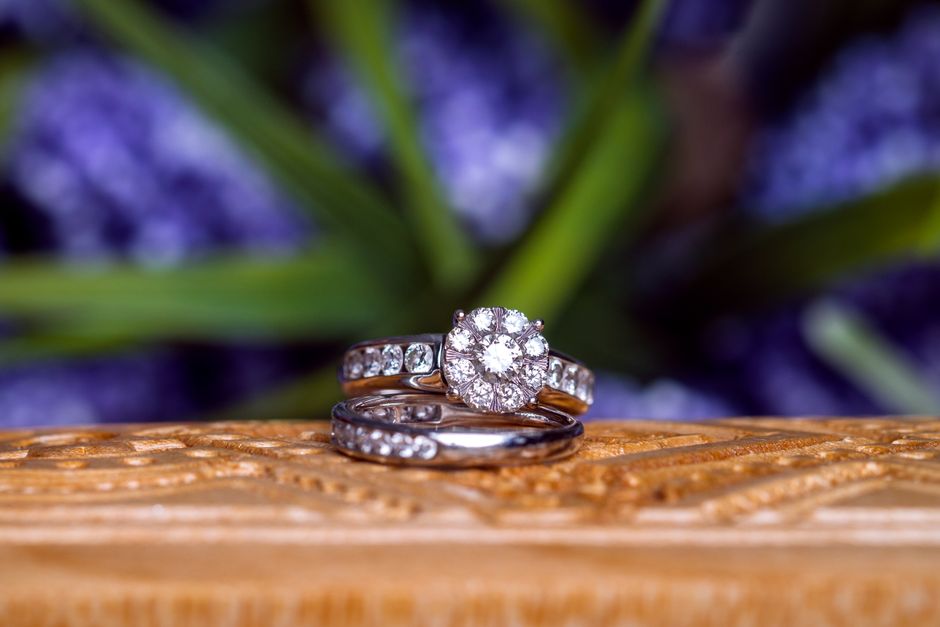
A full eternity ring cannot be resized; a half-eternity can. That single difference drives most of the others — cost, repairability, how the ring wears against a neighbouring band, and how carefully you have to be measured before ordering. Stones all the way around look spectacular and commit you to a size for the life of the ring.
What the terms actually mean
- Full eternity. Stones set continuously around the entire circumference. There is no plain metal anywhere on the shank.
- Half eternity. Stones across roughly the top half of the ring, plain metal underneath. Often the most practical version.
- Three-quarter eternity. A compromise — stones cover about three quarters, so the ring still reads as continuous from most angles while leaving a short plain section at the base.
Sellers are not consistent about these labels. Ask for the number of stones and how far the setting extends, not the marketing name.
Sizing: the decision you cannot undo
Resizing works by cutting the shank and adding or removing metal. A full eternity has no plain section to cut, and shifting the metal would disturb the stones nearest the join. In practice a full eternity that does not fit has to be remade with a different stone count, at close to the original price.
Because of that, order a full eternity only when you are confident of the size, and measure properly:
- Be sized at normal body temperature, not straight from the cold, and not immediately after exercise.
- Be sized on a band of similar width — a channel-set eternity behaves like a wide band, so use a wide sizer.
- Check the size twice on different days before ordering.
- Ask what the maker does if the size is wrong on arrival, in writing, before paying.
A half-eternity sidesteps all of this: the plain lower shank gives the bench somewhere to work, and normal sizing rules apply — roughly two sizes in either direction before the proportions suffer. See what determines whether a ring can be resized.
Repair and long-term wear
The bottom of any ring takes the most abuse — it is the part that contacts desks, steering wheels and gym bars. On a half eternity that surface is plain metal, which wears down predictably and can be re-shanked when it thins. On a full eternity that surface holds stones, so the same wear attacks the setting itself: prongs or channel walls thin, and a stone eventually loosens.
Two consequences follow for full eternity rings:
- Inspect more often. Twice a year is a reasonable cadence for a ring worn daily, and the lower stones deserve the closest look.
- Expect stone replacement over the years. Matching a small melee stone is routine work; matching an unusual size or a coloured stone across a set is harder, so keep the original specification.
Setting style matters more than the eternity label
| Setting | Security | Trade-off |
|---|---|---|
| Channel | High — stones sit between two metal walls | Less light enters from the sides; dirt collects in the channel |
| Shared prong | Moderate — each prong holds two stones | Maximum brilliance, but one bent prong affects two stones |
| French/pavé | Moderate | Many tiny beads of metal to check; very fine work |
| Bezel or half-bezel | Highest | Chunkier look; covers more of each stone |
| Flush/burnish | High | Stones sit level with the metal, so less sparkle |
If the ring will be worn every day and knocked about, a bezel or channel eternity survives better than shared prongs. The same trade-off appears in engagement rings, covered in the prong-set and bezel-set guides.
Where the money goes
A full eternity uses roughly twice the stones of a half eternity of the same width and quality, and setting labour scales with stone count rather than with metal weight. That is why the price gap is usually wider than people expect — and why a half eternity with better stones often looks better than a full eternity with worse ones at the same budget.
Total carat weight is the number sellers advertise, but it hides the distribution: twenty small stones and ten larger stones can share a carat total and look nothing alike. Ask for stone count, individual stone size in millimetres, and the colour and clarity range. For coloured stones, ask whether the set is matched for hue and saturation, because a mismatched row is obvious in daylight.
Comfort and stacking
Stones on the underside of a full eternity press against the finger and against any ring worn next to it. Two eternity bands worn together grind against each other, and the metal between the stones is thin. Many people who wear an engagement ring plus a band find a half eternity sits flatter and does less damage to its neighbour. If you plan to stack, bring the other ring to the fitting.
Frequently asked questions
Can a full eternity ring ever be resized?
Not by conventional sizing. Some makers will remake the ring with more or fewer stones, and a few designs with a hidden plain section can be adjusted slightly. Treat “not resizable” as the default and get any exception in writing.
Is a half-eternity noticeably less impressive?
Not when worn. The lower third of a ring faces the palm and is rarely visible. What you gain is the ability to resize, re-shank and repair the part of the ring that wears fastest.
What happens if a stone falls out?
A jeweler matches and re-sets it. Keep the original specification — stone size in millimetres, colour and clarity range — because matching is far easier with numbers than with a photograph.
Which is better for daily wear?
A half eternity in a channel or bezel setting, in a metal appropriate to your work. It resizes, it re-shanks, and the surface that takes the abuse is metal rather than stone.
Sources
- GIA Gem Encyclopedia — gem durability and the setting styles that suit daily wear.
- FTC Jewelry, Precious Metals, and Pewter Industries Guides, 16 CFR Part 23 — required disclosures for total weight, laboratory-created stones and treatments.