
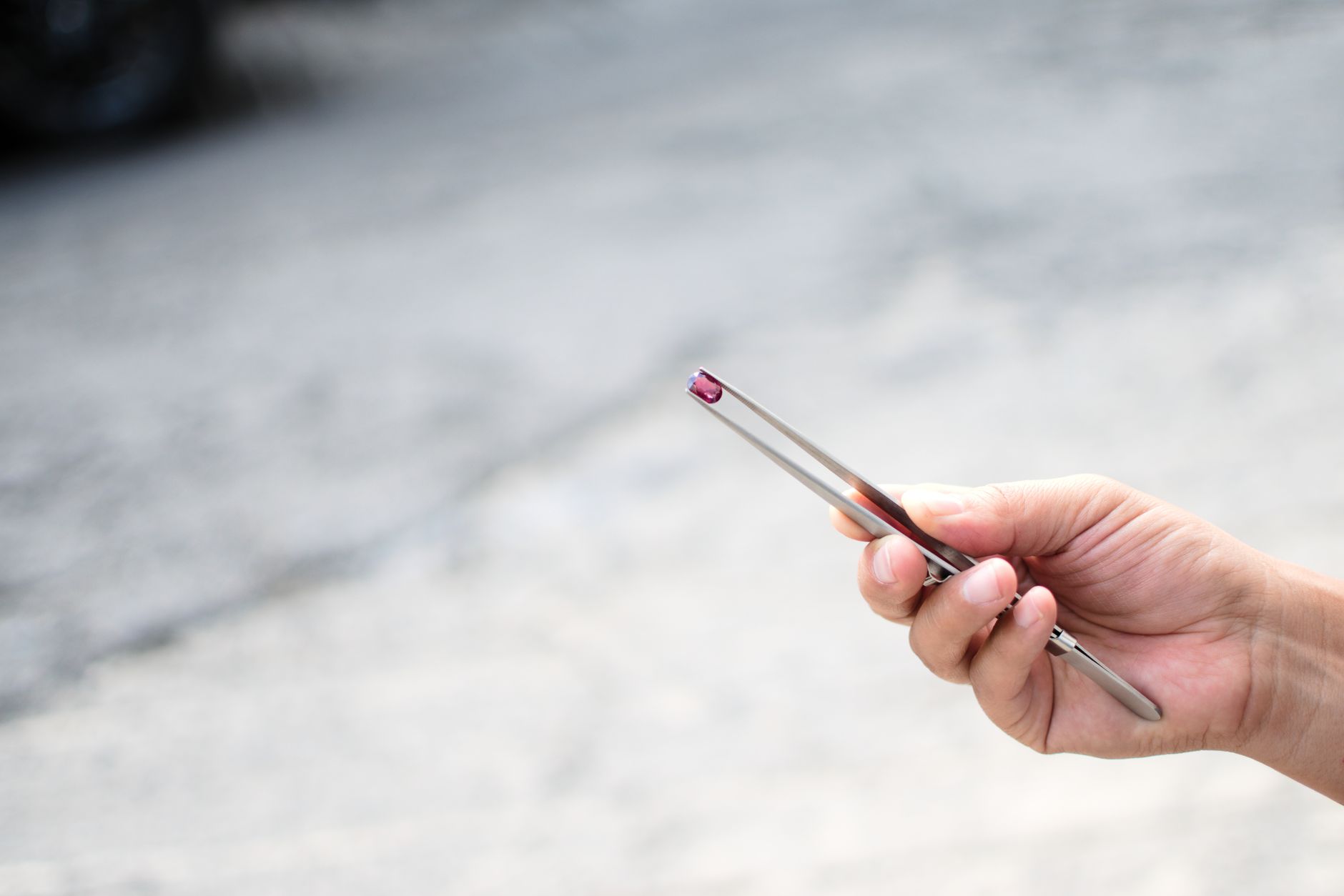
Inspect the necklace under bright light and magnification, checking each gemstone for movement and the surrounding metal for cracks, gaps, or thinning. Then examine the pendant's bail, connecting rings, chain, and clasp, because these parts often fail before the pendant body does. A home inspection can reveal warning signs, but it cannot measure metal thickness or confirm a hidden fracture. If anything moves, catches, bends, or looks uneven, stop wearing the necklace until a jeweler examines it.
Table of Contents
- Prepare the Necklace Without Damaging It
- How to Check Whether a Gemstone Is Loose
- Where Weak Metal Usually Appears
- Decide Whether the Necklace Is Safe to Wear
Prepare the Necklace Without Damaging It
Work over a soft, light-colored surface so the necklace cannot fall onto a hard floor. Use a bright lamp and, if available, a 10-power jewelry loupe. A phone camera's macro mode can help compare details, although digital zoom may blur fine cracks. Before inspecting the piece, remove surface dust with a clean, soft brush or lint-free cloth.
Do not use an ultrasonic cleaner, steam, solvents, or chemical dips unless you know the gemstone and any treatments it has received. Opals, emeralds, pearls, turquoise, and many treated stones can require special care. Gather only nonmetal tools: Lay the chain straight without pulling it taut. Untangle knots gently rather than forcing them, since a kinked or stretched link can resemble ordinary twisting.
- A 10-power loupe or magnifying glass
- A bright, movable light
- A clean wooden toothpick
- A soft cloth or padded tray
- A phone camera for reference photographs
How to Check Whether a Gemstone Is Loose
First identify how the gemstone is held. Prong settings use small metal claws, bezel settings surround the stone with a metal rim, and channel or pavé settings hold several stones close together. Each style shows weakness differently. Under magnification, compare all prongs or bezel edges around the stone.
Prongs should contact the gemstone and appear reasonably even. A prong that sits higher, looks shorter, leans away, or has a flattened tip may no longer secure the stone properly. Test for movement with minimal pressure: Do not push down hard or attempt to bend a prong back into place. Some gemstones have natural internal features that can look like cracks, while actual chips often appear along exposed edges or near prongs. A new gap, loose fragment, or change from an earlier photograph deserves professional inspection.
- Hold the pendant close to your work surface.
- Touch the gemstone's edge gently with a wooden toothpick.
- Watch the boundary between the stone and its setting.
- Stop immediately if the stone shifts, rocks, clicks, or rotates.
Where Weak Metal Usually Appears
Inspect the narrowest and most frequently moving areas first. These include prong tips, the pendant bail, jump rings, chain links near the clasp, hinge points, and soldered joints. A jump ring is the small connecting loop between jewelry components. Look for cracks, deep scratches, stretched openings, thinning, or changes in shape.
A dark line across a solder joint may mark a gap, although tarnish and residue can create a similar appearance. Compare both sides under the same light before deciding that the metal has split. Check these high-risk areas closely: Open and close the clasp once while supporting the chain. It should return fully to its closed position without sticking. Do not repeatedly flex the bail, rings, or links to "test" their strength; metal fatigue can worsen before a crack becomes visible.
- The base of every prong, where bending stress concentrates
- The inside top of the bail, where the chain rubs
- Jump rings that no longer close edge to edge
- Hollow pendant walls with dents or sharp creases
- Chain links that look longer, narrower, or twisted
Decide Whether the Necklace Is Safe to Wear
Minor surface scratches usually affect appearance rather than security. Movement in a gemstone, an open connecting ring, a missing prong, a split solder seam, or a partly broken chain link creates a loss risk and calls for immediate repair. Remove the necklace by supporting the pendant instead of letting it hang from the questionable part. Store it flat in a separate padded container.
Avoid tape, glue, pliers, or household solder, which can obscure damage and complicate a proper repair. A jeweler can inspect hidden surfaces, test the security of the setting, and determine whether worn metal needs rebuilding or replacement. Ask for the stone's condition to be recorded before repair, especially if it is chipped, fracture-filled, soft, or sensitive to heat. For valuable or sentimental jewelry, photograph the front, back, setting, bail, clasp, and hallmarks after each professional inspection. Bring the necklace in promptly if a new photograph shows a widening ring gap, shorter prong, thinner bail, or gemstone that has changed position.