
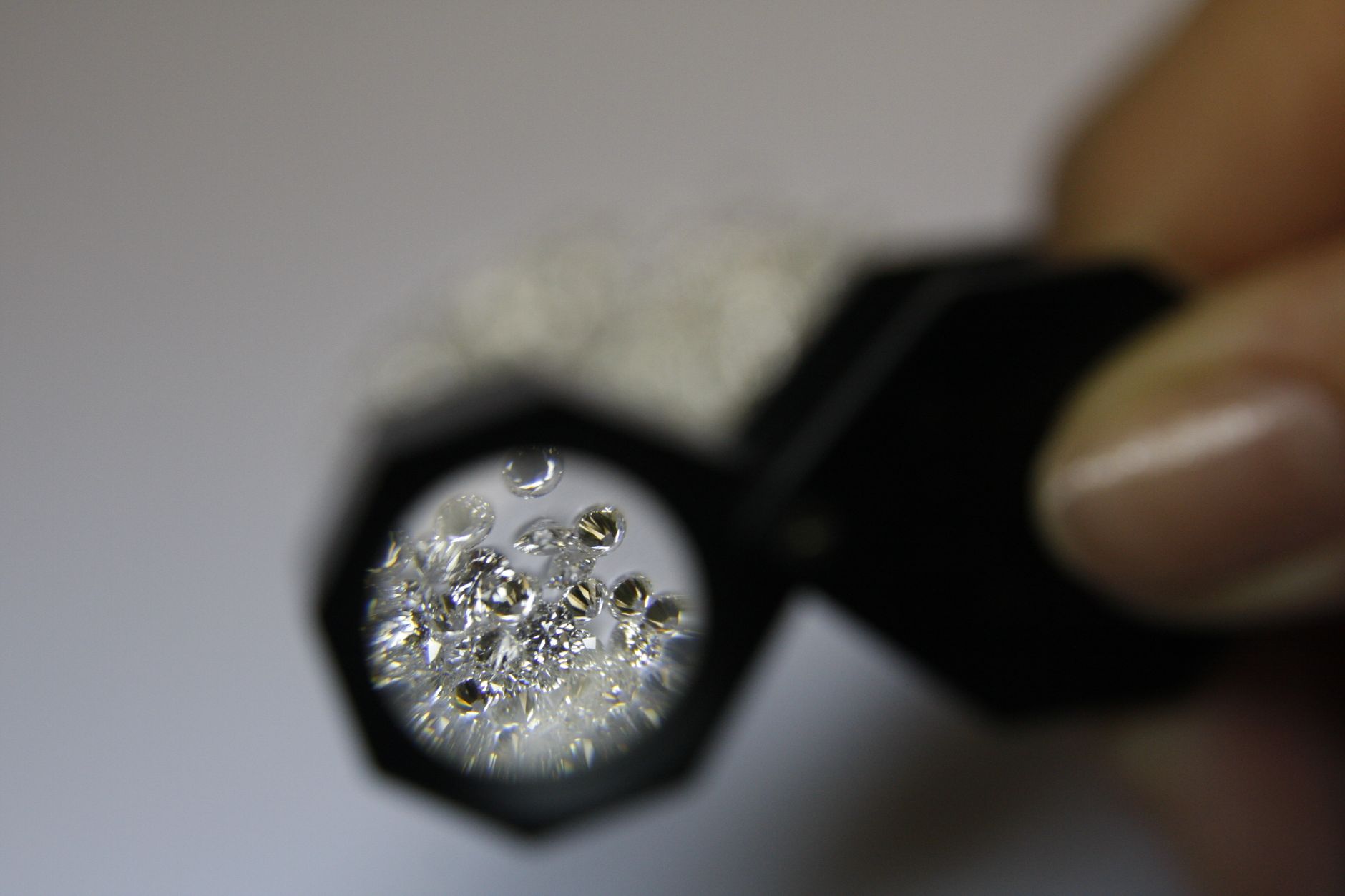
Jewelers grade diamond clarity in a ring setting by inspecting the visible portions of the stone under 10-power magnification for inclusions and blemishes. Because prongs, bezels, and galleries hide part of the diamond, the result is an estimate rather than a formal laboratory grade. Clarity means the relative freedom from internal marks, called inclusions, and surface marks, called blemishes.
A formal grade is normally assigned before mounting, when the loose stone can be viewed from all sides. An in-ring check still has practical value for buying, cleaning, repair, insurance, or resetting decisions. It tells what can be seen, what remains hidden, and whether unmounting makes sense.
Table of Contents
- What clarity measures
- Why a mounted diamond cannot receive a full grade
- How does the in-store examination work?
- How does the mounting change what you see?
- What should you do before buying, insuring, or resetting?
What clarity measures
Clarity describes the size, number, position, and visibility of natural marks formed during crystal growth and later handling. Common inclusions include tiny crystals, feathers, clouds, needles, and pinpoints. Common blemishes include scratches, nicks, polish lines, and marks around the girdle, the thin edge where crown meets pavilion.
A grader works at 10-power magnification, the accepted standard for judging whether a mark affects appearance. Marks invisible at that power do not change the grade, even if they appear under stronger magnification. The familiar scale runs from Flawless and Internally Flawless through Very Very Slightly Included, Very Slightly Included, Slightly Included, and Included.
Why a mounted diamond cannot receive a full grade
A laboratory grade requires a loose, clean diamond examined face-up, face-down, and from the side. The grader maps marks across the crown, girdle, and pavilion and tests whether they are internal, external, dirt, or reflections.
That full rotation is impossible once metal covers the girdle, lower girdle, culet, and much of the pavilion. A ring appraisal or in-store opinion therefore uses careful language. A jeweler may say the stone "appears" to fall in a range, "subject to mounting," or "as far as visible." That wording protects the buyer because a hidden feather, chip under a prong, or abraded girdle can alter the true grade.
How does the in-store examination work?
The jeweler usually starts by cleaning the ring, since lint, soap film, and oil can mimic clouds or dull the stone. The diamond is then checked with a loupe, a small hand magnifier, and often a binocular microscope for steadier focus.
The jeweler views the table and crown at several angles, tilts the ring to catch side light, and looks through the crown toward the pavilion where the mounting allows. A careful check follows the same order each time so little is missed:.
- Clean and dry the stone, then examine face-up under 10-power magnification.
- Tilt and rotate the ring to inspect the crown facets, table edge, and exposed girdle.
- Note the location, size, and relief of each visible mark and whether cleaning removes it.
- Record which areas are hidden by prongs, bezel metal, or heavy buildup.
How does the mounting change what you see?
Metal can both conceal and emphasize marks. A prong may cover a small chip, feather, or extra facet at the girdle. A full or partial bezel can hide girdle roughness, while a high cathedral shank or closed gallery can darken the pavilion and make inclusions harder to separate from shadow.
Setting style also affects face-up appearance. A six-prong solitaire lifts the stone and admits more side light, which can make small inclusions easier to spot. A bezel or halo can reflect light back into the stone, brighten the outline, and draw attention away from a faint inclusion near the center. Dirt works the same way, so a dull gray patch near a prong often proves to be trapped debris rather than a clarity feature.
What should you do before buying, insuring, or resetting?
Ask whether a laboratory report was issued for the diamond loose, and check that weight, shape, measurements, and inclusion plot match the stone in front of you. For an important purchase, inheritance, insurance schedule, or reset, consider having the stone briefly unmounted and graded loose by a qualified grader or laboratory. Unmounting carries small risks to prongs and girdle, so weigh the value of certainty against wear on an older mounting.
Keep the paperwork paired with the ring. Save the laboratory report, prior appraisal, photographs, and any note that the in-ring clarity was an estimate. At insurance inspection or trade-in, point out which inclusions the jeweler saw and which facets were hidden, then have the mounting tightened and the stone rechecked after cleaning.