
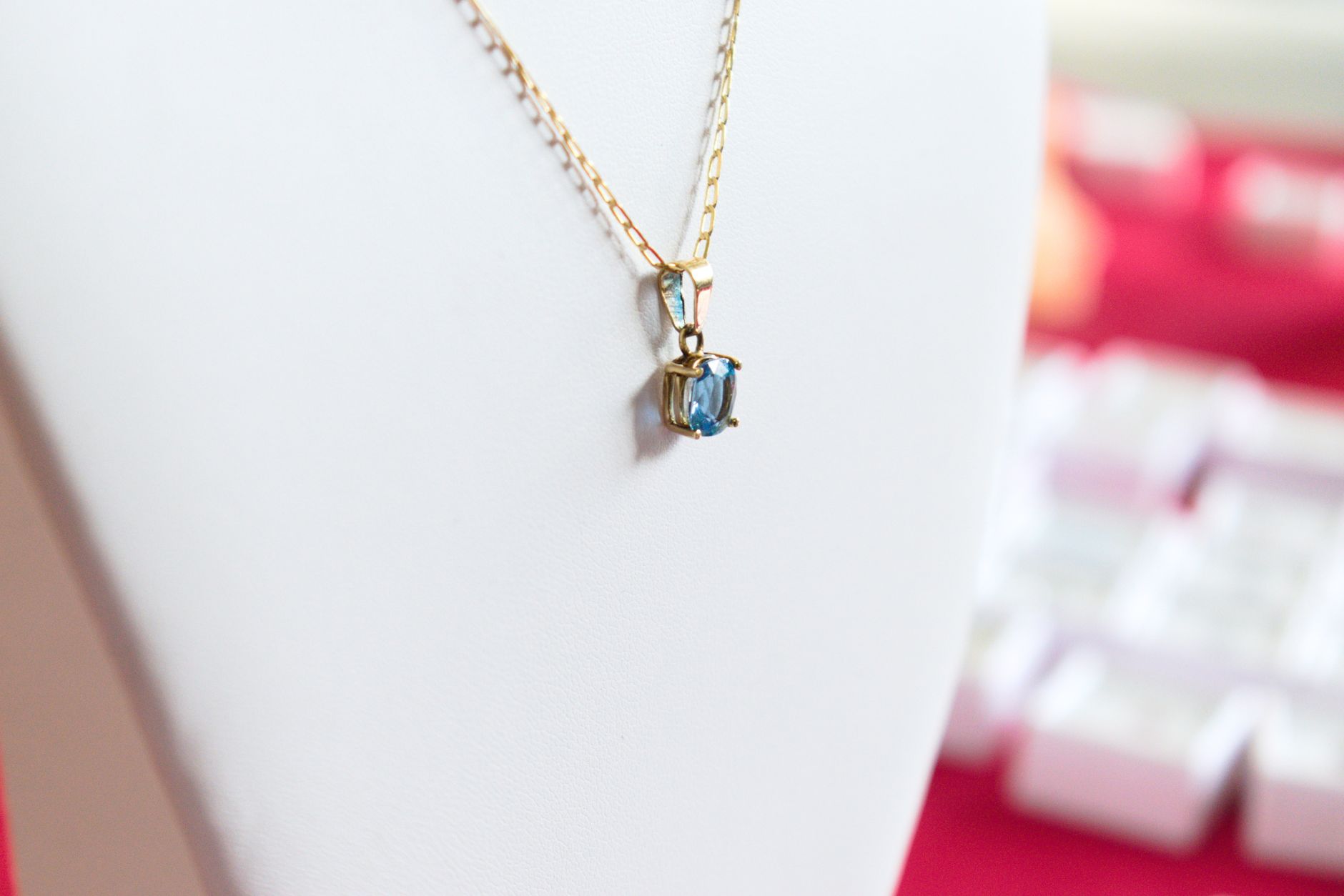
A gemstone pendant necklace does not change a stone's inherent color, but its setting, chain, position, and surroundings can change the color you see. These elements control how light enters, reflects through, and escapes from the gemstone—and whether the stone remains visible against skin or clothing. The effect can be subtle or dramatic. A pale gem may look brighter in an open setting, darker with a closed back, warmer beside yellow gold, or more defined against contrasting fabric.
Table of Contents
- The Setting Controls Light
- Metal Color Changes the Visual Context
- Pendant Position Affects Visibility
- Cut and Orientation Shape Brightness
- Construction Can Help—or Mislead
The Setting Controls Light
An open-back setting leaves the area behind the gemstone exposed. Light can reach the stone from several directions, which often helps transparent or translucent gems appear lively. Open sides can produce a similar effect while allowing easier access for cleaning. A closed-back setting blocks light from behind.
It may deepen the apparent color or reduce brightness, especially in a pale transparent stone. However, a reflective metal backing can return some light toward the viewer and make certain gems appear more luminous. Neither design guarantees a particular result. A gemstone's cut, clarity, color depth, and optical properties still determine how it handles light. Dust, skin oils, and residue can also obstruct an open setting and quickly dull its advantage.
Metal Color Changes the Visual Context
Metal creates a color boundary around the gem. Yellow and rose gold can make the overall composition feel warmer, while white gold, platinum, and silver-toned metals usually provide a cooler frame. This is a contrast effect; the metal does not normally alter the gem itself. The setting can influence appearance more directly when metal is visible through a transparent stone.
Yellow gold beneath a lightly colored gem may add a warm cast. Bright white metal can make some colorless or pale stones appear crisper, although it may also emphasize gray or cool undertones. Consider these common pairings as visual tendencies, not fixed rules: Prongs matter too. Fine prongs reveal more of the gemstone, while a broad bezel creates a stronger metal border. A bezel may improve definition from a distance even if it covers part of the stone's edge.
- Yellow gold can enrich honey, orange, red, and earthy tones.
- Rose gold can complement pink, peach, and some purple stones.
- White metals can sharpen blue, green, violet, and colorless gems.
- Darkened metal can create strong contrast around pale or bright stones.
Pendant Position Affects Visibility
A pendant is viewed against a background rather than in isolation. Skin tone, a neckline, or fabric can make the gemstone appear lighter, darker, warmer, cooler, or less saturated through contrast. A pale aquamarine may fade against a light blue blouse but stand out against charcoal fabric. A deep garnet can look nearly black over dark clothing yet show more red against a lighter background. Transparent stones are especially responsive because the background may be visible through them.
Chain length determines where that comparison occurs. Before choosing a length, identify whether the pendant will usually rest on bare skin or clothing. An adjustable chain provides more control when necklines and colors change. Scale also affects recognition. A small stone with low color contrast may disappear from conversational distance, even when it looks attractive up close. A visible metal outline, halo, or larger bail can help define the pendant without requiring a larger gemstone.
Cut and Orientation Shape Brightness
A well-proportioned faceted stone redirects light toward the viewer, creating flashes and areas of brightness. If the cut allows too much light to escape through the bottom, the center may look pale, glassy, or transparent. A setting cannot fully correct that optical weakness. Cabochons—stones with smooth, rounded tops—behave differently. They emphasize body color, translucency, patterns, or moving optical effects rather than sharp flashes.
Their appearance often depends on broad, soft illumination. The pendant's movement continually changes the angle between the stone, light source, and viewer. Facets may flash briefly, while strongly directional effects can appear and disappear. A pendant that tilts forward may also return less light directly to the eye than the same gemstone held upright. When comparing pieces, inspect each pendant: Some stones change appearance under different light sources because each source contains a different mix of wavelengths. That lighting response belongs to the gemstone, but the pendant's orientation and setting determine how clearly the viewer can see it.
- Upright and at its natural hanging angle
- Under daylight and ordinary indoor lighting
- Against both light and dark backgrounds
- From close range and normal conversational distance
Construction Can Help—or Mislead
Foil, reflective plates, colored coatings, and tinted adhesives can intensify or modify a gemstone's apparent color. These treatments or construction methods may be intentional, but buyers should know when the visible effect does not come from the stone alone. A closed setting can make inspection difficult. It may conceal the gem's back, inclusions, mounting damage, or color-enhancing material.
Ask whether the stone is natural, laboratory-grown, treated, assembled from multiple layers, or backed with reflective material. Cleaning requires equal care. Residue beneath a gemstone can darken it or reduce sparkle, but not every stone tolerates ultrasonic cleaning, steam, chemicals, or soaking. Follow care guidance for the specific gemstone and setting; when its identity or treatment is uncertain, use only a soft cloth until a qualified jeweler examines it.