
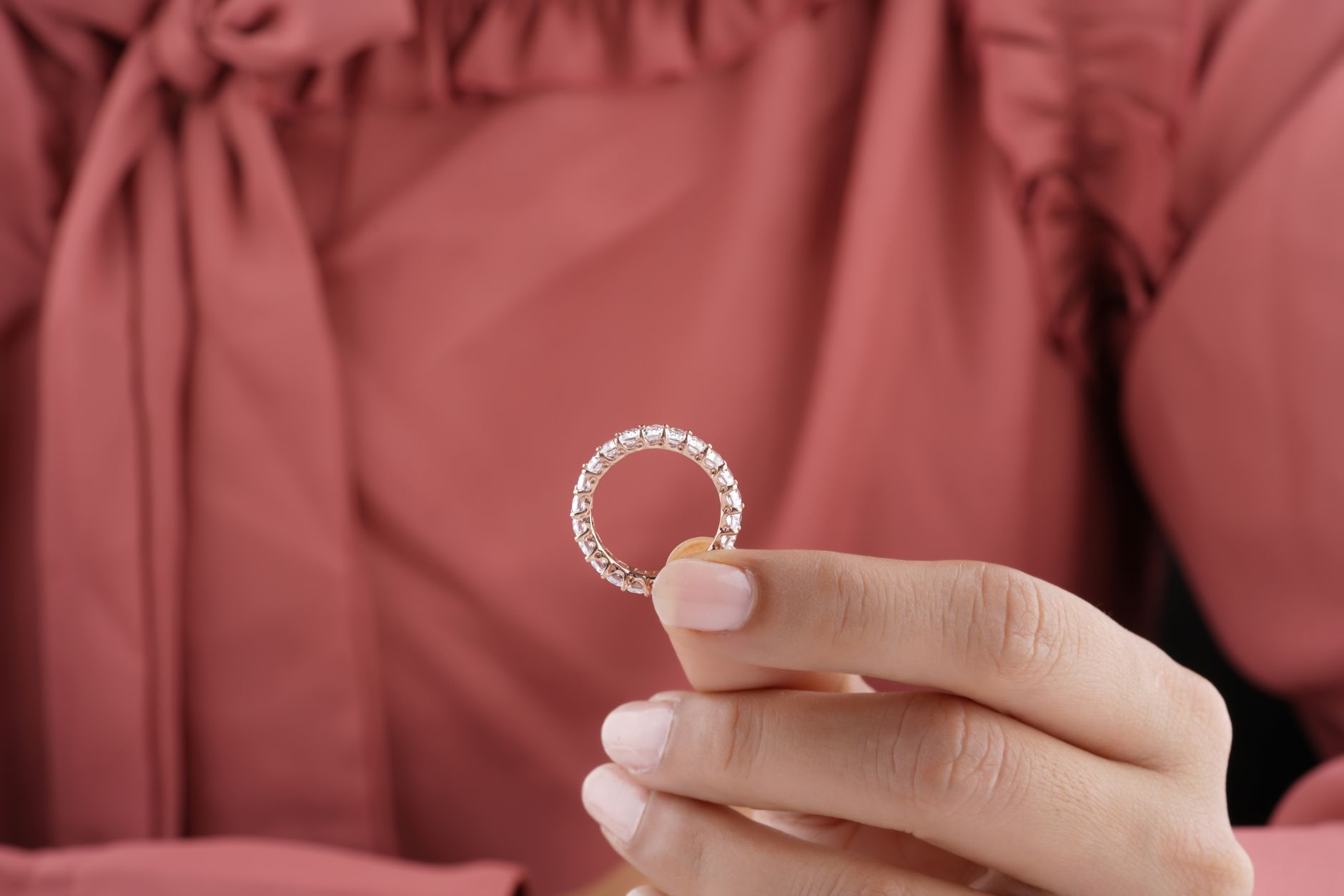
A secure, comfortable gemstone eternity band starts with a protective setting, durable stones, and an exact professional fit. Buy only after confirming its cleaning requirements, inspection needs, and repair options. A gemstone eternity band has a continuous circle of set stones. Because every side carries gems, the setting and fit matter across the entire ring—not just across its visible top.
Table of Contents
- Which setting offers enough protection?
- Match the gemstone to how you will wear it
- Get a secure fit without restricting circulation
- Use the gemstone—not the metal—as the cleaning limit
- Inspect early and repair before a stone is lost
Which setting offers enough protection?
Prong settings expose more of each gemstone, improving visibility and light return. That exposure has a cost: prongs can catch fabric and need periodic security checks. Full bezels surround gemstone edges with metal and provide maximum edge protection, according to GIA's guide to ring settings. Choose a full bezel when preventing edge damage matters more than showing the maximum amount of each stone.
Prongs suit buyers who prefer a more exposed look and accept closer maintenance. Pointed gems require particular care. V-shaped prongs protect vulnerable corners on heart, princess, pear, and marquise cuts. Confirm that every point is covered rather than assuming ordinary prongs provide equal protection.
Match the gemstone to how you will wear it
daily wear favors gems that resist scratching and accidental impact. Hardness measures scratch resistance, while toughness describes resistance to breaking; neither quality should be considered alone. Ruby and sapphire rank 9 on the Mohs hardness scale, have excellent toughness, and lack cleavage.
Opal and tanzanite face greater accidental-impact risk, as explained in GIA's overview of gemstone durability. That does not make a more vulnerable gem unsuitable. It means the buyer should consider when the band will be worn, how protective its setting is, and whether frequent inspections are realistic. Ask the seller to identify the gemstones and any treatments because those details also determine safe cleaning.
Get a secure fit without restricting circulation
A professionally sized band should resist slipping without becoming tight enough to affect circulation. Finger size can change with temperature, so one quick fitting may not represent every condition, according to GIA's ring-wearing guidance. During fitting, move and bend your fingers normally.
check whether the stones or setting press uncomfortably against neighboring fingers, and reassess the fit if your hands are unusually hot or cold. Before purchasing, ask whether that exact design can be resized and how adjustments would affect the stones. Also ask what happens if the correct size changes later; the answer may influence whether a full-circle design suits you.
Use the gemstone—not the metal—as the cleaning limit
Identify every gem and treatment before choosing a home-cleaning method. GIA considers warm, soapy water safe for ruby, but fracture-filled, cavity-filled, or dyed ruby should receive only damp-cloth cleaning. Do not assume an ultrasonic cleaner is safe because the ring contains hard stones. GIA warns that ultrasonic vibration can damage fillings, oils, resins, wax coatings, organic gems, and heat-sensitive stones such as opal, topaz, turquoise, zircon, and tanzanite.
Stone security should be checked before and after ultrasonic use because vibration can loosen gems, according to GIA's ultrasonic-cleaner guidance. For diamond-set bands, avoid chlorine bleach, abrasive cleaners, and toothpaste. GIA cautions that these substances can erode setting metals and loosen prongs. When a band contains several gem types, follow the restrictions of its most cleaning-sensitive component.
Inspect early and repair before a stone is lost
Periodic inspection is a practical form of loss prevention. GIA notes that bent or broken prongs expose vulnerable gemstone areas, while a loose diamond can wear through its metal prongs and eventually fall out.
Stop wearing the ring if you notice: Before buying, ask who performs security inspections, how replacement stones are matched, and whether treatment information will be given to the repairer. If a stone moves, place the band in a closed container and take it for professional inspection rather than continuing to wear or clean it.
- A bent, broken, or visibly displaced prong
- A gemstone that moves in its setting
- New snagging after the ring receives an impact
- Damage around a pointed corner or exposed edge