
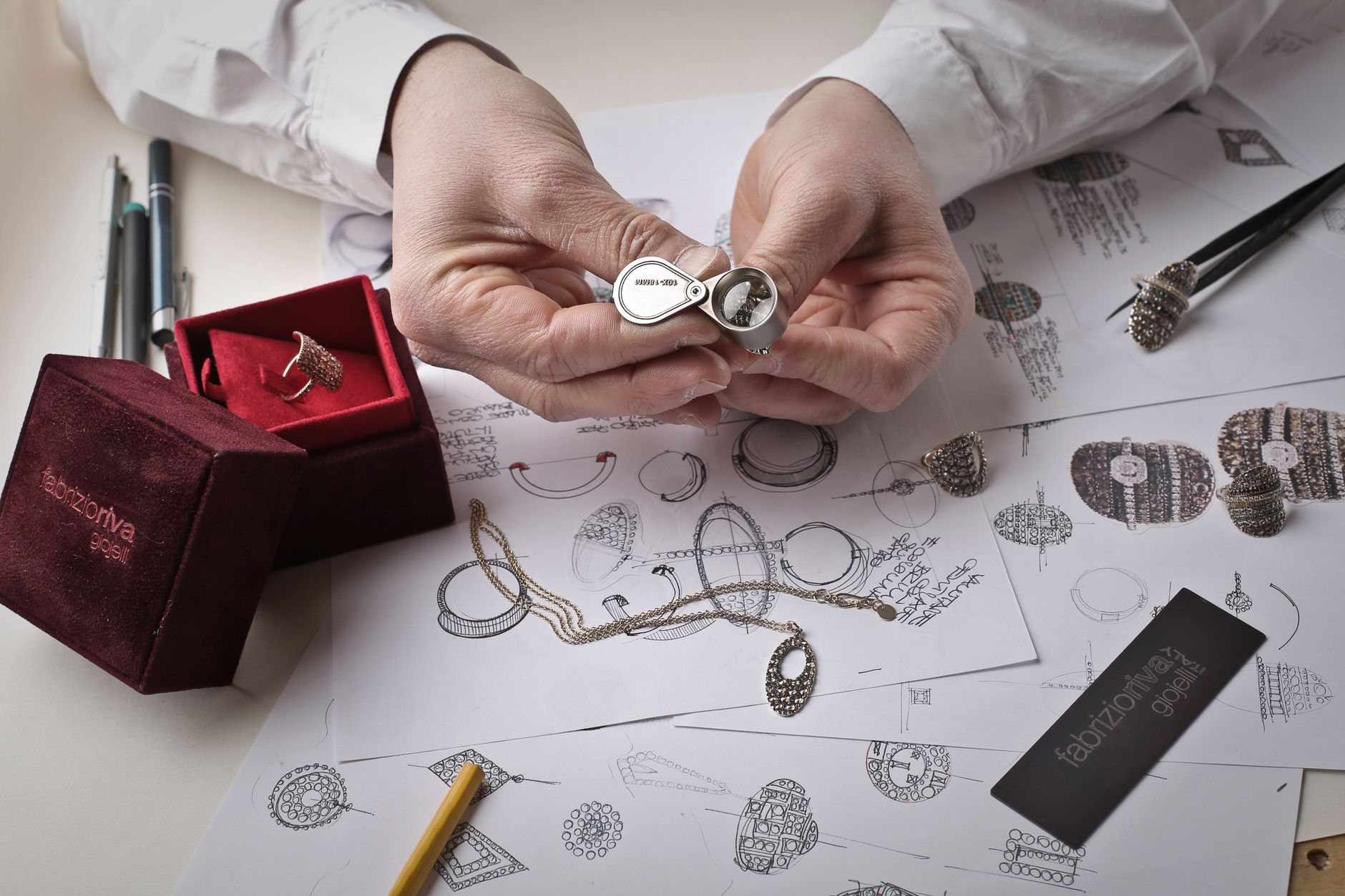
A jeweler's loupe — a small magnifier held right at the eye — shows what 10-times magnification reveals inside and on a gem, plus tiny details of finished jewelry. You will see internal inclusions, surface blemishes, cut precision, metal stamps, and report inscriptions, but not a stone's origin or value alone.
The standard tool is a 10x triplet. According to Nobbier, three bonded lenses cancel color fringing and edge distortion for a flat, sharp field in its triplet design guide. That 10x view is also the trade benchmark for judgment.
Table of Contents
- Why is 10x the standard?
- What do you see inside the stone?
- What do you see on the surface and setting?
- What can't it show, and how do you use it?
Why is 10x the standard?
Diamond clarity grading is defined at 10x. According to GIA, trained graders make the final clarity call from what is visible through a standard 10x loupe, weighing size, location, relief, nature, and number in its clarity grading explanation.
That shared baseline keeps buyers and sellers speaking the same language. A flaw invisible at 10x does not change the clarity grade, even if stronger magnification could find it.
What do you see inside the stone?
A loupe reveals internal inclusions often invisible to the naked eye. According to the Diamond Certification Laboratory of Australia, these include crystals, clouds, pinpoints, needles, feathers, and trapped minerals in its loupe inspection guide. Location matters as much as size.
A small crystal under the center table affects brilliance more than a similar mark hidden near the girdle edge. Clouds and pinpoints can look hazy rather than distinct. Needles, feathers, and larger crystals read as sharper lines, wings, or mineral specks.
What do you see on the surface and setting?
The same view checks finish and cut quality. Scratches, chips, facet junctions, polish lines, symmetry faults, and uneven light reflection all become legible. On finished jewelry it makes metal and craftsmanship details readable.
Stamps such as 14K or 925, maker's marks, prongs, bezels, worn edges, and casting pits stand out. Use that detail to judge wear, not just beauty. Sharp facet junctions and even reflection signal careful cutting, while thin prongs, worn edges, and pits signal repair or risk.
What can't it show, and how do you use it?
A loupe can display a diamond's girdle inscription so you can match the report number to the physical stone. According to GIA, buyers can check that number against the grading report, but the inscription alone does not establish value.
One limit is firm. According to GIA, synthetics cannot be spotted with a loupe and require laboratory testing, so do not rely on magnification to separate natural from laboratory-grown diamond. For a steady view, work under strong daylight-equivalent light: Higher powers shrink working distance, field of view, and depth of focus, so hold still and refocus in small moves.
- Hold the loupe close to the eye.
- Bring the gem toward you until sharp, about an inch away.
- Tilt slightly to catch inclusions, polish lines, and stamps.