
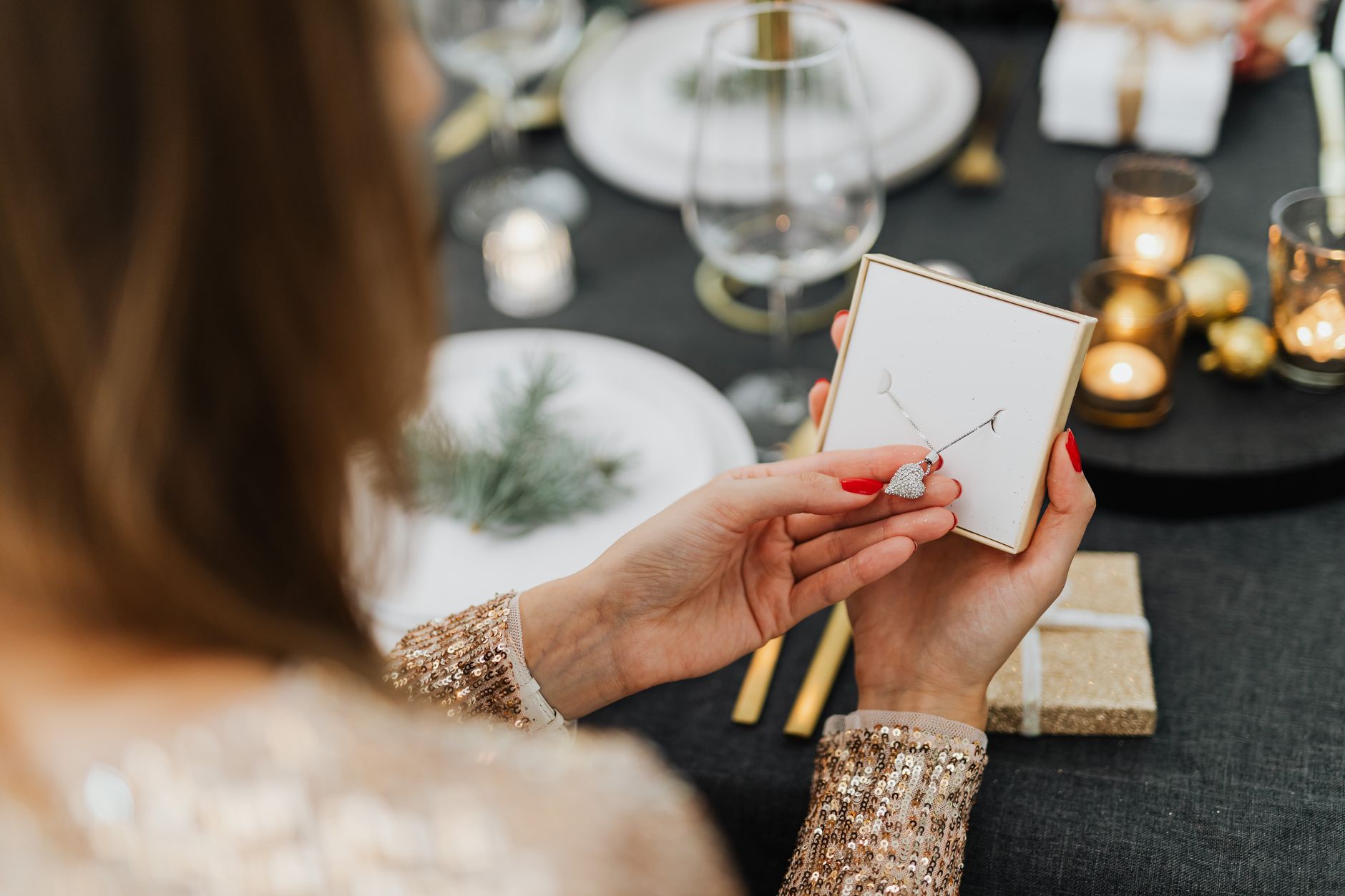
For most December parties, one well-made necklace in a metal that suits your skin and your wardrobe will outperform a pile of seasonal costume pieces. Buy a solid gold or sterling silver chain in the 16-to-18-inch range, add one statement piece — a station necklace, a pendant with real stones, or a graduated collar — and you are set for the whole season.
The bigger decision is timing. Jewelers, engravers and repair benches are at their busiest between late November and Christmas, so sizing, restringing, clasp replacement and appraisal work all take longer than they do in March. If a piece needs any work at all, the practical deadline is weeks before the event, not days.
Table of Contents
- Buy by neckline, not by trend
- What the metal stamp actually tells you
- Chain styles that survive a party
- Pearls, diamonds and colored stones for evening
- What needs lead time before a December event
- Protecting value after the purchase
- Frequently Asked Questions
Buy by neckline, not by trend
A necklace is a frame for whatever you are wearing, and the neckline decides the length. A 16-inch choker or collar sits at the base of the throat and works with a crew neck, a boat neck or a strapless gown. An 18-inch princess length falls just below the collarbone and is the most forgiving choice because it clears most necklines without competing with them. Longer lengths change the job the piece does.
A 20-to-24-inch matinee length lands on the chest and reads well over a knit dress or a high-necked blouse, where a short chain would disappear into the fabric. A 30-inch-plus opera length suits a deep V or an open blazer, and can be doubled for a layered look without buying a second piece. If you own one necklace and want it to cover several events, 18 inches is the safest length. If you are buying a second, make it longer rather than shorter — two pieces at similar lengths tangle and crowd each other, while an 18-inch and a 24-inch layer cleanly.
What the metal stamp actually tells you
Precious metal jewelry carries a stamp, usually on the clasp tag or inside the bail. In the US market, 14K means 58.3 percent gold by weight, 18K means 75 percent, and 10K means 41.7 percent. European pieces use the same figures as three-digit numbers: 585, 750 and 417. Sterling silver is stamped 925, platinum is typically 950 or PLAT, and palladium-rich white gold is still sold under the K stamps. Those numbers are a purity claim, not a quality claim.
An 18K chain is softer and richer in color than a 14K one, and it is more likely to stretch or kink if you wear it daily with a heavy pendant. For a party piece that will see occasional wear, 18K is a pleasure; for something you will wear constantly, 14K holds its shape better. Watch for stamps that describe plating rather than content. GP means gold plated, GF or 1/20 12K GF means gold filled, and vermeil means a thick gold layer over sterling silver. These are legitimate categories with legitimate uses, but they are not solid gold, and no amount of refinishing turns them into it. A piece with no stamp at all is not necessarily fake, but it is worth testing before you pay a precious-metal price for it.
Chain styles that survive a party
Not all chains behave the same way under a long evening. Some are mechanically sturdy; others look wonderful and fail at the first snag. Gauge matters as much as style. A hollow chain weighs less and costs less, but it dents and cannot always be laser-welded back together.
If you are buying one gold chain to keep, solid construction in a slightly thinner gauge is generally a better long-term buy than a hollow chain in a dramatic width. Check the clasp before you check anything else. A spring ring is the cheapest and the most likely to open under a coat collar; a lobster claw is more secure; a box clasp with a figure-eight safety is the sturdiest and is standard on strands of pearls. A heavy pendant on a weak clasp is how necklaces are lost at parties.
- Cable, rolo and curb chains: interlocking links of even weight, easy to repair, hard to kink. The safe default for a pendant.
- Box and Venetian: clean lines and good drape, but a sharp kink in a thin box chain is usually permanent.
- Rope: visually rich and strong in heavier gauges; thin hollow rope can split along the twist.
- Snake and herringbone: beautiful flat sheen, notoriously prone to a permanent crease if folded, and often uneconomical to repair.
- Omega and mesh: hold their shape and sit flat, but they are built around a core and a damaged section usually cannot be seamlessly rebuilt.
Pearls, diamonds and colored stones for evening
Pearls remain the most reliable formal necklace because they read as dressed-up under almost any lighting. The distinctions that drive price are type and surface: akoya pearls are the classic round white strand, freshwater pearls are more affordable and more variable in shape, and South Sea and Tahitian pearls are larger and command far more. Look at luster — the sharpness of the reflection on the pearl's surface — before you look at size. Strung pearls need maintenance that chains do not. Silk thread stretches and absorbs perfume, lotion and body oils, and a strand worn regularly needs restringing periodically.
Knots between pearls are the point: they stop the pearls rubbing and stop the whole strand escaping if the thread breaks. Put pearls on last, after perfume and hairspray, and wipe them with a soft cloth before they go back in the box. For diamonds and colored stones, the setting matters more than the carat weight at party-wear scale. Bezel settings protect a stone's edges and are the most forgiving around clothing and hugs; prong settings show more of the stone and catch more light but also catch more knitwear. If you are buying a diamond piece at any real price, ask whether it comes with an independent grading report and whether the stones are natural or laboratory-grown — both are real diamonds, and the price difference between them is substantial, so the disclosure is the point.
What needs lead time before a December event
Anything that touches a bench takes longer in December. Build backwards from the date.
Two habits save the most trouble. First, try the piece on with the actual outfit well ahead of the event, because a chain that sits perfectly over a t-shirt can vanish under a high collar. Second, if you are buying as a gift, confirm the return window and whether it extends past the holidays — and keep the receipt and any grading report with the box, since a lost report is expensive to replace.
- Shortening or lengthening a chain, and replacing a clasp: straightforward bench work, but queued behind everything else in the busy season.
- Restringing pearls: measured in days, longer for a knotted strand or an unusual thread.
- Engraving a locket or pendant: hand engraving is slower than machine engraving, and both book up.
- Rhodium replating white gold: a finishing-room job that cannot be rushed, and white gold that has gone warm and yellow is overdue for it.
- Insurance appraisal for a new high-value piece: appointment-based, and your insurer may need the document before coverage starts.
Protecting value after the purchase
Store chains hanging or laid flat in separate pouches. Tangled chains are the single most common reason a fine necklace goes to a repair bench, and a knot in a thin chain can require cutting and resoldering. Soft pouches also stop harder stones from scratching softer metals in a shared drawer. Keep silver away from air and sulfur.
Tarnish on sterling is a surface reaction, not damage, and an anti-tarnish strip in a closed bag slows it dramatically. Avoid dipping solutions on silver with intentional oxidized detail — they strip the darkened recesses that give the design its depth — and never use them on pearls, opals, emeralds or anything glued rather than set. Finally, record what you own. Photograph each piece, note the metal stamp, weight, stone details and what you paid, and keep the receipts with the photos. If a piece is stolen or lost, that file is the difference between a straightforward insurance claim and an argument about what the necklace actually was.
Frequently Asked Questions
Is gold-filled jewelry a reasonable buy for a party necklace?
Yes, if you understand what you are buying. Gold filled carries a far thicker gold layer than plating and holds up well with care, but it is not solid gold and should not be priced as if it were.
How do I know whether a chain will hold a heavy pendant?
Match the chain's weight to the pendant's. Hang the pendant on the chain in the store, look at whether the bail strains the links, and check that the clasp is a lobster or box type rather than a light spring ring.
Can a kinked herringbone or snake chain be repaired?
Usually not invisibly. Those chains are built from tightly fitted flat links that rely on their original alignment, so a crease tends to be permanent and repair often costs more than the chain is worth.
Should white gold or platinum go with diamonds?
Both work. Platinum is denser, more durable and more expensive, and it develops a soft patina over time. White gold is lighter and cheaper, but its bright finish comes from rhodium plating that wears off and needs redoing.