
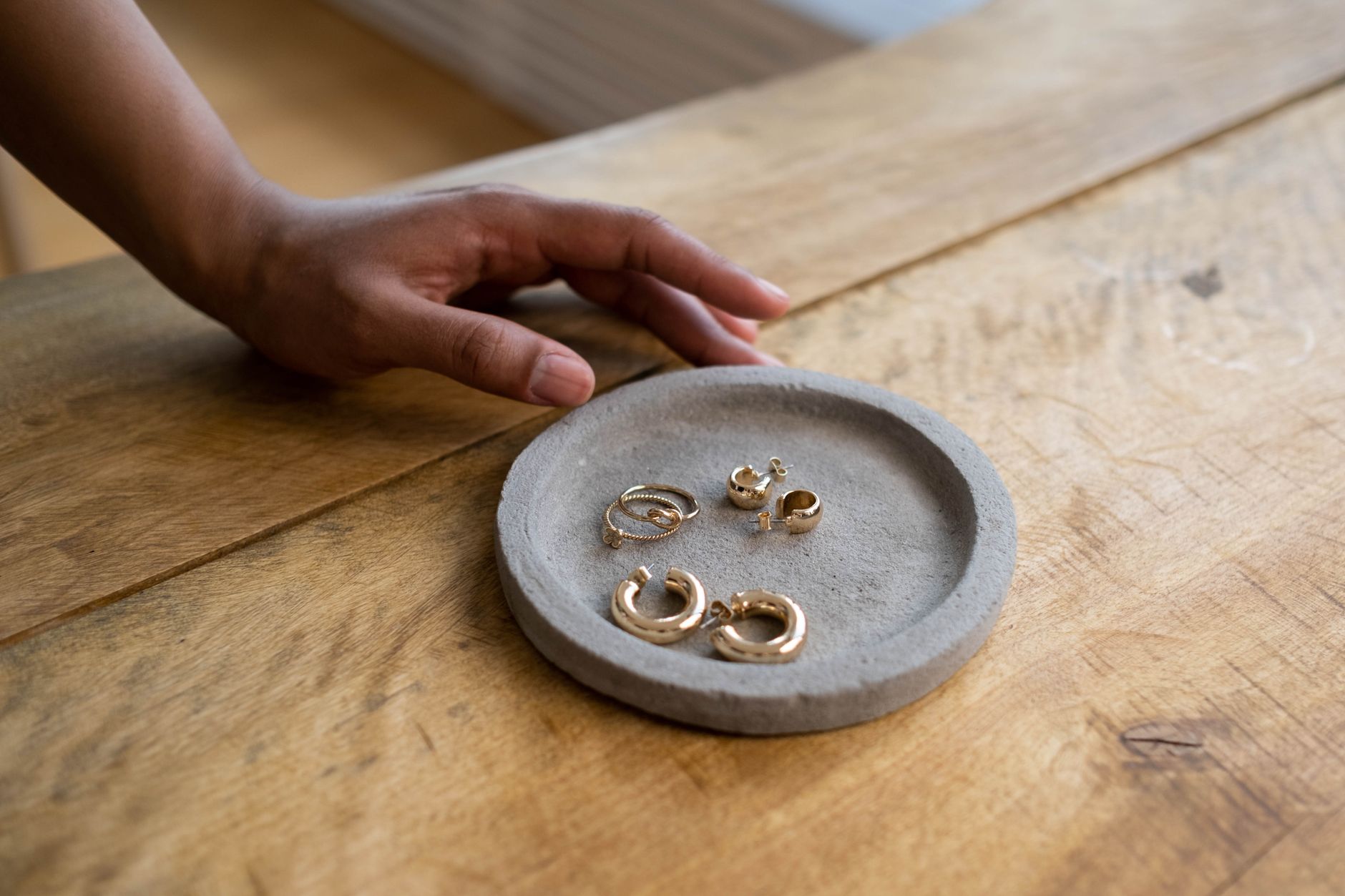
Flash-plated gold jewelry is a piece made of a cheaper base metal with a gold layer so thin it is measured in millionths of an inch — typically under 0.175 microns, well below the thresholds that let a piece be called gold plated, gold filled, or vermeil. That thinness is the whole story: the gold is a cosmetic finish applied in seconds, and the metal you actually own is whatever sits underneath it.
"Flash" is a plating industry term for a very brief trip through the electroplating bath. It is legitimate manufacturing, widely used on costume and fashion jewelry, and there is nothing dishonest about it — but it changes what you should pay, how long the colour lasts, and how the piece should be marked. The confusion usually comes from listings that use "gold" as though all gold layers were comparable.
Table of Contents
- What "flash" actually means on the production line
- The base metal is what you are really buying
- How to read the hallmarks and stamps
- What wear actually looks like, and how long it lasts
- Deciding before you buy
- Frequently Asked Questions
What "flash" actually means on the production line
Electroplating deposits gold onto a conductive base metal by passing current through a solution containing gold ions. Thickness is a function of current and time, so a longer bath means more gold. A flash cycle is measured in seconds and leaves a film that is often thinner than a human hair by orders of magnitude. Thickness is stated in microns (one thousandth of a millimetre) or in millionths of an inch.
As a rough ladder: flash plating sits below about 0.175 microns; standard gold plating runs from roughly 0.5 microns upward; heavy or "hard" gold plate on quality fashion pieces can reach 2.5 microns or more. Vermeil is a separate category with its own legal definition in the United States — sterling silver base with a gold layer of at least 2.5 microns under the Federal Trade Commission's jewelry guides. Gold filled is not plating at all. It is a mechanically bonded layer of gold sheet, required in the US to be at least 1/20th of the item's weight in gold for the "gold filled" designation. A gold filled chain contains vastly more gold than a flash-plated one of the same size, which is why the two never sell at the same price.
The base metal is what you are really buying
Under a flash layer you will most often find brass, copper, nickel silver, zinc alloy (pot metal), or stainless steel. Sterling silver appears under better plating but rarely under flash, because it would be strange to protect a valuable base with a disposable finish. Base metal matters for three reasons. It determines what happens when the gold wears through, since brass and copper oxidise to green or brown against skin.
It determines allergy risk, as nickel is a common contact allergen and a thin gold layer stops shielding skin the moment it abrades. And it determines resale, since a flash-plated brass piece has essentially no precious metal recovery value — refiners price by recoverable gold weight, and a flash layer yields almost none. Many manufacturers apply a barrier layer between base and gold, usually nickel or palladium, to stop copper atoms migrating up into the gold and dulling it. That intermediate layer is invisible and rarely disclosed, which is worth knowing if you react to nickel and were told the piece is "gold".
How to read the hallmarks and stamps
Solid gold carries a fineness mark: 14K, 585, 18K, 750, 9ct, 375. A karat number alone, with no plating abbreviation, is a claim of solid gold throughout. Plated pieces are supposed to carry the karat of the plating followed by a qualifier.
Common marks and what they mean: There is no standard hallmark that means "flash plated". This is the practical gap: a flash-plated item and a 3-micron item may both be stamped 18K GP, and the stamp will not distinguish them. Unmarked costume jewelry is common and legal in many markets, so absence of a stamp tells you little on its own — but a gold-coloured piece with no fineness mark and a very low price is almost certainly plated.
- **GP** — gold plated. The karat given (e.g. 14K GP) describes the surface layer only, not the body.
- **GEP** — gold electroplated. Same meaning, naming the process.
- **HGE / HGP** — heavy gold electroplate. Implies a thicker deposit, but the term is loose.
- **GF or 1/20 12K GF** — gold filled, with the fraction giving the gold's share of total weight.
- **RGP** — rolled gold plate, a bonded layer thinner than gold filled.
What wear actually looks like, and how long it lasts
Flash plating does not fail evenly. It wears first at friction points: the underside of a ring shank, the inside of a bangle, clasp mechanisms, earring posts, and the high points of any textured surface. You will usually see a pink or yellow-white shadow of the base metal before the piece looks obviously worn. Lifespan depends far more on contact than on time.
A pendant that hangs clear of skin can hold its finish for years; a ring worn daily on a working hand may show base metal in weeks. Sweat, chlorinated water, perfume, hand sanitiser, and cosmetic acids all accelerate the process, because they attack the base metal through the microscopic porosity that every thin plating layer has. Replating is possible and is normal practice for fashion jewelry, but it costs money each time and cannot be done indefinitely on a soft base — polishing before each replate removes a little base metal. Pieces with glued stones, pearls, or enamel often cannot be replated at all, because the cleaning and bath chemistry damages them.
Deciding before you buy
The honest use case for flash plating is fashion: trend pieces, statement earrings, items you expect to wear for a season. Judged that way it is good value.
It becomes a problem only when it is priced or described as though it were an heirloom purchase. Practical checks before buying: A last point on terminology: "solid gold" means the item is gold alloy throughout, not that it is unhollow. A hollow 14K gold hoop is still solid gold in the legal sense, and it contains more gold than any flash-plated piece of the same shape.
- Ask the seller for the plating thickness in microns and the base metal by name. A vague "gold tone" or "18K finish" answer is your answer.
- Weigh the price against the thickness claim. A piece costing a few dollars cannot contain a heavy gold deposit.
- For daily-wear items — wedding bands, everyday earrings — treat solid gold, gold filled, or high-micron plating over steel as the realistic options.
- If you react to jewelry, ask whether the underplate is nickel, and prefer a stated nickel-free base rather than relying on the gold layer.
- Keep flash-plated pieces away from water, perfume and cleaning products, store them dry and separately, and wipe them after wear rather than using polishing cloths, which abrade the layer.
Frequently Asked Questions
Can a jeweller tell me the plating thickness?
Some can, using an X-ray fluorescence (XRF) analyser, which reads surface composition and can estimate coating thickness without damaging the piece. Many independent jewellers and pawn shops have one and will run a reading.
Does a magnet test identify flash plating?
Only partly. Gold, brass, copper and zinc are all non-magnetic, so a magnet mainly flags a steel base. A non-magnetic response does not mean the piece is solid gold.
Is flash-plated jewelry worth anything to a gold buyer?
Essentially nothing for its metal. Refiners pay on recoverable gold weight, and a sub-micron layer over brass does not reach the minimum that makes recovery economic.