
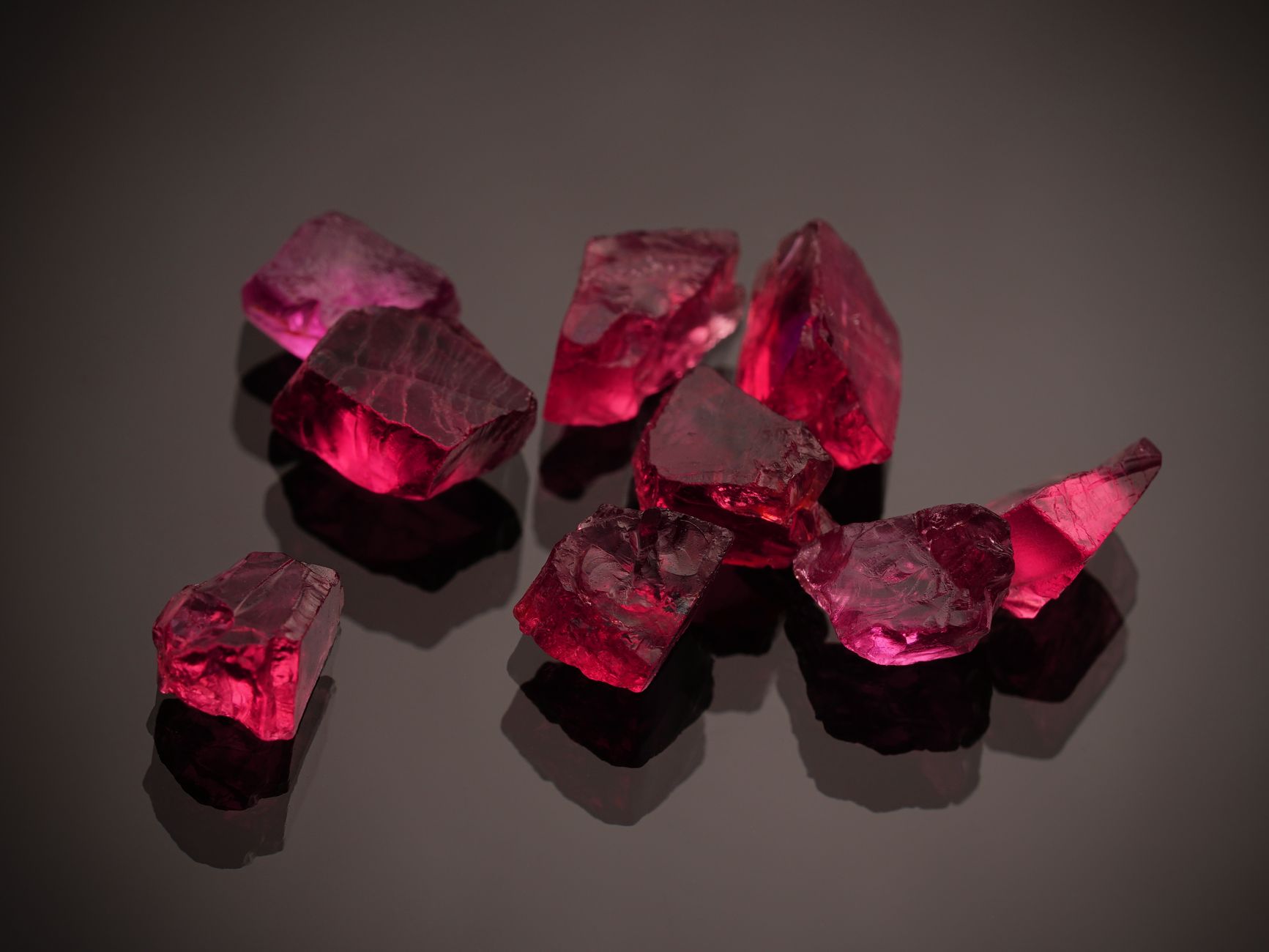
Round or teardrop-shaped bubbles suspended inside a gemstone are one of the most reliable warning signs in practical gemology, and they usually mean the "stone" is glass — either an imitation cut from paste, or a glass filling inside a real but heavily treated gem. Trapped gas is a normal feature of a melted, cooled liquid; it is not how most natural crystals grow, so a genuinely bubbly interior points toward something that was molten at some stage. That said, "bubble" covers several very different findings, and a few of them are harmless or even proof of natural origin. Before you conclude anything about a ring, take clear photographs of specific features in a specific way — because a gemologist can often narrow the answer from good images, and cannot do much with a blurry one.
Table of Contents
- Why gas bubbles point to glass
- Round inclusions that are perfectly normal
- Glass filling inside a real gemstone
- What to photograph, and how
- What photographs can settle, and what they cannot
- Who this actually affects, and what to do next
- Frequently Asked Questions
Why gas bubbles point to glass
Most gemstones form as crystals: atoms arrange into a repeating lattice, either slowly in the earth or quickly in a laboratory. Glass has no crystal structure. It is a supercooled liquid, and when molten glass is poured, pressed, or flame-worked, air gets caught in it and freezes in place as a sphere or a stretched teardrop. Two other features usually travel with those bubbles in imitation stones. The first is swirl marks, also called striae — faint, wavy internal lines like the flow patterns in a marble, left by uneven mixing of the melt.
The second is soft detail at the edges: glass is much less hard than sapphire, ruby, or diamond, so facet junctions blur, the girdle rounds off, and the surface picks up scratches and small shell-shaped chips. There is an important middle category. Flame-fusion synthetic corundum, made by melting alumina powder into a boule, is chemically real ruby or sapphire but is also grown from a melt. It frequently contains round gas bubbles plus curved growth lines, rather than the straight, angular growth lines of natural corundum. So a bubble can mean lab-grown rather than fake — a genuine gem material, but not a mined one, and priced very differently from natural.
Round inclusions that are perfectly normal
A bubble sitting inside a liquid-filled cavity is a different thing entirely, and it argues for natural origin. Gemologists call these two-phase and three-phase inclusions: a tiny sealed pocket holding fluid, a gas bubble, and sometimes a salt crystal. Under magnification you are looking at a bubble inside an irregular, angular cavity, not a free sphere floating in clear material. Three-phase inclusions are a classic identifying feature of emerald from certain deposits, and fluid inclusions are common in quartz, topaz, and many other natural stones. If the bubble is trapped in a jagged, wispy, fingerprint-like feature, it is evidence in the stone's favour, not against it. Amber is another exception.
Natural amber is fossilised tree resin and routinely contains clouds of round gas bubbles; so does copal, its much younger relative, and so does pressed amber reconstituted from small fragments. In amber, bubbles alone settle nothing, and identification depends on other tests. Assembled stones — doublets and triplets — add a third case. These glue a thin slice of natural material to a backing of glass or synthetic, and bubbles often sit in the cement layer. Viewed from the side, they line up along a flat plane rather than scattering through the volume. Opal triplets and garnet-topped doublets are the ones most often found in older jewelry.
Glass filling inside a real gemstone
Lead-glass-filled ruby is the case most likely to surprise an owner. Heavily fractured, low-grade corundum is infused with molten high-lead glass, which fills the cracks and makes them nearly disappear. The result looks like a clean, saturated ruby. Under magnification, the filled fractures show flattened, disc-shaped bubbles, and tilting the stone under a light often produces a distinct blue or orange flash from the filled planes. Emeralds are commonly clarity-enhanced too, though traditionally with oil or resin rather than lead glass.
Fracture-filled diamonds exist as well. All of these are disclosable treatments, and the distinction matters far more than "real or fake": a glass-filled ruby is corundum, but its durability and its value are closer to a composite than to an untreated stone. The practical consequence is care. Lead glass is attacked by things a jeweler uses routinely — ultrasonic cleaners, steam, pickling acid, and the heat of a torch during sizing or re-tipping. A filled stone can come back from an ordinary repair visibly damaged, with the fractures reopened and whitened. If you suspect filling, say so before handing the piece over for any work.
What to photograph, and how
Shoot the whole piece first, then the detail. Use a plain, non-reflective background and include something for scale — a ruler with millimetre marks is better than a coin. For magnification, hold a 10x jeweler's loupe flush against your phone's lens, bring the stone close, and tap the screen to focus. Steady both hands on a table. Take many frames and keep the sharp ones.
Lighting is what separates a useful inclusion photo from a useless one. Place the stone on a dark surface and bring the light in from the side rather than the front, so the beam passes through the stone instead of bouncing off it. Inclusions then glow against a dark field. Direct overhead light mostly photographs reflections. One optional trick: resting a loose stone in a shallow clear dish with a little water reduces surface glare and makes internal features easier to see. Skip it for anything porous, assembled, or organic — opals, opal triplets, pearls, amber, turquoise, and any glued doublet should stay dry.
- The full piece, front and back, in focus and filling the frame.
- Any hallmarks, maker's marks, or stamped numbers on the metal, magnified.
- The back of the setting: note whether the stone is open-backed or closed. Closed, foiled backs are typical of antique paste, and they also hide the pavilion from view.
- The bubbles themselves, through the table facet, at magnification.
- The girdle and several facet junctions, to show whether edges are crisp or rounded.
What photographs can settle, and what they cannot
Good images can identify a bubble field, a flash effect, curved striae, a cement plane, or a rounded girdle. That is often enough for an experienced gemologist to tell you what is worth testing. Photographs cannot measure refractive index, specific gravity, or spectral absorption, and those are what actually name a material. A qualified appraiser or a gem laboratory settles it with instruments: a refractometer, a polariscope to check whether the stone is singly or doubly refractive, a microscope, and spectroscopy where needed. Independent laboratories — GIA and Gem-A among the widely recognised ones — issue reports that state the material and any detected treatment.
Ask specifically for treatment disclosure, not just an identification, and ask for a written report rather than a verbal opinion if the piece is insured. Avoid the destructive home tests that circulate online. Pressing a hot needle to a stone to see if it smells or softens will permanently mark amber, plastic, and resin-filled gems. Scratch testing damages whatever loses. Neither test tells you anything a loupe and a lab cannot tell you without harm.
Who this actually affects, and what to do next
The finding matters most to people holding jewelry they did not buy new: inherited pieces, estate and auction purchases, holiday-market buys, and older insured items whose appraisal predates modern treatments. A 1990s appraisal may describe a ruby accurately for its time and say nothing about a filling that was never tested for. It also matters to sellers. Describing a lead-glass-filled ruby as a ruby, or a flame-fusion sapphire as natural, is a misrepresentation on most marketplaces regardless of intent, and disclosure obligations sit with the seller.
Note too that a glass stone does not make the mounting worthless. Antique paste jewelry — particularly Georgian and Victorian foiled paste — is collected on its own merits, and the metal, the craftsmanship, and the age carry value independent of what sits in the setting. Have the metal tested and the piece assessed as a whole rather than judging it by the stone alone. If the piece is insured for a stated value based on an old appraisal, send your photographs to the appraiser or insurer and ask whether a re-examination is warranted before the next renewal.
Frequently Asked Questions
Does one bubble mean the stone is worthless?
No. It means the material needs identifying. The finding could be glass, a flame-fusion synthetic, a treated natural stone, or a normal fluid inclusion, and those outcomes sit at very different points on the value scale.
Can a jeweler tell me for certain with just a loupe?
A skilled jeweler can often recognise bubbles, swirl lines, and flash effects on sight, and that is a strong indication. Certainty requires instrument testing, which is why a lab report exists as a separate service from a counter opinion.
Should I have the stone removed from the setting for testing?
Usually not as a first step. Most identification can be done with the stone mounted, and unsetting adds risk — especially with a suspected filled stone, where heat and pressure during removal can cause visible damage.