
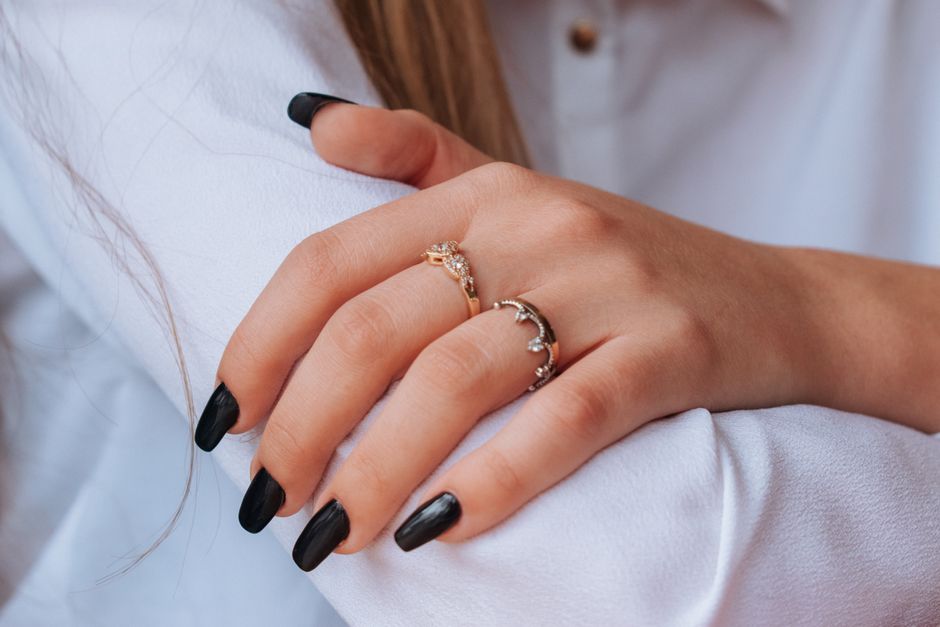
Almost every white gold ring you have seen is not actually white. White gold alloys range from pale grey to distinctly warm, and the bright mirror finish comes from a thin layer of rhodium plated over the top. That layer wears, and knowing when and what it costs to renew is part of owning the ring.
What rhodium is doing there
Rhodium is a platinum-group metal: extremely hard, highly reflective, chemically inert and bright white. Electroplating a thin layer over white gold produces the cold, mirror-bright colour buyers associate with the metal, hides the alloy’s underlying warmth, and adds a hard surface that resists scratching better than the gold beneath.
The layer is thin — typically a fraction of a micron up to about a micron on jewelry, far thinner than a human hair. It is a finish, not a structural part of the ring.
Why white gold is not white on its own
Gold is yellow. To make a white alloy, it is mixed with whitening metals:
- Nickel-white gold — harder, whiter, cheaper, and the reason some people react to white gold jewelry. The EU limits nickel release from items in prolonged skin contact under REACH Annex XVII entry 27, at 0.5 micrograms per square centimetre per week.
- Palladium-white gold — softer, greyer, more expensive, and nickel-free.
Karat determines how much whitening metal there can be. 14K gold is 58.3 percent gold and 18K is 75 percent, so an 18K white gold ring necessarily has less room for whitening alloy and tends to look warmer under the plating than a 14K one.
How the plating wears
Wear is not even. It goes first where the ring rubs: the underside of the shank, the edges of a bezel, the high points of a setting. The result is a warm or grey patch against bright white, which is far more visible than uniform dulling. Contributing factors:
- Contact. A ring worn against another ring wears at the touching edges. Bands on the same finger accelerate each other.
- Skin chemistry and cosmetics. Acidity, chlorine and abrasive hand products all shorten the interval.
- Occupation. Hands-on work removes plating in months, not years.
- Original thickness. A heavier plate lasts longer, and thickness is a variable the maker chooses.
Rings need re-plating most often; earrings and pendants can go many years untouched because nothing abrades them.
What re-plating involves
The piece is cleaned thoroughly, any remaining plating is prepared, and it is electroplated again — a bench job usually measured in days rather than weeks. Points to raise before handing it over:
- Stones. Porous and organic materials — pearls, opals, turquoise, emeralds — must be protected or removed, because the process involves solutions and current.
- Two-tone designs. Yellow sections must be masked, which adds labour.
- Engraving and oxidised detail. Blackened recesses will be stripped by the preparation. Say so in advance if the darkening is part of the design.
- Metal loss. Polishing before plating removes a little gold each time, so repeated cycles slowly thin a shank. On an old ring, ask whether it needs re-shanking first.
Alternatives to living with the cycle
| Option | Trade-off |
|---|---|
| Keep re-plating | Ongoing cost, and a little metal lost each time |
| Let it go unplated | Free; the ring takes on a warmer, softer grey that many people prefer |
| Platinum | Naturally white forever, heavier, higher purchase price, develops a patina |
| Palladium | Naturally white and light, fewer jewelers service it |
If the bright white look is non-negotiable and the ring is worn daily, platinum removes the maintenance cycle entirely. Under the FTC Jewelry Guides, unqualified “platinum” is reserved for at least 950 parts per thousand pure platinum, with lower finenesses disclosed by their marks.
Frequently asked questions
How often does white gold need re-plating?
It depends entirely on wear. A daily-wear ring on an active hand may show wear within a year; earrings can go a decade. Judge it by appearance, not by the calendar.
Is unplated white gold ugly?
No — it is a soft, warm-toned grey. Many owners stop re-plating and prefer it, particularly on an 18K piece worn alongside yellow gold.
Can rhodium plating be applied to silver?
Yes, and it is often used to slow tarnish on sterling. The same wear rules apply, and it does not change the silver underneath.
Does re-plating damage the ring?
Not by itself, but the polishing that precedes it removes a small amount of metal. Over many cycles that matters, which is why a very old ring may need a new shank before another plating.
Sources
- FTC Jewelry, Precious Metals, and Pewter Industries Guides, 16 CFR Part 23 — karat gold marking and platinum fineness rules.
- ECHA — REACH Annex XVII, entry 27 (nickel) — release limits for jewellery in prolonged contact with skin.