
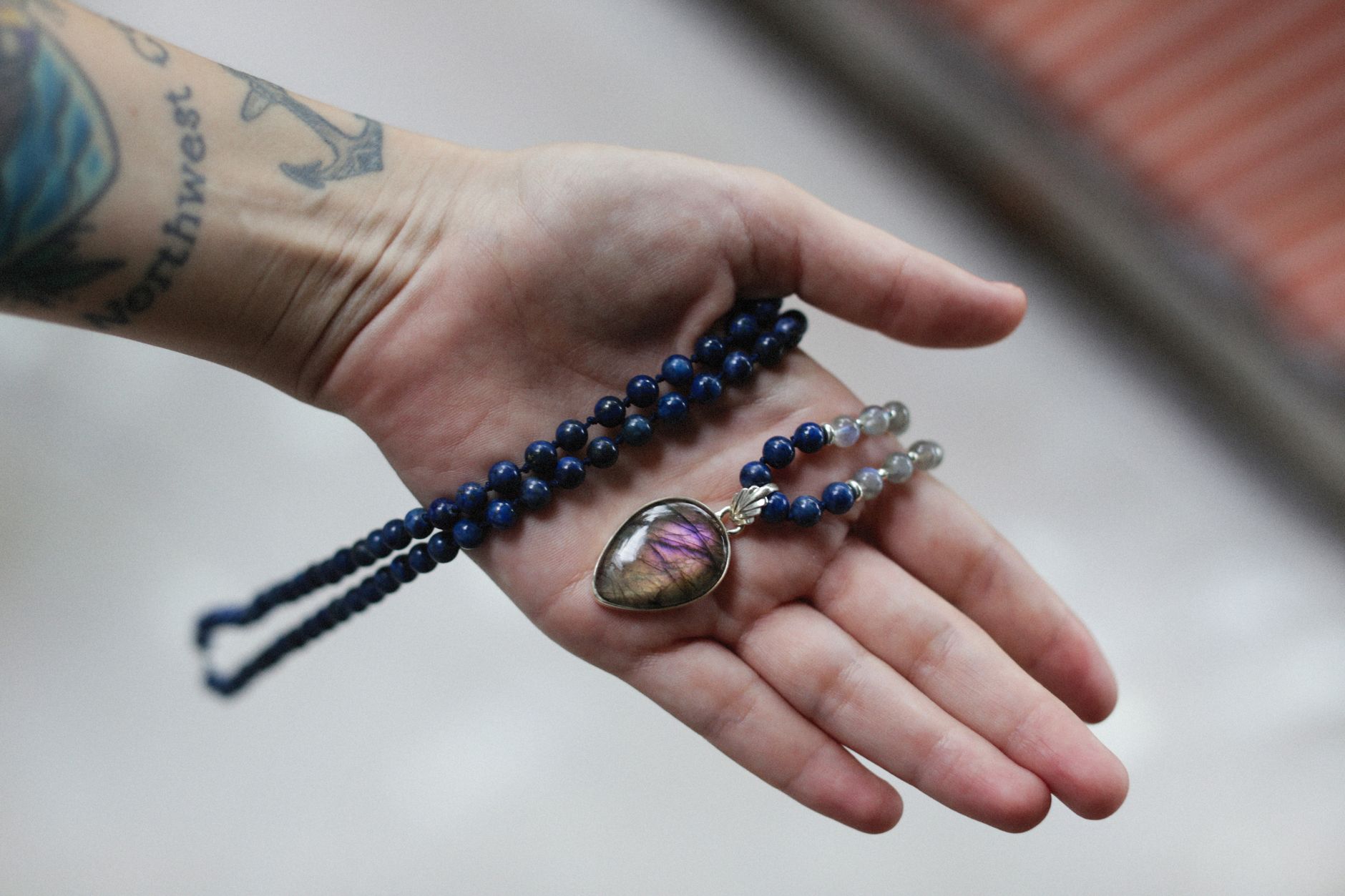
Buy labradorite jewelry for the strength and range of its moving color flash, not for carat weight alone. Prices lack a universal benchmark, the stone needs protection from impact, and buyers should ask about treatment, returns, and written specifications. Labradorite is a feldspar valued for labradorescence, an internal light effect that changes with the viewing angle. Unusual red or green material deserves extra scrutiny because treatment can be difficult to detect.
Table of Contents
- Judge the flash from several angles
- What should labradorite cost?
- Is labradorite durable enough for jewelry?
- Treatment requires direct questions
- Questions to put to the seller
- Clean it without high-energy equipment
Judge the flash from several angles
The Gemological Institute of America explains that labradorescence comes from light interference within layered feldspar structures. Because the flash shifts as the stone moves, assess a piece through video or photographs from several angles, not one ideal image in controlled lighting. GIA's guide to phenomenal gems supports this viewing-angle approach. Look for the colors, coverage, and movement you actually want.
A bright face-up photograph does not show whether the effect disappears after a slight turn. "Spectrolite" is a trade variety of labradorite from Finland. GIA describes it as having stronger, richer, full-spectrum labradorescence, while notable iridescent material also comes from Canada and Madagascar. Treat the name or origin as information to verify, not a substitute for inspecting the individual stone.
What should labradorite cost?
There is no authoritative universal retail price benchmark for labradorite. GemSelect currently quotes multicolor loose material at US$0.50 to $4 per carat, with variation tied to size, color intensity, and play-of-color. GemSelect's labradorite information page presents that as a gemstone-retailer range, not a finished-jewelry price guide.
Do not multiply that loose-stone figure by carat weight and assume it determines a ring, pendant, or bracelet's fair price. It also cannot establish that a stone is untreated, correctly identified, or accurately described by origin. Instead, compare pieces using documented facts: gem weight or dimensions, visible color performance, treatment disclosure, stated identity, and return terms. A higher asking price alone proves none of them.
Is labradorite durable enough for jewelry?
Labradorite has a Mohs hardness of 6 to 6.5, but it is also brittle and has perfect-to-distinct cleavage. That combination means an impact can chip the stone or split it along an internal plane, according to the Handbook of Mineralogy's labradorite data. For rings, favor a bezel or another setting that shields vulnerable edges.
A high, exposed stone presents more opportunities for impact, especially if the jewelry is intended for frequent wear. Pendants and earrings are generally less exposed than rings during ordinary use. If daily ring wear is essential, make the setting's protection part of the buying decision rather than relying on hardness alone.
Treatment requires direct questions
Labradorite can undergo copper-diffusion treatment that completely changes its color. GIA's archived treatment guidance says confirming the process can be extremely difficult and may require examination by a qualified laboratory. This matters most when unusual red or green feldspar carries a stronger value claim. A GIA study found no quick, reliable method for determining whether red andesine feldspar had been treated.
It also showed that copper diffusion could make colorless labradorite resemble natural red labradorite sunstone. GIA's 2022 red feldspar study documents those identification limits. For such material, request laboratory documentation rather than relying on "natural" or "untreated" in a verbal sales pitch. The report should identify the tested stone and state what the laboratory could determine about treatment.
Questions to put to the seller
The Federal Trade Commission advises buyers to ask whether a gemstone is natural, laboratory-created, or imitation, whether it has been treated, and what return policy applies. Ask before paying: FTC guidance also calls for disclosure of treatments that are nonpermanent, require special care, or significantly affect value. Have the seller put the answers you rely on—including weight or size—on the receipt or other purchase document.
- Is the stone natural, laboratory-created, or an imitation?
- Has it received any treatment, including copper diffusion?
- Does any treatment require special care, and is it permanent?
- What supports an origin or "spectrolite" claim?
- What are the gem's weight and dimensions?
Clean it without high-energy equipment
GemSelect recommends warm soapy water, a soft brush, and a soft cloth for labradorite. It advises against both ultrasonic cleaners and steam because this brittle, cleavable stone needs gentler handling.
Ask for design-specific care instructions if the setting makes the underside difficult to reach. Keep those instructions with the receipt and any treatment or laboratory documentation.
- Wash gently in warm soapy water.
- Use a soft brush without pressing hard on the stone.
- Wipe and dry with a soft cloth.
- Do not use steam or an ultrasonic cleaner.